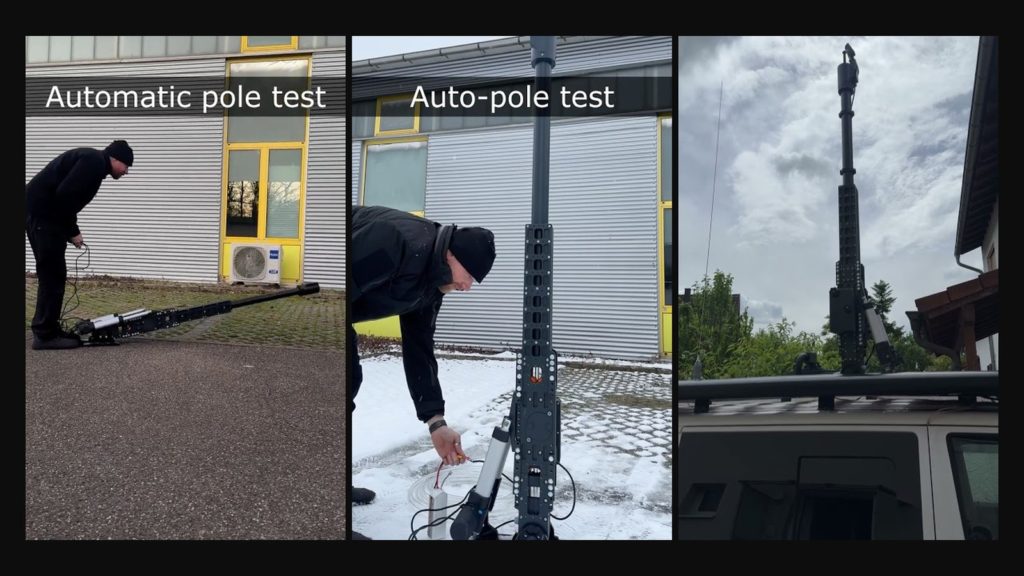
A 12-metre antenna mast that unfolds by itself from the roof of a van, at the press of a remote control button.
Behind this project is Christian Ulrich, a German engineer based near Karlsruhe, just over two hours' drive from Basel. His trade is mobile robots, which he designs and builds to order in his small company, UlrichC Robotics. Since last winter, he has been applying his robotics know-how to a problem well known to CB operators and radio amateurs. How do you put an antenna up high and fast, even in a parking space with no room to unfold a tripod? His prototype is called the Cu-Auto-Pole. He is testing it on CB and the 10-metre band, and he shares every step, breakdowns included, on Instagram and YouTube.
Christian Ulrich, a roboticist by trade
Christian Ulrich runs UlrichC.DE, a sole proprietorship based in Durmersheim, between Rastatt and Karlsruhe, in Baden-Württemberg. His website has been online since 2001 and his first documented robot projects date from 2009. He describes himself as a developer and manufacturer of robotic vehicles and their components, from mechanics to electronics and software. Most of his work is development to order: robots built for a specific customer and a very specific use.
On Instagram, his @ulrichc_robotics account has more than 27,000 followers. His approach is refreshing. He doesn't just show what works, he also explains what breaks, why it broke and what he is changing for the next version. One of his sayings sums up his approach nicely. “Real engineering isn't about avoiding problems, it's about finding them before your customers do.”
Why feature him on HB9V? Because his mast answers a question many of us ask when operating portable or mobile. How do you put up a tall, efficient vertical antenna without guy ropes, without a ladder and without spending half an hour on it? And because he answers it like an engineer, with SWR measurements to back it up.
The Cu-Auto-Pole, an antenna mast that raises itself
The principle is simple to describe and much less simple to build. In transport, the mast lies flat on the vehicle's roof rack. Once the vehicle is parked, you remove the transport lock and start the deployment with a wireless remote control. An actuator first raises the assembly to vertical, then the telescopic mast extends to its operating position. The antenna sits at the top, ready to transmit.
In its current version, it takes about 5 minutes to deploy everything and 2 minutes to fold it all away. The mast can reach up to 12 metres above the vehicle. As with all of Christian's projects, the structure is made of perforated black profiles, and this look earns him some amused comments. Lying on the roof of the van, the Cu-Auto-Pole looks for all the world like a cannon, and more than one viewer has asked him whether he was planning to go to war.
Roof-mounted
The mast travels lying on a van's roof rack and is raised on site, with no tripod or guy ropes.
Remote-controlled
A wireless remote control is all it takes to deploy and fold the mast, once the transport lock has been removed.
12 metres
Once deployed, the top of the mast stands about 12 metres above the vehicle.
Built-in antenna
A Gain-Master type 5/8-wave vertical antenna, housed in the mast, covers the 10, 11 and 12-metre bands.
Designed for tight spaces
The mast rises vertically from the roof without overhanging the vehicle. A single parking space is enough.
Prototype
Christian points it out under every video. It is a proof of concept, and the Cu-Auto-Pole is not for sale.
“Cu-Auto-Pole V1”, automatic antenna deployment in a narrow parking space. Video: UlrichC Robotics, YouTube.
From the workshop to the van roof, the birth of the mast
Christian has filmed the project almost from day one. His short videos let you follow the mast's progress, from the snowy workshop to its first installation on the vehicle.
- Early 2026, the mast stands up. The automatic mast is still under construction, but it can already raise itself. Christian announces a finished version for 2026.
- First automatic extension. In the middle of winter, on snowy ground, the mast extends by itself for the first time. Cautious, Christian does not yet dare go all the way to 12 metres.
- The mast becomes an antenna. Around mid-February, the mast is tested as an antenna for the first time. Christian finds better reception than with the antenna he uses as a reference.
- First trip on the roof. In spring, the Cu-Auto-Pole is mounted on the van's roof rack. It rises to vertical and then extends skywards.
- Version 1 in real conditions. The mast deploys in a narrow parking space, where it would have been impossible to put up a conventional antenna.
The mast raises itself for the first time.
First automatic extension, in the snow.
First test of the mast as an antenna.
First deployment on the van roof.
Videos: UlrichC Robotics, YouTube (Shorts).
In the field: heat, breakage and lessons learned
This is the most interesting part for a radio amateur. This summer, during a test in the middle of a heatwave, the built-in antenna suffered. At around 60 to 70 °C, its SWR climbed to about 3, and the RF amplifier connected behind it did not survive. Christian repaired the components, modified the antenna and ran a full new test in a car park, keeping a close eye on the system. The video of this new test, with the deployment by remote control, passed 13,000 likes on Instagram.
The lesson for your station. An antenna that is fine in spring can drift out of tune in full sun. Materials expand, a capacitor or a coil changes value, and the SWR shoots up. An amplifier without protection against high SWR can then pay the price. Check your SWR in hot weather too, not just on the day you install the antenna.
A few weeks later, the Gain-Master antenna housed in the mast had to be replaced. The replacement took about eight hours of work, done at night, and the first deployment after the repair went without a hitch. Christian draws an engineer's conclusion. Eight hours is acceptable on a prototype, but the next version must make it possible to change the radiating element without dismantling half the system.
At the end of August, another test, this time with power. Rig on, amp on, mic in hand. The aim is not to set a power record, but to observe how the antenna behaves in real conditions. Christian is mainly watching the SWR and the common-mode currents on the antenna. At high power, small flaws become measurable. Next, he plans to lengthen the antenna and try a collinear configuration, in order to study the radiation pattern. As he puts it himself, “the mechanics get the antenna into the air, the RF power shows what it really does”.
July 2026, a new remote-controlled deployment after the heat-related failure.
August 2026, first deployment after the Gain-Master antenna was replaced.
August 2026, a power test on CB, under the watchful eye of the SWR meter.
July 2026, a 150 × 90 cm flag hoisted to 12 metres to test the mast in the wind.
Videos: Christian Ulrich, Instagram @ulrichc_robotics.
“Clothes dryer” mode
Christian also has a sense of humour. After weeks of SWR measurements and mechanical adjustments, he proudly announces that the Cu-Auto-Pole has finally proved “its most important function”. Drying the laundry! Mast partly extended horizontally, a few towels hung on it, and job done. Every radio amateur will recognise the old joke. For decades, our families have suspected our antennas of being nothing more than needlessly complicated clothes lines. The verdict is clear. The towels stayed on, the mast remained stable and no antenna tuner was needed. RF performance in laundry configuration, however, has yet to be evaluated.
In the same vein, the 150 × 90 cm flag hoisted to 12 metres is a nod to the video game Helldivers 2. Behind the joke lies a real test: seeing how the mast behaves when it presents a large surface to the wind.
August 2026, laundry mode, “not for sale either”, Christian points out. Video: Christian Ulrich, Instagram @ulrichc_robotics.
CB, the 10-metre band and the 5/8 antenna
The antenna Christian chose is a Gain-Master type 5/8-wave vertical, a well-known classic among CB operators. The model from Italian manufacturer Sirio is centre-fed, covers 25.5 to 30 MHz without tuning and is about 7.4 metres long. A 5/8-wave concentrates its radiation close to the horizon, which is ideal for long-distance contacts, on CB as on 10 metres. Christian uses it across the 10, 11 and 12-metre range, in other words CB around 27 MHz and the two neighbouring amateur bands.
| Band | Frequencies | Who can transmit in Switzerland |
|---|---|---|
| 12 m | 24.890 to 24.990 MHz | Licensed radio amateurs |
| 11 m (CB) | 26.965 to 27.405 MHz, 40 channels | Anyone, with a compliant CB set |
| 10 m | 28.000 to 29.700 MHz | Licensed radio amateurs |
In Switzerland. CB can be used without a licence, provided the equipment complies with the regulations. The 10 and 12-metre bands are reserved for radio amateurs. If you fit a tall antenna on a vehicle, also mind the total height and overhead lines, and never drive with the mast extended. For a fixed installation, the rules on non-ionising radiation (ONIR) and your municipality have their say. The band details are in our Swiss band plan.
His real job: mobile robots
The Cu-Auto-Pole remains a side project. The core of Christian's business is robotic platforms for outdoor use, sold under the name Cu-Chassis-XT. These are wheeled or tracked chassis, built to serve as the base for inspection, research, remote handling or surveillance robots. The customer adds their sensors, cameras or articulated arm. Everything is developed in-house, from the aluminium mechanics to the control electronics.
| Platform | Type | Empty weight | Payload | Speed |
|---|---|---|---|---|
| 6WD-Max | 6-wheel drive, all-terrain | 50 kg | 100 à 150 kg | 10 à 15 km/h |
| RT-Max | Tracks, large format | 65 kg | 50 à 150 kg | 4 km/h |
| RT-Tac | Tracks, aluminium housing | 35 kg | 50 kg | 4 à 5 km/h |
| 4WD-Carrier | 4-wheel drive, carrier | 70 kg | 100 kg | 6 km/h |
| 2WD-MegaMax | 2-wheel drive | 36 kg | 180 kg | 4 km/h |
| 2WD-Center | Compact, indoor and outdoor | 20 kg | 50 kg | 5 km/h |
A selection of Cu-Chassis-XT platforms, based on the data sheets published on ulrichc.de. Prices are not published, everything is quoted on request.
His recent videos show his mindset clearly. The 6WD-Max climbs over obstacles while drawing only about 120 watts, less than many household appliances. “Power isn't everything,” he writes. For him, what counts is the drivetrain, traction and the smart use of energy. On a tracked robot, he replaced the DC motors with brushless (BLDC) motors. On the first test, the robot turns on the spot and climbs a step, but the control loop still needs fine-tuning. A small 4×4 fits in its transport case, with an infrared night-vision camera and a zoom camera on a two-axis stabilised gimbal. Finally, before going back to its customer, each robot undergoes a final check, on tarmac, on grass, then driving down off a kerb.
The Cu-Chassis-XT 6WD-Max climbs over obstacles on 120 watts.
A tracked robot switched to brushless motors, first test.
A small 4×4 in a case, infrared camera and stabilised zoom camera.
The final check of a 4WD-Au before it goes back to the customer.
The 2WD-Center, a compact base for robotics projects.
Pouring a beer with a robotic arm, his favourite precision test.
Videos: Christian Ulrich, Instagram @ulrichc_robotics.
“Pouring a beer with a robotic arm isn't automation, it's a matter of operator skill. The angle, the speed, the timing: every movement has to be precise.”
Christian Ulrich, on his robotic arm test
Fifteen years of robots on video
His YouTube channel did not wait for the mast. You will find his tracked platforms climbing over obstacles, a 4×4 carrier in the snow, a linear gripper for a manipulator arm, and even a drone era. Between 2015 and 2019, he built a whole series of multicopters, from a small 250-gram quadcopter to a 20-kilo automatic hangar for launching and landing a drone.
Testing the Cu-Chassis-XT 4WD-Max platform prototype, in 2021. Video: UlrichC Robotics, YouTube.
The Cu-Chain-Chassis PRO climbing, the 4WD-Carrier in the snow, the Cu-Gripper3 gripper and the Cu-Copter-Z quadcopter. Videos: UlrichC Robotics, YouTube.
What's next?
Version 2 of the Cu-Auto-Pole is already on the drawing board. Christian is aiming for a mast that goes higher, deploys faster and is even more reliable, with easier access to the built-in antenna. On the antenna side, he wants to try a longer model in a collinear configuration. For now, the project remains a proof of concept and is not on the market. To see what comes next, the best thing is to follow his accounts, where he posts his tests as he goes.
Follow Christian Ulrich and UlrichC Robotics
His Cu-Auto-Pole tests and his robots are posted regularly on Instagram and YouTube. The website presents all his platforms and their data sheets.
Instagram @ulrichc_robotics → YouTube channel → ulrichc.de → Facebook →
A word from HB9V
At HB9V, the Club Radioamateur Suisse, we love builders who show their failures as much as their successes. The Cu-Auto-Pole is not a finished product, it is a full-scale test bench, and that is exactly what makes it so fascinating. It teaches us that an antenna drifts out of tune in the heat, that an amp doesn't like an SWR of 3 and that a 12-metre mast also makes a very good clothes line. If you too are building a mast, an antenna or a robot, tell us about your project via the contact page. It could well be the subject of our next article.
Our partners

Phonicom.ch, your amateur radio specialist in Switzerland
No robotic mast in your garage yet? To put up a vertical when operating portable or on your vehicle, Phonicom can supply you with antennas, masts, made-to-measure coax cables, connectors and SWR meters, with advice from radio amateurs and after-sales service in Switzerland.
Visit phonicom.ch →Also on HB9V
- Alpha Antenna's HOA Buster: when a gutter becomes an HF antenna
- An almost invisible HF vertical antenna: 4 metres, multiband and discreet
- CB during a blackout: the equipment to stay in touch
- HB9HIN's station: amateur radio, CB and the QO-100 satellite
- Swiss amateur radio band plan: all HF, VHF and UHF frequencies
Sources: Instagram account @ulrichc_robotics (posts from April to October 2026), YouTube channel UlrichC Robotics, website ulrichc.de (Robotik, Copter and Impressum pages), accessed on 23 November 2026; Sirio Gain-Master antenna, manufacturer's data sheet. Featured image: three stills taken from Christian Ulrich's videos (UlrichC Robotics, YouTube). Christian Ulrich's quotes are translated from English by HB9V.
© 2026 HB9V · Club Radioamateur Suisse All rights reserved. No reproduction, even partial, without the written permission of HB9V. Photos and trademarks mentioned remain the property of their respective owners.