🏠 HOA Buster: what if your biggest antenna was already fixed to your roof?
Not allowed to put up an antenna, a landlord who says no, strict condominium rules or simply a partner who doesn't want to see anything on the house? US company Alpha Antenna has an idea that is as simple as it is clever: use the gutters and downpipes as the radiating element. Its matching box, the HOA Buster, is staked at the foot of a downpipe and turns tens of metres of metal into an HF antenna from 80 to 10 m, advertised as needing no tuner. OnAllBands (DX Engineering) interviewed its designer at Hamvention 2026. We went further: the physics, real measurements, user feedback, installation pitfalls and what you need to know to use it in Switzerland.
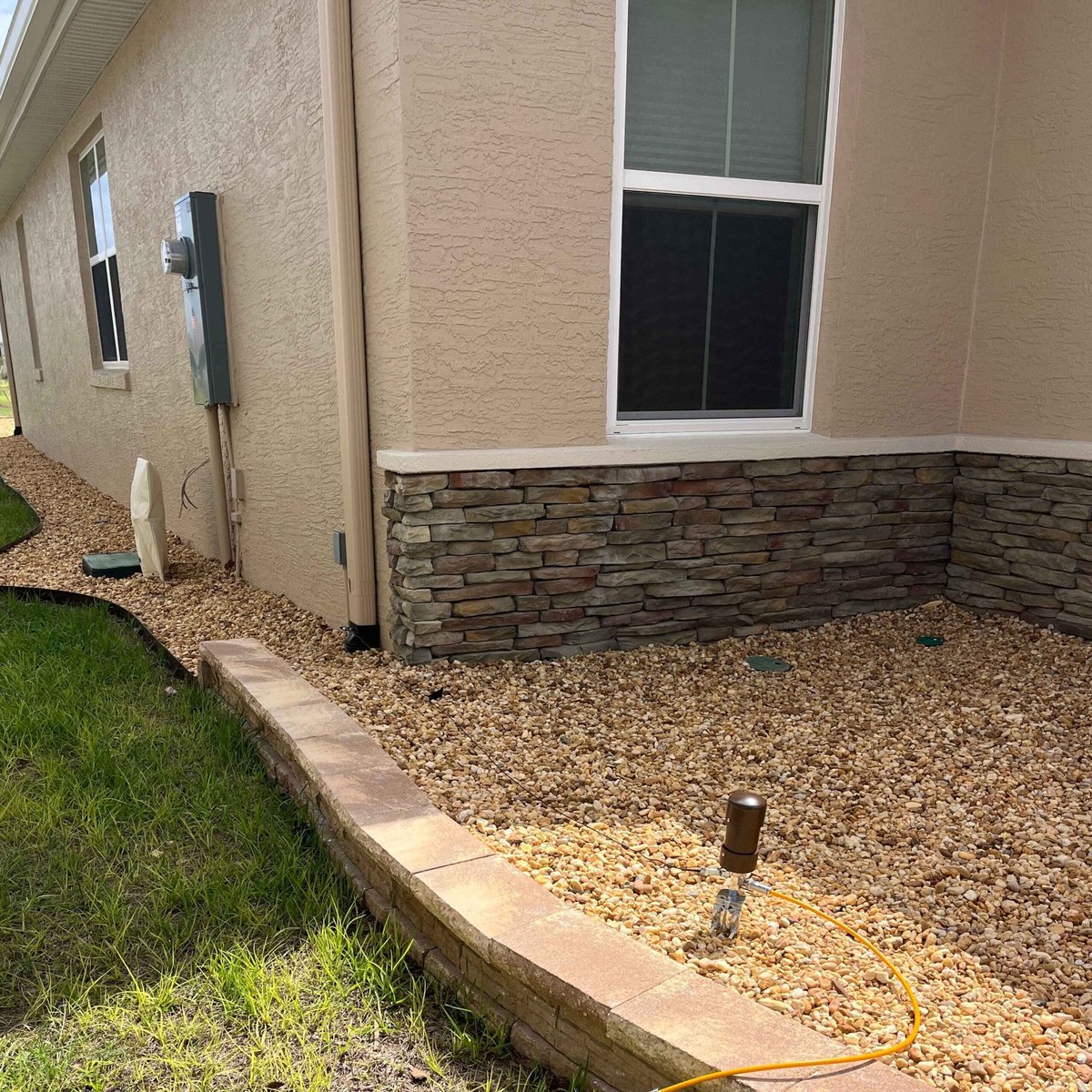
Can you spot it? The HOA Buster box (brown, in the foreground) staked in the gravel and connected to the downpipe against the wall. It is easily mistaken for a garden irrigation valve. (Photo: Alpha Antenna, alphaantenna.com)
💡 An idea born for wheelchair-using hams
Alpha Antenna is a small company based in Pleasant Hill, Missouri. Its founder, Steven Deines, N0TES, has been designing VHF, UHF and HF antennas since 1979. The company specialised in field and emergency (EmComm) antennas after Greensburg, Kansas, was destroyed by a tornado in 2007. Its range includes magnetic loops, HexTenna rigid dipoles and portable verticals.
At Dayton Hamvention 2026, N0TES told OnAllBands how the HOA Buster came about. The name comes from HOAs (Homeowners Associations), the American residents' associations that often ban any visible antenna. But the original target audience was different:
“I came up with the idea to help people in wheelchairs, who couldn't get out and put up antennas. I knew they could roll up to a downspout and push a stake into the ground. Then you clip a wire from the HOA Buster onto the downspout, and you have an end-fed wire antenna that runs up the downspout and along the gutters: it's the biggest antenna you own. Why not use it?”
Steven Deines, N0TES, founder of Alpha Antenna (OnAllBands, September 2026)
The manufacturer regularly receives feedback from Handiham, the American association that helps radio amateurs with disabilities: a blind ham can install the system on their own, clip the wire to the downpipe and connect the coax. It is probably the most touching selling point of this product.
🔬 How a gutter becomes an antenna
Electrically, a metal gutter with its downpipe is nothing more than a long wire: a few vertical metres (the downpipe), then one or several tens of horizontal metres (the gutter run) along the roof. The HOA Buster feeds it at the end, exactly like a random-length end-fed antenna.
The principle explained by N0TES is simple: seen from its end, a long conductor of random length usually presents a capacitive reactance. The box contains an inductor calculated to cancel out this capacitance and bring the impedance close to 50 Ω on as many bands as possible. The stake in the ground acts as the ground return (counterpoise) and drains static electricity.
Why such a wide bandwidth? Because a gutter is a very wide conductor (a cross-section of several centimetres of sheet metal) compared with a 2 mm copper wire. The “fatter” an element is relative to the wavelength, the lower its Q factor and the wider its bandwidth. That is what keeps the HOA Buster usable from one band to the next without adjustment.
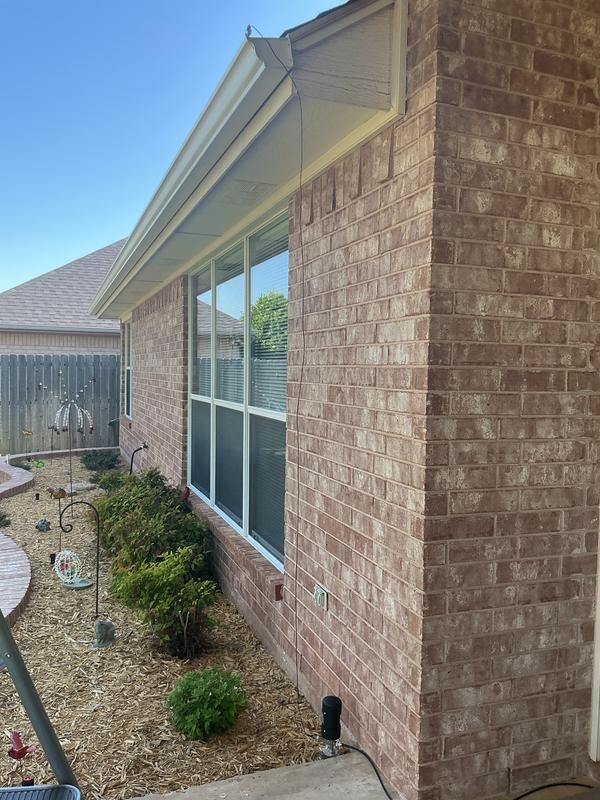
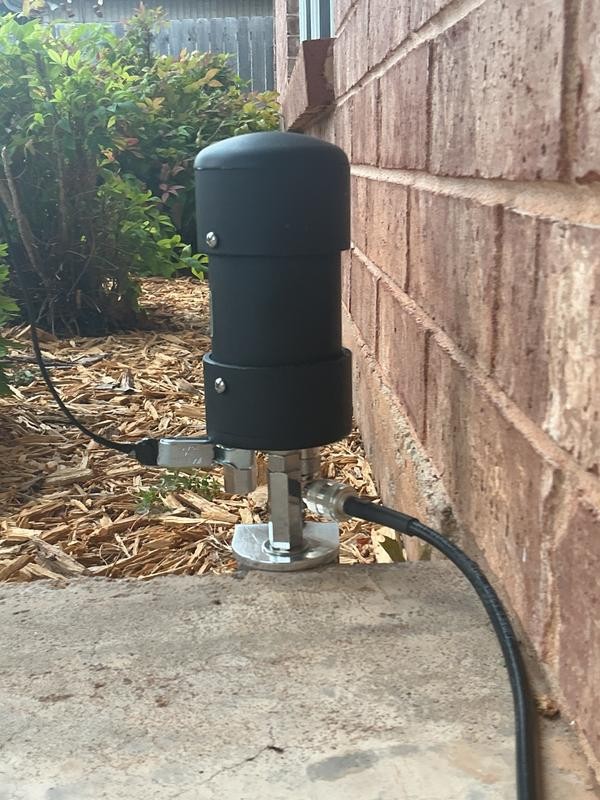
Left, the gutter running along the roof acts as the antenna; right, the HOA Buster box installed at the foot of the downpipe, with the coax connected underneath. These gutters are only 2.4 m above the ground, yet Jim makes contacts all over the country and abroad. (Photos: Jim, DX Engineering customer, published by OnAllBands)
🧭 Polarisation and pattern. As the gutter is mostly horizontal, the antenna is mainly horizontally polarised. According to the manufacturer, it radiates roughly omnidirectionally, with a slight preference for the direction away from the wall it is fixed to. Being low (3 to 8 m on a house), it sends much of its energy upwards on 80 and 40 m: that is the realm of NVIS, near vertical incidence skywave propagation, ideal for regional links up to a few hundred kilometres. N0TES says so himself: “NVIS is where the HOA Buster really shines”.
📋 Specifications
| Feature | Advertised value |
|---|---|
| HF bands | 80 m to 10 m (3.5 to 29.7 MHz) without a tuner; 160 m possible depending on gutter length; 6 m mentioned in some documentation |
| VHF / UHF | 2 m (144 MHz), 70 cm (440 MHz), 900 MHz, plus CB and GMRS (US bands) |
| Power | 250 W PEP on SSB (USB and LSB), 125 W on CW, 25 W on digital modes, AM or FM |
| Connector | SO-239 (PL-259 on the coax side), facing downwards |
| Enclosure | PVC tube made to order, choice of 6 colours, designed for outdoor use without extra weatherproofing (connectors facing downwards) |
| Contents | Matching box, 25 cm ground stake with bracket, 2.4 m (8 ft) jumper wire with clips |
| Custom wire | From 45 cm to 6 m on request (any longer and it may touch the ground) |
| Gutter | Conductive metal, at least 7.6 m (25 ft) of gutter and downpipe combined, no maximum length |
| Coax | No minimum or maximum length required |
| Options | 15 m RG-58 coax with PL-259; 18 m (60 ft) end-fed wire element for portable use |
| Price | 249 US dollars (DX Engineering list price, 2026), excluding shipping and import charges |
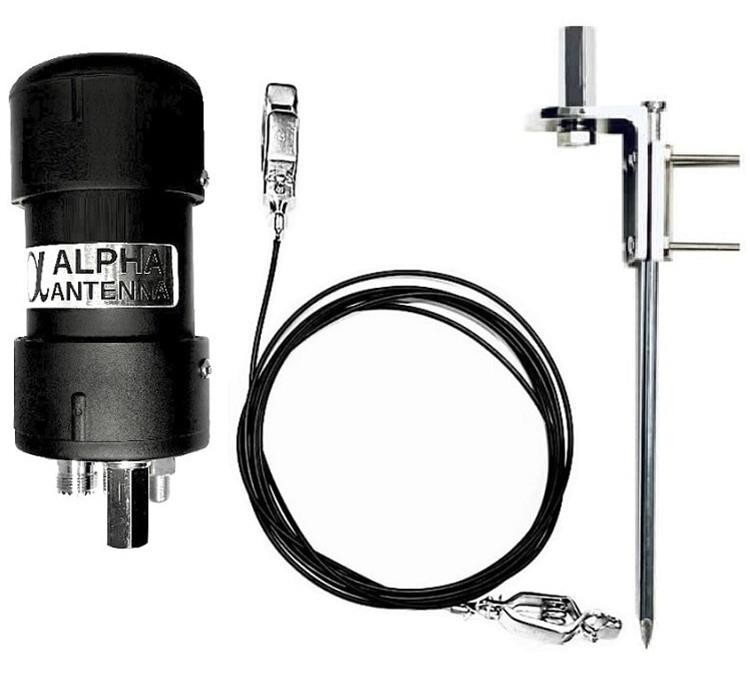
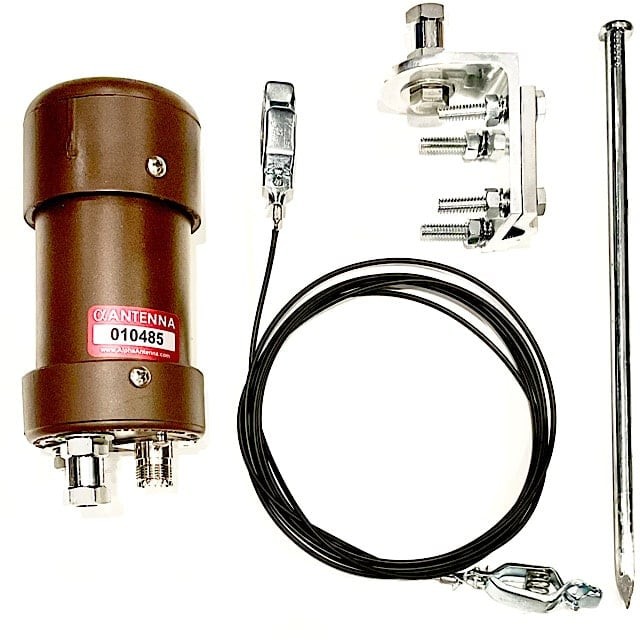
The kit contents: the matching box with its SO-239 socket, the jumper wire with crocodile clips and the ground stake with its bracket. The box comes in six colours (here black and brown) to blend into the surroundings. (Photos: Alpha Antenna; left, published by OnAllBands)
🎒 Portable bonus. With the optional 18 m (60 ft) element, the HOA Buster becomes a classic end-fed antenna, with no gutter and no real ground. A throw weight lets you launch the wire into a tree. For N0TES, “60 feet is the magic number”: a length that avoids extreme impedances on the 80 to 10 m bands. An interesting option for POTA or SOTA in French-speaking Switzerland.
📊 What the measurements say
An antenna that is “tunerless from 80 to 10 m” deserves checking. Two sets of measurements are publicly available.
N2UX's independent test (NanoVNA)
In January 2023, American radio amateur N2UX installed the HOA Buster on an aluminium downpipe (less than 15 minutes to install) and measured the maximum SWR on each band with a NanoVNA:
Maximum SWR measured by N2UX on each band (full bar = SWR of 5). Green: usable directly; orange: borderline; red: tuner required.
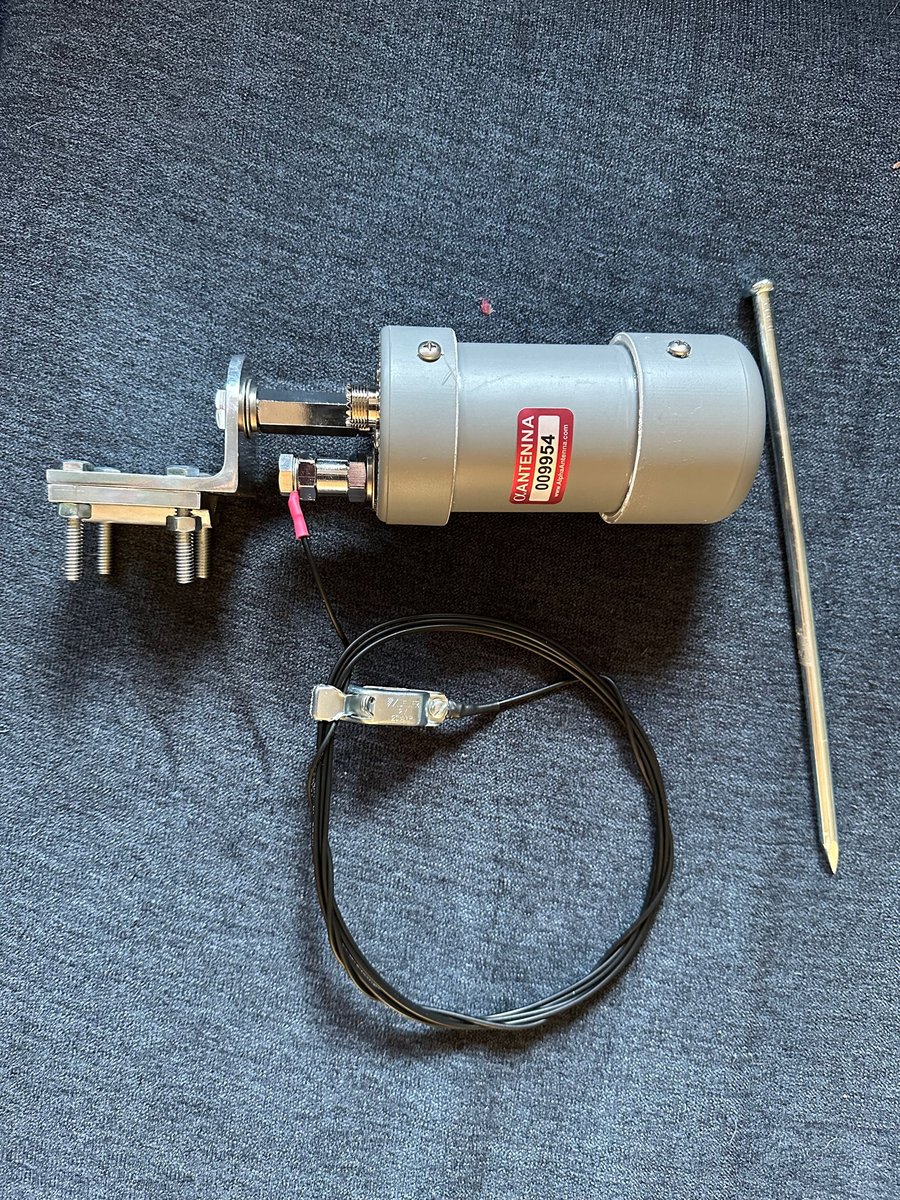
The HOA Buster (here in grey) received by N2UX for his test: box, bracket, stake and jumper wire. (Photo: N2UX, n2ux.org)
Result: on most bands, he leaves his MFJ tuner in bypass. Only 6 m really needs tuning. He rates the antenna “excellent” for his purposes and clearly better than his portable tripod antenna.
The manufacturer's published sweep
Alpha Antenna also publishes the SWR curve of a “typical” installation: a 2.7 m downpipe and just 7.6 m of gutter, in other words the recommended minimum. It shows an SWR below 1.5 on 160 m and 20 m, around 2 to 3 on most other bands, and up to about 3.3 to 3.5 on 60 m and 30 m.
⚠️ Our critical reading. The manufacturer states that transceivers do not reduce their power until an SWR of 2.9:1. In practice, many rigs start cutting power much earlier (often from 2:1, depending on the model), and coax losses increase with SWR, especially at the top end of HF and with RG-58. “Tunerless” therefore mainly means “without an external tuner”: your transceiver's built-in automatic tuner (which usually handles up to 3:1) will do the rest. With a gutter longer than the minimum, results are often better, as N2UX found. To work out your losses, use our coaxial cable calculator.
It is also worth remembering that a low SWR does not prove that an antenna radiates well: a dummy load shows a perfect SWR. The HOA Buster is a non-resonant antenna with a minimal counterpoise (a 25 cm stake), and the manufacturer itself admits that a resonant antenna will do better. Some of the power is inevitably lost in the ground and in the coils. The real judge is on-air operation: WSPR, FT8 and the reports you receive.
🗣️ What users say
Reviews published at DX Engineering, on eHam and on the manufacturer's website are mostly positive, with a few interesting limitations:
“Much better than I expected. My gutters are only 2.4 m above the ground and I make contacts all over the country and abroad. Another surprise: the SWR doesn't budge an inch in driving rain. With installation taking under a minute, it's a no-brainer for anyone living under strict rules.”
Jim, DX Engineering customer (5-star review)
“I checked with a VNA: the antenna works everywhere except on 80 m in my case. The only SWR peak fell outside the amateur bands. Just make sure your gutters are metal and the connection is solid. All of that without a tuner.”
Timothy, DX Engineering customer
🌺 Hawaii: over 30 m of gutter
A ham living in a very restrictive housing development fixed every gutter joint with self-drilling screws to ensure continuity. Result: he tunes from 160 to 10 m, despite foil-backed insulation under the roof. “The HOA Buster saved my hobby.”
📻 First QSO on 160 m
WB6NAH had never managed to get on Top Band. With his gutters, he made his first FT8 contact on 160 m.
🏘️ Terraced house: the noise
With an 8 m downpipe, one ham hears an S9 noise floor, compared with S2 on his loft dipole. Yet signals are stronger than with the dipole. Around 2 am, the noise disappears: probably the neighbour's LED lighting. He is keeping the antenna.
🏡 Bungalow: too low for QRP
One bungalow owner had 55 m of gutters, but less than 3 m above the ground. The match was perfect, but at QRP and 20-30 W the results disappointed him. He ended up running an 8 m vertical wire up a tree in the garden, fed by another model from the same brand.
One last piece of feedback is worth mentioning: a user found that his transceiver switched itself off and on and his LED lamps flickered when transmitting. That is the classic symptom of RF coming back into the shack via the coax braid, common with end-fed antennas. We come back to this below.
🛠️ Step-by-step installation
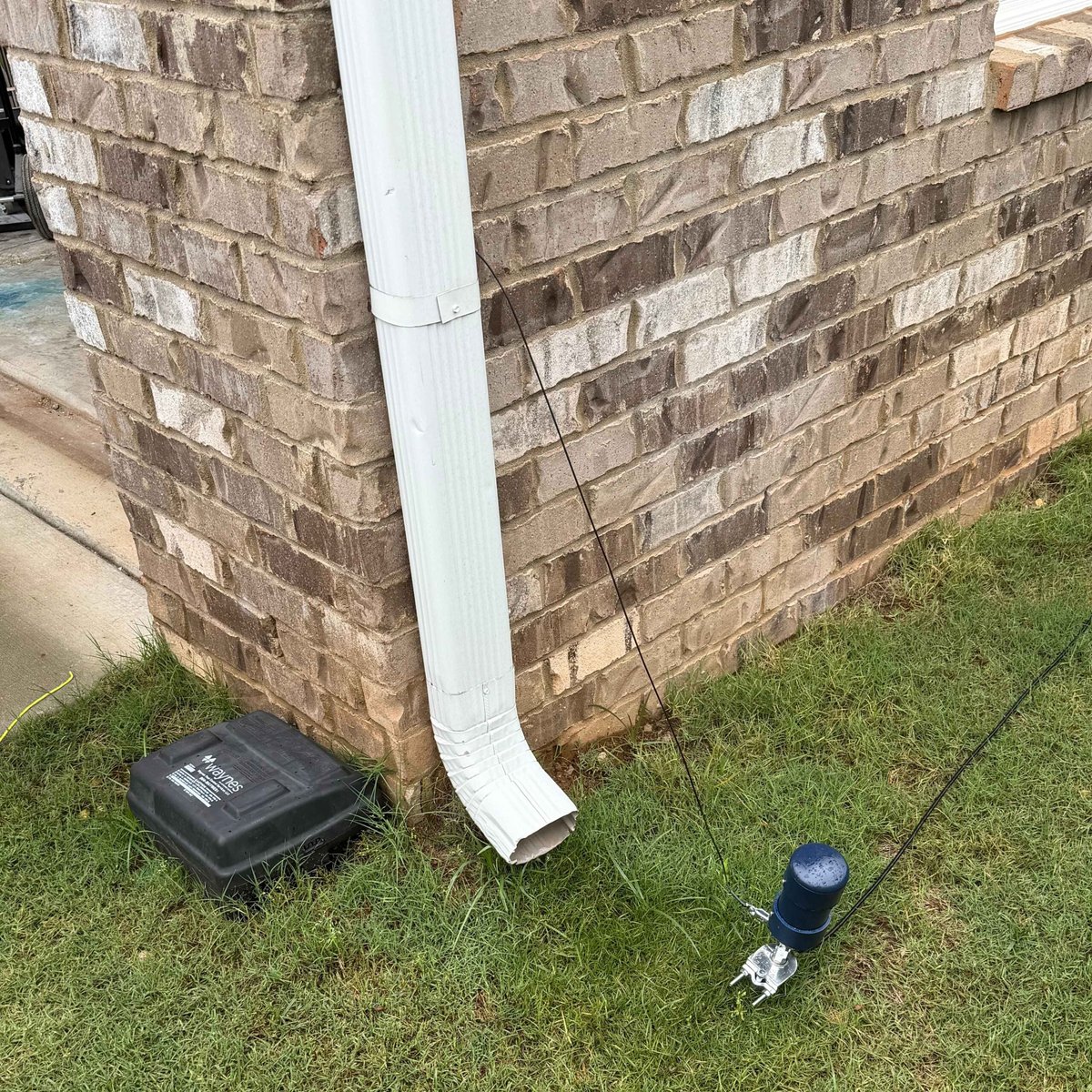
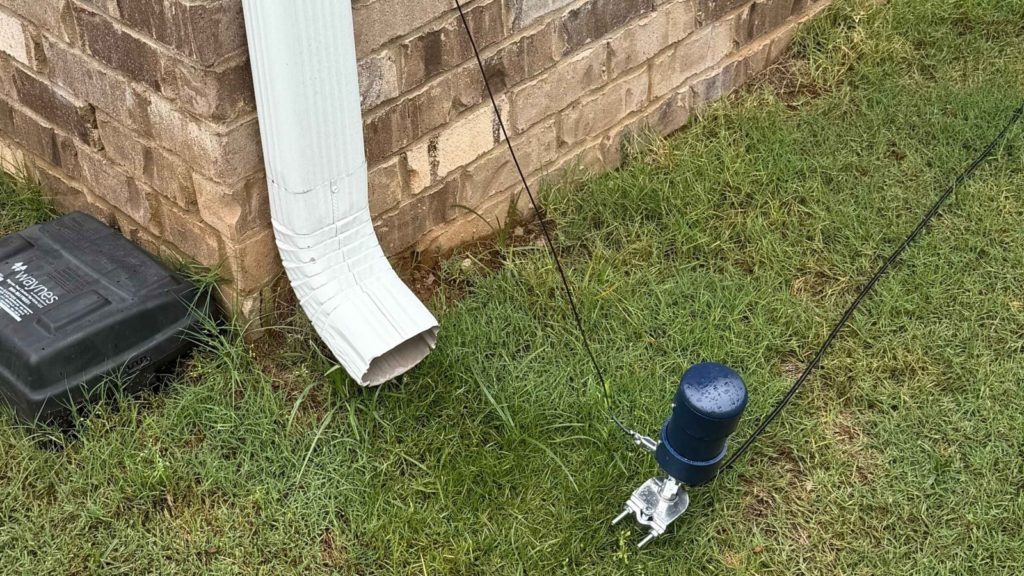
A real installation: the box (in blue) is staked in the lawn, the custom jumper wire runs halfway up the downpipe, and the coax heads off towards the house. Note that the downpipe ends above the ground without touching it. (Photo: Alpha Antenna, alphaantenna.com)
The manufacturer shows the full installation in its video:
Video: “HOA Buster DEFEATS Your HOA!”, Alpha Antenna YouTube channel.
Based on the manual (version 2.1) and the advice published by the manufacturer:
- Choose the right downpipe. The system is end-fed: pick a downpipe at one end of the gutter run, not in the middle. If you are torn between two locations, compare them with WSPR (see below).
- Check continuity. Use a multimeter to make sure there is good electrical contact from one downpipe to the other. If some sections are poorly connected, add a self-drilling screw at each joint.
- Prepare the contact point. Scrape off the paint or powder coating where the clip will bite: you need bare metal. For a permanent installation, replace the clip with a lug screwed into the downpipe.
- Drive the stake into real soil (not gravel or a concrete slab) and fix the box onto its bracket.
- Run the jumper wire between the downpipe and the box, along its whole length, without it touching the ground anywhere.
- Connect the coax to the box's SO-239 socket. Use a single length up to the shack, do not coil it and never run it parallel to the jumper wire or the downpipe.
- Test. A sweep with a NanoVNA or antenna analyser, followed by a few hours of WSPR or FT8 with an eye on PSK Reporter, will tell you straight away whether the antenna radiates.
🔌 The tip that changes everything: a common-mode choke. An end-fed antenna with a minimal counterpoise is happy to use the outer braid of the coax as its “second half”. Possible consequences: RF in the shack, a microphone that “bites”, devices resetting, noise picked up by the cable. A 1:1 current balun or a few ferrite toroids (mix 31 for HF) on the coax, at the box output and where it enters the house, will solve most of these problems. If your soil is sandy, clay or stony, the manufacturer also recommends a longer stake and a few radials laid on the ground to bring down the SWR and the losses.
🚫 Pitfalls that stop the antenna from working
🧱 Façade with metal mesh
Render applied over metal lath, a steel or aluminium sheet façade, or foil-backed insulation right behind the gutter will absorb RF. The glass fibre mesh used in modern renders, on the other hand, is no problem at all.
🌍 Downpipe connected to earth
The gutter is the active element: it must not touch earth anywhere. A downpipe that goes into a cast iron drain or a buried metal pipe short-circuits the antenna. A connection into a plastic pipe, however, is perfect.
🧴 PVC gutters
No metal, no antenna. With plastic gutters, you need to switch to the 18 m wire element, or run a discreet wire along the gutter.
📡 VHF and UHF often disappoint
FM operation on 2 m and 70 cm uses vertical polarisation, whereas the gutter is horizontal: the cross-polarisation loss is often 10 to 20 dB. Some users also report an SWR that is too high on VHF and UHF. For repeaters, keep a dedicated vertical.
🇨🇭 The HOA Buster in Switzerland: what you need to know
Here, there are no “Homeowners Associations”, but there are very real equivalents: condominium (PPE) rules, tenancy agreements, municipal regulations and planning permission procedures for visible antennas. So the HOA Buster makes perfect sense in Switzerland, provided you keep a few local specifics in mind.
| Topic | What you need to know |
|---|---|
| 🌧️ Our gutters | Good news: in Switzerland, gutters and downpipes are very often made of copper, titanium zinc or powder-coated aluminium, so they are excellent conductors. Soldered or seamed joints generally ensure good continuity. |
| ⚡ Lightning conductor | On buildings with lightning protection, gutters and downpipes often serve as down conductors and are connected to earth. In that case the gutter is grounded: the HOA Buster cannot drive it properly. And it is obviously out of the question to disconnect the protection system to operate a radio. |
| 🏢 Condominium and rental | In a condominium, gutters are part of the common property; in a rental, they belong to the landlord. Even though the box is discreet, it is better to get permission than to risk a dispute. |
| 📻 Usable bands | The HF amateur bands from 80 to 10 m, plus 160 m if your gutter allows (see our Swiss band plan). 27 MHz CB is licence-free in Switzerland. However, GMRS and the 900 MHz band are US allocations: they do not apply here. |
| ☢️ Non-ionising radiation | The antenna runs along the house, a few metres from living spaces, both yours and your neighbours'. As a licence holder, you remain responsible for complying with the ONIR (Swiss Ordinance on Protection against Non-Ionising Radiation) limit values in accessible places. Keep your power reasonable (the box is limited to 25 W on FT8 anyway) and do the calculation with the USKA tools. |
| 💶 Buying | The HOA Buster is sold in the United States (Alpha Antenna direct, DX Engineering). Allow for international shipping, 8.1 % import VAT and the carrier's customs clearance fees. The box is made to order: a lead time of several weeks is possible. |
🔧 What about a home-made version?
Using a gutter as an antenna is not a new idea: radio amateurs have been doing it for decades. The HOA Buster's merit is to make it a tidy, tested, ready-to-use product. But there are other solutions:
- A remote automatic tuner at the foot of the downpipe, weatherproof and powered via the coax or a separate cable. This is the most effective solution: tuning takes place at the antenna feed point, the coax runs at 1:1 SWR and the gutter can be tuned on practically every band. It is also the most expensive.
- A 9:1 UNUN transformer at the foot of the downpipe, used with the transceiver's tuner. Cheaper, but with higher losses and an SWR that varies from band to band.
- Another discreet antenna, if you have no metal gutter: an almost invisible 4-metre HF vertical or a magnetic loop such as the Baby Loop, which performs very well in small spaces.
⚖️ The verdict
✅ Strengths
- Invisible: easily mistaken for an irrigation box or a surge arrester
- Installed in minutes, with no ladder or tools
- Wide bandwidth thanks to the gutter's cross-section
- Works without an external tuner on most bands
- Unaffected by rain, according to users
- Accessible to hams with reduced mobility or visual impairment
- Reusable for portable operation with the 18 m element
⚠️ Limitations
- Non-resonant antenna: less efficient than a well-sited dipole
- Low gutter right against the house: local noise, upward radiation
- Only 25 W on digital modes
- Unconvincing on VHF and UHF (horizontal polarisation)
- Results highly dependent on the building (façade, continuity, ground)
- Unusable with PVC gutters or gutters connected to a lightning conductor
- Imported from the United States
🤔 Who is the HOA Buster for?
The HOA Buster is a very good answer for the ham who is not allowed or not able to install a visible antenna, who has metal gutters on a one- or two-storey house, and who wants to operate SSB, CW or FT8 on the low and mid bands. For regional nets on 80 and 40 m, its NVIS character is even an advantage. It is not an antenna for the demanding DXer, and it will not replace a Yagi or an unobstructed vertical. But between an imperfect antenna that works and no antenna at all, the choice is easy.
🇨🇭 A word from HB9V
At HB9V, the Radio Amateurs of Canton Vaud club, we often hear the same sentence: “I'm not allowed to put up an antenna”. The HOA Buster is a reminder that before giving up, it is worth looking around: a copper gutter, a balcony, a tree or a loft can hide a perfectly respectable antenna. Our advice: first check the continuity of your gutters and make sure there is no lightning conductor, fit a common-mode choke on the coax, and judge the result with WSPR rather than with the SWR meter. Whether you are an HB3/HB9 licence holder or preparing for your exam, radio is never more rewarding than when you make do with what you have.
🔌 Coax, ferrites, tuner: everything for a discreet antenna
For made-to-measure coaxial cable, ferrites against RF feedback or an antenna tuner suited to your installation, talk to our Swiss partner.
See the equipment at Phonicom →🤝 Our partners

Phonicom.ch, your amateur radio specialist in Switzerland
Discreet antennas, made-to-measure coax, tuners, ferrites or HF transceivers: to put together a station that suits your home, Phonicom will advise and equip you (Yaesu, Diamond and many more), with after-sales service in Switzerland.
Visit phonicom.ch →📚 Also on HB9V
- 🕵️ Almost invisible 4-metre HF vertical antenna: another discreet solution
- 🔁 Ciro Mazzoni's Baby Loop antenna: the complete guide: HF from a balcony
- 💻 FT8, the complete guide: the ideal mode for testing a modest antenna
- 🗺️ PSK Reporter: see where your signal is being received
- 🧮 Coaxial cable calculator: your coax losses depending on SWR
- 📊 Swiss amateur radio band plan: all HF, VHF and UHF frequencies
📖 Sources: interview with Steven Deines, N0TES, published by OnAllBands (DX Engineering), 15 September 2026; HOA Buster manual version 2.1, product sheet, installation advice and customer reviews published by Alpha Antenna; DX Engineering product page (ALP-HOABUSTERBLK); N2UX test (January 2023); user reviews on eHam. Photos: Alpha Antenna (alphaantenna.com), N2UX (n2ux.org) and Jim, DX Engineering customer, published by OnAllBands. Video: Alpha Antenna YouTube channel.