📻 At first, a frequency is just a number on a dial. Then, one evening, it becomes a meeting place.
At first, a frequency is only a number. You hear signals come and go, and you pause there as you turn the VFO. But listen to a regular QSO (what English speakers call a "net") a few evenings in a row and something changes. You recognise the voices, you know who always checks in first, who turns up five minutes late and who turns a simple signal report into a twenty-minute story about the weather and antennas. The frequency then feels less like a slice of spectrum and more like a friendly neighbourhood.
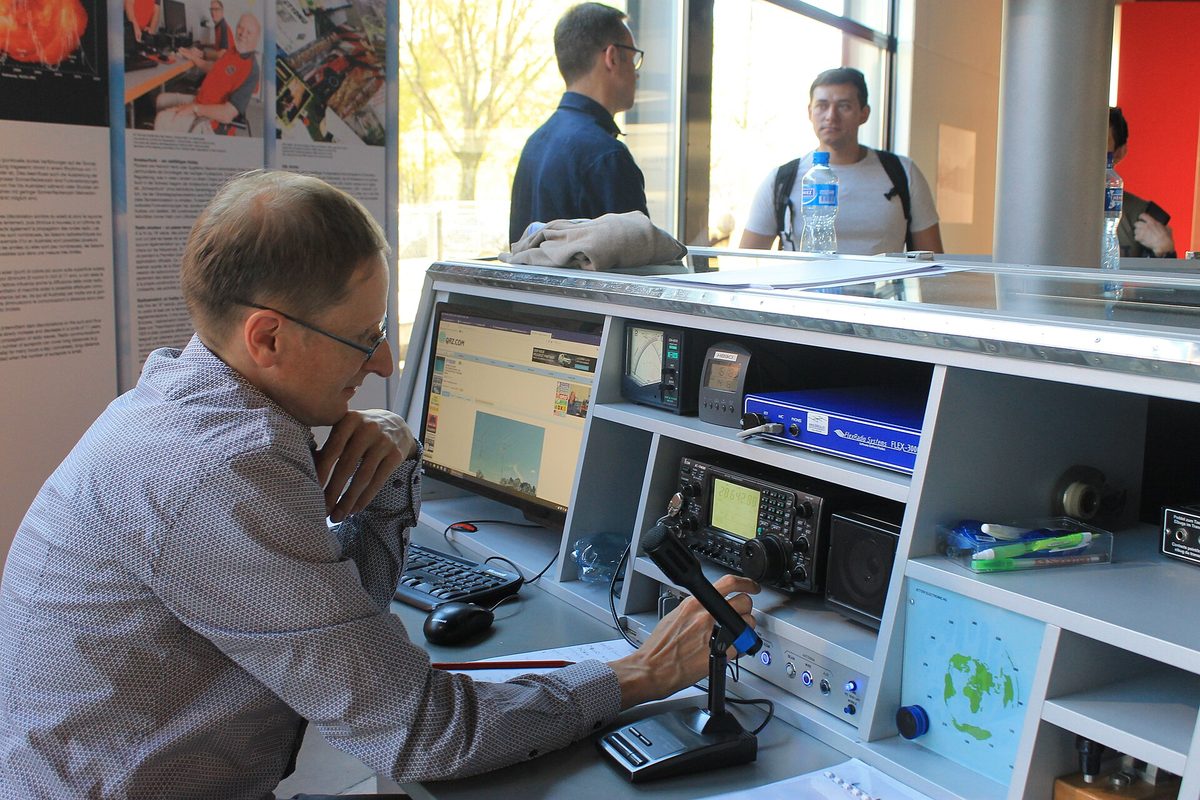
An operator at the microphone of station HB9O, at the Swiss Museum of Transport (Verkehrshaus) in Lucerne, in April 2019. Photo: Valanagut, Wikimedia Commons, licence CC BY-SA 4.0.
📡 What exactly is a "net"?
The English word net comes from network. But here the network is not made of cables: it is a human network of radio amateurs linked by the same frequency at an agreed time. In French-speaking Switzerland, people tend to speak of a regular QSO, a section QSO or simply the "evening QSO".
In practice, a net is an organised gathering of stations on a given frequency, often a VHF or UHF repeater, sometimes a direct (simplex) frequency or an HF frequency. A net control operator keeps things moving. They open the QSO, call the stations, hand over the floor and make sure everyone gets a chance to speak. Some nets are highly structured; others are more like a group of friends around a virtual café table. With one advantage over the café: nobody argues about who pays the bill.
Equipment matters little. A full station worthy of a DXer and a simple handheld take part in the same meeting. Operators may be a few kilometres away or at the other end of the country; for the duration of the net, they share the same invisible meeting place.
To give you an idea, here is what an evening QSO in French-speaking Switzerland might look like. This is an example, as HB9V does not organise an official QSO for the time being.
🗓️ Much more than a roll call
The simplest net is the check-in net. The net control operator announces the opening and invites stations to check in. Each one replies with their callsign, sometimes their first name, their QTH or a short comment. It sounds ordinary, and it is. But this routine serves a valuable purpose: it gives you a reason to switch on the radio.
Without a meeting, you switch on, listen for three minutes, hear nothing of interest and switch off. With a QSO scheduled every evening at a fixed time, there is somewhere to go. Regularity creates habit, and habit creates enthusiasm. You end up planning your evening around the QSO and looking forward to it. As Mark Haverstock, K8MSH, mischievously puts it, radio then becomes a social network, but without endless scrolling, without adverts, without algorithms and without political arguments.
🤝 Everyone has a place
A good net brings together operators of all levels. The brand-new holder of an HB3 licence often has stage fright when it comes to pressing the PTT. The net gives them a friendly setting for their first contacts. They know someone will answer, they know how it works, and nobody will judge them if they stumble over their callsign.
The experienced operator, for their part, has a chance to pass on knowledge by explaining a procedure, answering a question or slipping in a tip, without making the newcomer feel they have wandered by mistake into an advanced physics lecture.
This matters all the more because, seen from outside, amateur radio can be intimidating: antennas, power supplies, SWR meters, coaxial cables, digital modes, propagation maps, regulations, and enough abbreviations to resemble a secret society. A welcoming net sweeps all that aside.
"You don't need to know everything. All you need is your callsign and the ability to say 'good evening'."
Mark Haverstock, K8MSH, in OnAllBands (September 2026)
👂 Voices that become faces
After hearing the same people again and again, something funny happens. You recognise the voices before you even hear the callsigns. "Ah, here's Marie. I bet she'll talk about the weather again." You end up knowing where everyone lives, which radio they use, which antenna they have and which one is currently undergoing the most widely practised maintenance procedure in amateur radio, namely waiting for the parts to arrive.
You also pick up snippets of people's lives. A newborn grandchild, a POTA or SOTA activation set up during the holidays, an antenna finally finished after three weekends. These details turn callsigns into people. That is the moment a frequency becomes a community.
🎙️ The net control operator, conductor of the net
Every good net needs someone to run it: the net control operator (Net Control Operator, NCO). They are traffic warden, host and referee all at once. And keeping an amateur radio conversation on track is no small task. A simple "How are you this evening?" can lead to a detailed discussion of antennas, lawnmowers, solar panels, old valve sets and the weather for the next seven days.
A good net control operator does not cut the conversation short, they keep it moving while letting everyone enjoy their turn. Organised without being authoritarian, warm without letting the net descend into cacophony.
🔔 Opening and closing
They announce the start of the net, its name, the frequency and how it will run, then close it on time, thanking the participants.
📝 Taking check-ins
They note the callsigns checking in, in order, and call them back one by one. A paper list works perfectly well.
🎤 Handing over the floor
Each station gets its turn. They encourage the shy ones, politely rein in the talkative ones, and leave room for weak or distant stations.
🚦 Keeping priority
If a station reports urgent traffic, it goes before everything else. The chatter can wait.
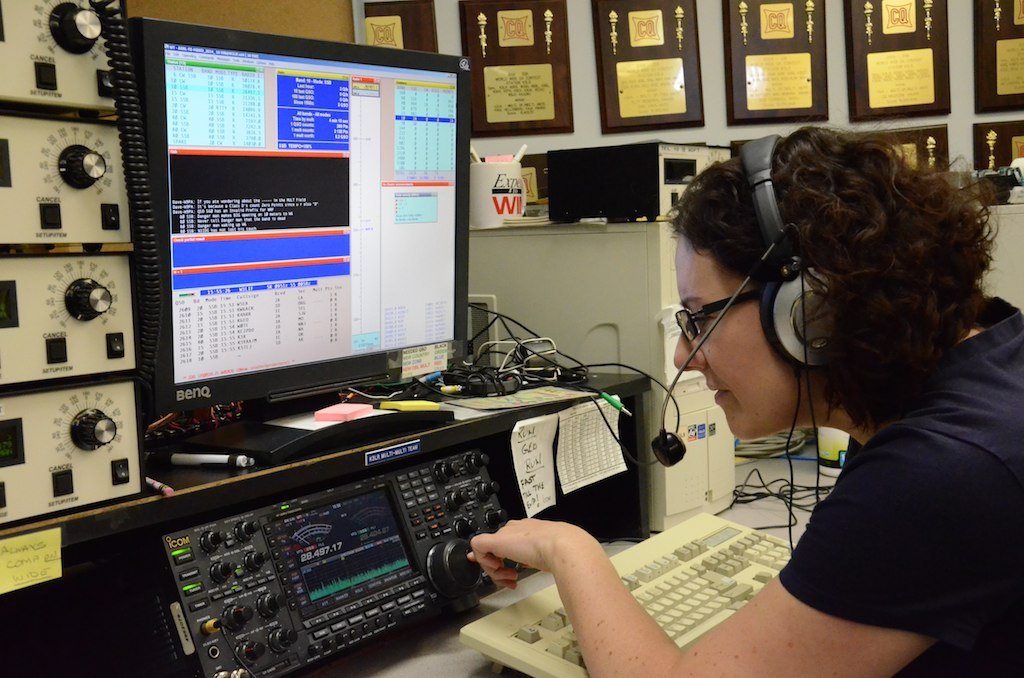
Headphones on and hand on the tuning knob: an operator from the Monroe County Amateur Radio Club during Field Day 2014 (United States). Photo: Doug Butchy, Wikimedia Commons, licence CC BY 2.0.
📋 Your first net, step by step
Every net has its own customs. Listen to one or two sessions before joining in. Here is the most common format on a repeater or on direct in VHF/UHF.
- Listen first. Note the frequency, the time, the net control operator and how the others check in.
- Wait for the call. The net control operator opens the net and invites stations to check in. Do not talk while they are calling.
- Give only your callsign, clearly and without rushing, using the phonetic alphabet if needed. No speeches at this stage: the operator is taking the list.
- Wait your turn. The operator calls you back by your callsign. Then give your first name, your QTH, a report and, if you like, a few words.
- Hand back by ending with your callsign and passing the floor back to the net control operator, or to the station they indicated.
- Announce your departure if you leave the net before the end: a simple "I'm signing off, 73" followed by your callsign is enough.
🪪 Your callsign, regularly. The ITU Radio Regulations (provision 25.9) require amateur stations to transmit their callsign "at short intervals" during their transmissions. On a net the habit is simple: your callsign at the start and end of each over. And if you forget it at the microphone, don't worry, it has happened to everyone: the microphone has a strange power over memory.
The Q codes you will hear most
| Code | Meaning | On a net |
|---|---|---|
| QRZ? | Who is calling me? | The net control operator invites stations to check in. |
| QSL | I acknowledge receipt | "QSL": your over was received. |
| QTH | My location is… | Where you are transmitting from, usually your town or village. |
| QRM / QSB | Interference / fading | To explain why a signal is hard to copy. |
| QSY | Change frequency | Two stations move elsewhere to chat and free up the net. |
| QRT | I am closing down | You go off the air for the evening. |
The full list is on our Q codes page.
🚨 Nets that serve the community
Not all nets are purely social. Some are used to pass formal messages from one station to another ("traffic"). Others are devoted to a particular activity: DX chasing, awards, contests, technical discussions, equipment, club life. And some are designed for public service and emergencies.
In the United States, Skywarn nets gather observations from radio amateurs during severe storms for the National Weather Service. In the United Kingdom, Raynet radio amateurs provide communications for events such as running races. When the usual means are overloaded or down, a trained network can collect information and pass it on to the emergency services.
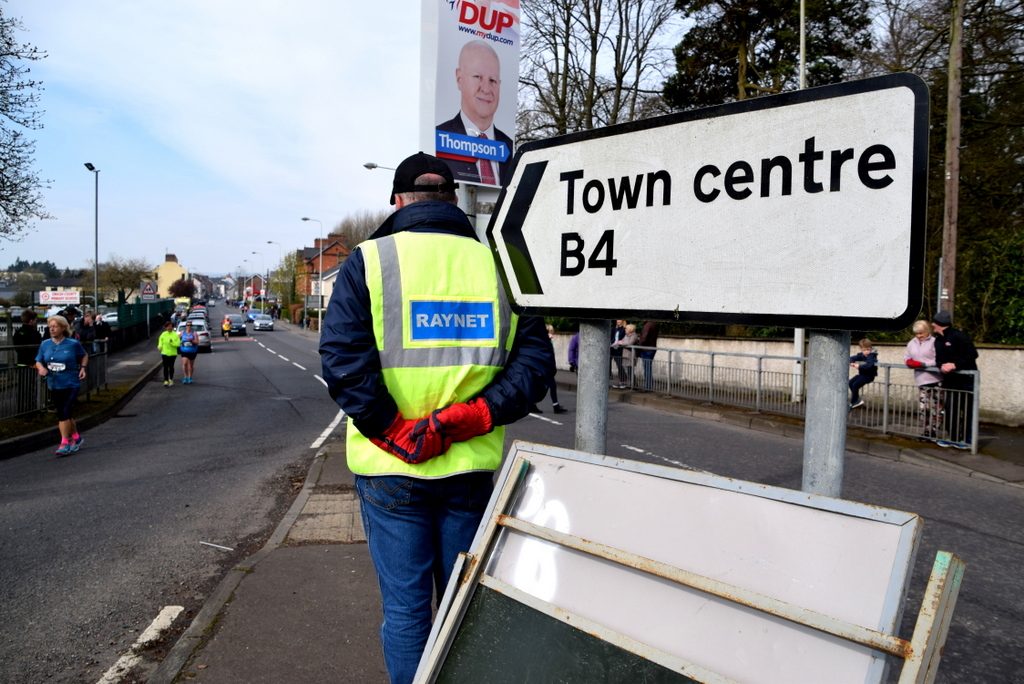
A Raynet radio amateur at a checkpoint of the Omagh half marathon (Northern Ireland), in April 2019. Photo: Kenneth Allen, geograph.org.uk via Wikimedia Commons, licence CC BY-SA 2.0.
⏱️ You can't improvise an emergency network. As K8MSH points out, you don't become effective by reading the manual five minutes after the alert. It is regular participation in a net that trains you to know when to transmit, to speak clearly, to be brief and to work as a team. An evening QSO is already an excellent exercise.
🌱 How to keep a net alive
A net can be technically perfect and still fade away. The secret is participation. Procedures that are too long put newcomers off, and too much formality turns a friendly QSO into a parliamentary committee meeting. You need just enough structure to avoid chaos, and enough flexibility to stay enjoyable.
A good idea, borrowed from K8MSH's local net: ask a question each week to get the conversation going.
📻 Your first radio?
The classic that brings back memories, and sometimes regrets about selling a legendary rig.
📡 Your favourite antenna?
Careful, sensitive subject. Allow a little extra time.
🏝️ Just one item on a desert island?
The handheld? The tuner? The coffee? The answers say a lot.
👽 The strangest thing you have heard on the radio?
According to K8MSH, this question alone can fill several sessions.
The net is also the right place for announcements: club meeting, radio flea market, activation day, repeater news. Selling a transceiver in perfect condition? This is the ideal audience (and for a written ad there is also the Swiss amateur radio marketplace hbtroc.ch). Need volunteers for an event? This is where you'll find them.
🎧 The importance of listening
Taking part in a net does not always mean talking. Listening is very valuable, especially at the beginning. You learn when to transmit, how to identify yourself, how to keep it short and how to deal with interference.
Above all, you learn what no book or video really teaches: on-air etiquette. Being polite matters far more than being heard loud and clear. And nobody needs to hear your whole life story every time you press the PTT.
✅ Good habits at a glance
- Listen before transmitting, and leave a short pause between overs (a station in difficulty may need the frequency).
- Keep overs short: on a repeater, the timer often cuts off monologues.
- Always hand back to the net control operator.
- No contentious topics: the frequency is a shared space.
🏔️ A community without walls
The most remarkable thing about a net is that it creates a community without anyone having to travel. Your neighbour is there, so is someone thirty kilometres away, and depending on the band and propagation the group can reach much further. No walls, no parking problems. The only condition is that your signal reaches the meeting. Sometimes it is strong and clear, sometimes it arrives with so much noise and fading that people wonder whether you are transmitting from inside a blender.
Here, it is often the repeaters perched on the summits that act as the meeting room. They pick up signals from handhelds and mobile stations and retransmit them across a whole region.
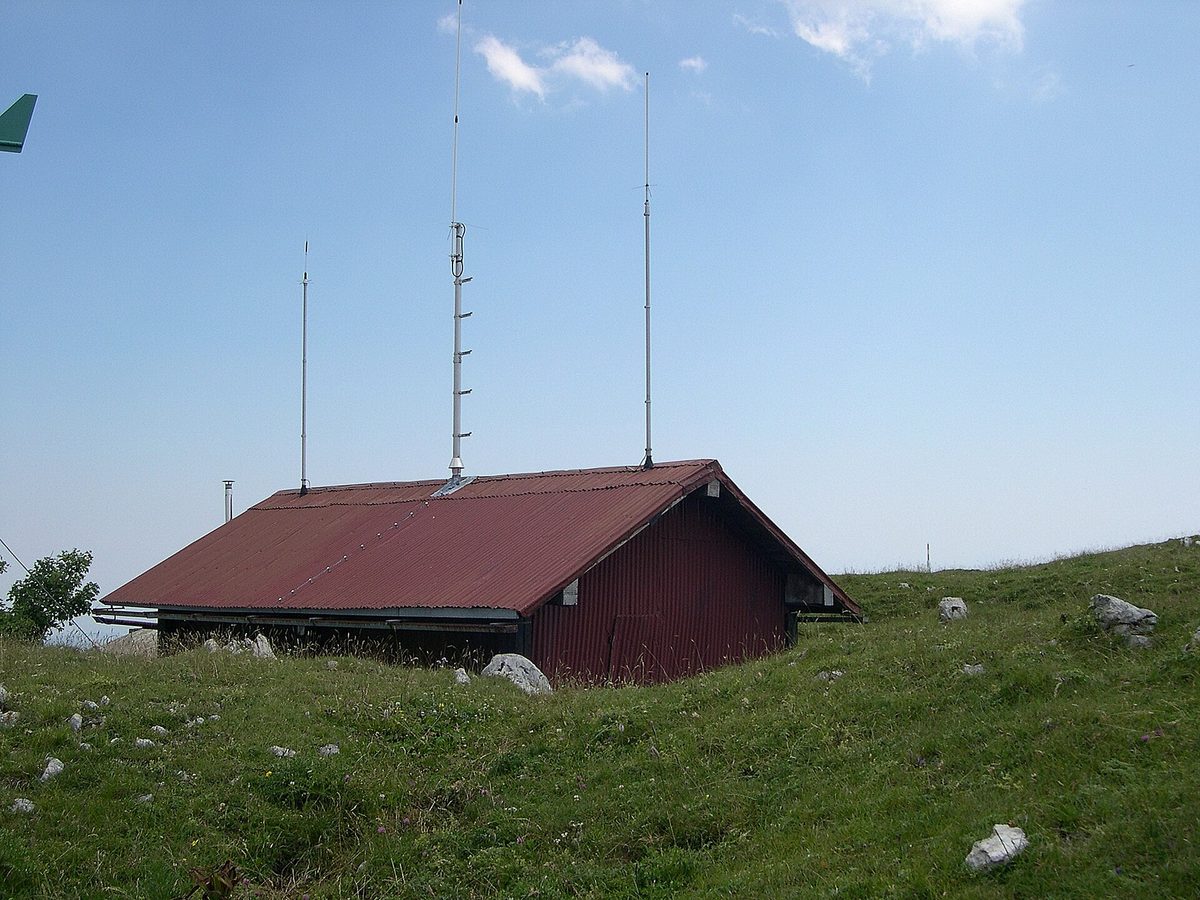
The Cabane des Apprentis on the summit of the Pointe de Poêle Chaud (1,628 m, Vaud Jura), which in 2005 hosted a Franco-Swiss VHF amateur radio repeater. Photo: Serge Nueffer, Wikimedia Commons, free to reproduce with attribution.
And digital networks enlarge the room even further. The HB9V XLX reflector links repeaters and personal access points (hotspots), and networks such as Brandmeister on DMR bring together talkgroups from all over the world.
🇨🇭 Where to find a net in French-speaking Switzerland?
The easiest way is to start close to home, on VHF or UHF. Let's go back to our example:
📻 Example evening QSO: every evening from 20:30, on 145.300 MHz direct or on the la Praz repeater, 438.850 MHz. These times and frequencies are given as an example only, as HB9V does not organise an official QSO for the time being. For the regular meetings that already exist, see our QSOs in Switzerland page, and on a quiet frequency, don't hesitate to put out a call.
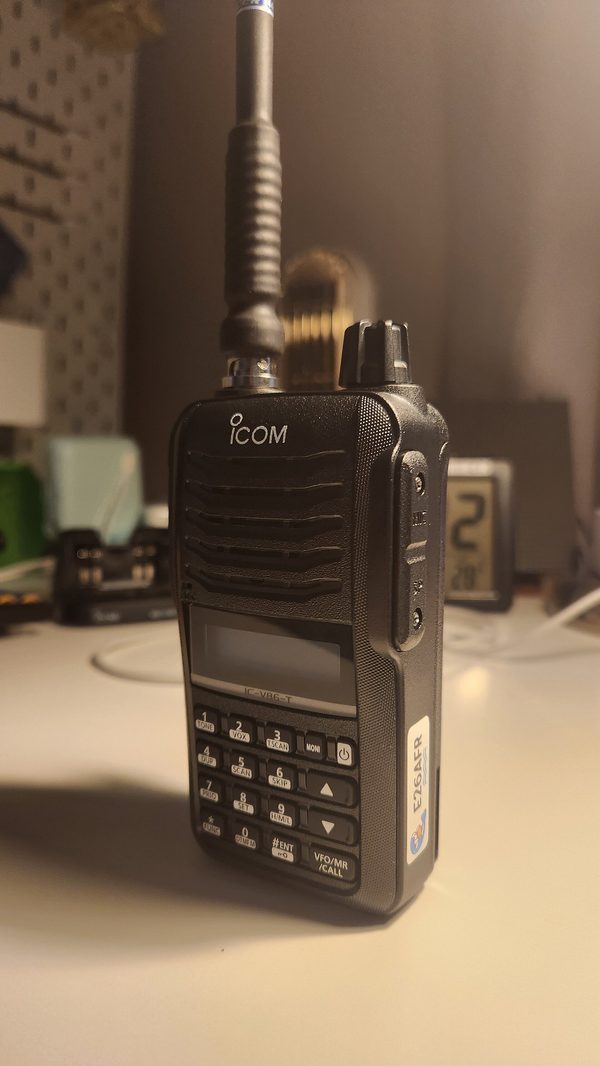
A simple VHF handheld, here an Icom IC-V86, is all you need to join a QSO on a repeater. Photo: Game11454, Wikimedia Commons, licence CC BY-SA 4.0.
| Where to look | What you will find there |
|---|---|
| QSOs in Switzerland (HB9V) | Regular QSOs in Switzerland: days, times and frequencies. |
| Map of Swiss repeaters | Repeaters near you, with frequencies and offsets, so you can listen before joining in. |
| HB9V XLX reflector | Who is connected right now, and on which module. |
| netfinder.radio | An international directory of nets, mostly English-speaking. |
| ARRL net directory | Nets registered with the American association, useful on HF. |
| HF nets SDR tuner (W0XZ) | Listen to HF nets live on an online receiver, depending on propagation and schedules. |
💛 Much more than radio
Ultimately, a good net is about people. The radios are only the tools that make the meeting possible. The frequency is the meeting room, the net control operator is the host, the participants are the neighbours, and the conversations are the reason everyone keeps coming back.
Over time, something changes. A callsign you hear has a face. You notice when someone does not check in. You hear a familiar voice again after a long absence and realise you had missed it. That is when amateur radio becomes much more than a technical hobby. A net turns strangers into friends, a group of operators into a team, and a number on a dial into a place where you feel at home.
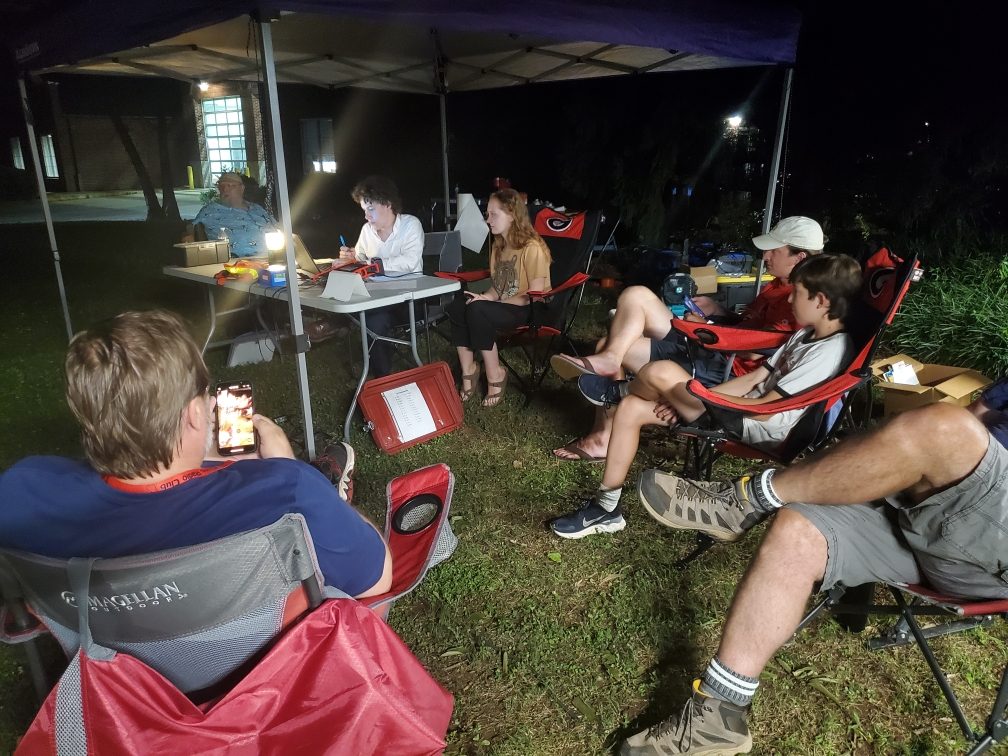
Field Day evening at the Athens Radio Club (Georgia, United States), in June 2023. Radio is also about people getting together. Photo: Kmccook, Wikimedia Commons, licence CC BY-SA 4.0.
🇨🇭 A word from HB9V
At HB9V, the Club Radioamateur Suisse, we do not organise an official QSO for the time being. But the spirit of the evening QSO speaks to us: catching up on news, adjusting an antenna, talking about the next coffee-and-croissant meet-up and warmly welcoming those who have just obtained their HB3 or HB9 licence. If you have never yet dared to press the PTT, now is the perfect moment. Listen to a regular QSO near you for an evening or two, then simply give your callsign. Someone will answer, we promise. And if you are not licensed yet, listening to the QSO is an excellent way to discover what everyday amateur radio is like.
📻 A handheld, an antenna, and you're on the QSO
To choose a VHF/UHF handheld, a mobile antenna or a roof antenna that will get you into the repeater, talk to our Swiss partner.
See the equipment at Phonicom →🤝 Our partners
Phonicom.ch, your amateur radio specialist in Switzerland
Handhelds, mobile stations, VHF/UHF and HF antennas, custom coax. To join an evening QSO in good conditions, Phonicom will advise and equip you (Yaesu, Diamond and many more), with after-sales service in Switzerland.
Visit phonicom.ch →📚 Also on HB9V
- QSOs in Switzerland: all the regular meetings, days and frequencies
- Map of Swiss amateur radio repeaters: find the nearest repeater
- Q codes: QRZ, QSL, QSY and all the others
- Brandmeister, the worldwide DMR network: digital talkgroups
- Swiss amateur radio band plan: all HF, VHF and UHF frequencies
- The HB9V app: repeaters, world map and tools in your pocket
📖 Sources: Mark Haverstock, K8MSH, "Nothing But Net: When a Frequency Becomes a Community", published by OnAllBands (DX Engineering), 25 September 2026; ITU Radio Regulations, provision 25.9 (identification of amateur stations); HB9V's QSOs in Switzerland page; directories netfinder.radio, ARRL and W0XZ. Photos (Wikimedia Commons): HB9O and HB9SG by Valanagut (CC BY-SA 4.0), MCARC Field Day by Doug Butchy (CC BY 2.0), Raynet in Omagh by Kenneth Allen (CC BY-SA 2.0), Pointe de Poêle Chaud repeater by Serge Nueffer (free with attribution), Icom IC-V86 by Game11454 (CC BY-SA 4.0), Athens Radio Club Field Day by Kmccook (CC BY-SA 4.0). Licences: CC BY 2.0, CC BY-SA 4.0, CC BY-SA 2.0. Featured image cropped from the HB9SG photo.