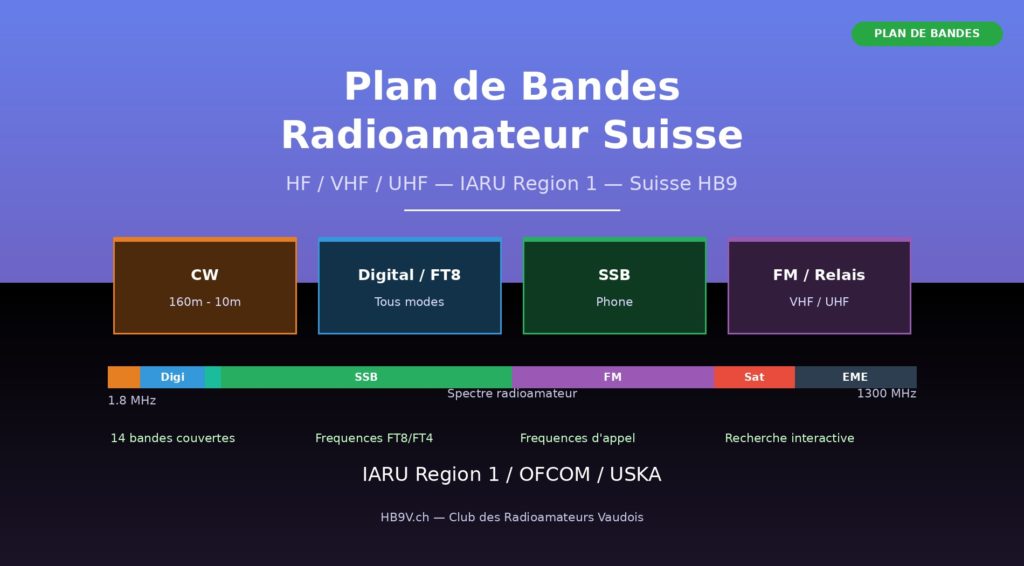
📡 Complete amateur radio band plan for Switzerland: discover our new interactive page with the IARU Region 1 band plan adapted for HB9 and HB3 radio amateurs. 15 bands from 160m to 23cm, colour-coded spectrum diagrams, detailed tables for each segment, FT8/FT4 frequencies, calling and emergency frequencies. Everything you need to know about amateur radio frequencies in one place.
📻 Go straight to the band plan: Swiss Amateur Radio Band Plan: an interactive interface with visual diagrams, search and HF/VHF/UHF filters.
🎯 Why a band plan on HB9V?
The amateur radio band plan is every operator's reference document. It sets out, band by band, which segments are reserved for CW, digital modes, SSB or FM. It is an essential tool for operating by the rules and quickly finding where the activity is.
Existing band plans are often presented as raw tables or hard-to-read PDFs. It is difficult to find your way around quickly, especially for new HB3 radio amateurs discovering the bands. Our interactive band plan solves this with a modern interface, colour-coded visual diagrams and instant search.
Whether you are setting up WSJT-X for FT8, looking for the SSB calling frequency on 20m, or checking whether SSB is allowed on 30m, the Swiss amateur radio band plan on HB9V gives you the answer in seconds.
Static PDFs, cluttered tables, no search, hard to read on mobile
Visual diagrams, instant search, HF/VHF/UHF filters, 100% responsive
📊 The band plan in figures
⚡ Page features
The amateur radio band plan on HB9V offers much more than a simple table of frequencies. Here are the six main features that make it unique:
🎨 Spectrum diagrams
Each band has a colour-coded visual diagram showing how the segments are allocated: CW (orange), digital (blue), SSB (green), FM (purple), satellite (red), beacons (turquoise). Understand how a band is organised at a glance.
📋 Expandable cards
Each band is presented in an expandable card. Click to display the spectrum diagram and the detailed table of segments with exact frequencies, permitted modes and recommended uses.
🔍 Instant search
Type a frequency (e.g. 14.074), a mode (e.g. FT8) or a band name (e.g. 2m) in the search box. Results appear instantly as the band cards are filtered.
📡 HF / VHF / UHF filters
Filter the bands by category in one click: HF (160m to 10m), VHF (6m, 4m, 2m) or UHF+ (70cm, 23cm). Ideal for focusing on the bands you are interested in.
⚡ FT8/FT4 table
A complete summary table of all FT8 and FT4 frequencies on the 15 bands, with USB dial frequencies and the best opening periods. Essential for setting up WSJT-X.
📻 Calling frequencies
All the calling frequencies listed: SSB calling, FM calling, QRP CW centres of activity, and Swiss emergency frequencies (145.500 MHz, 3.760 MHz, Rega 161.300 MHz).
📡 View the Band Plan
15 bands, visual diagrams, FT8 frequencies, calling frequencies: the whole Swiss amateur radio spectrum in one place.
Open the Band Plan →📻 Overview of the HF bands (1.8 - 29.7 MHz)
The HF (high frequency) bands allow long-distance communication thanks to ionospheric propagation. The amateur radio band plan covers 10 HF bands, from 160m to 10m. Here is a summary:
| Band | Frequencies | FT8 | Feature |
|---|---|---|---|
| 160m | 1.810 - 2.000 MHz | 1.840 | Topband, night-time, winter DX |
| 80m | 3.500 - 3.800 MHz | 3.573 | Night-time, European contacts, HB9 emergency |
| 60m | 5.3515 - 5.3665 MHz | 5.357 | Narrow band, 15 W EIRP max |
| 40m | 7.000 - 7.200 MHz | 7.074 | All-round, day and night, busiest in the evening |
| 30m | 10.100 - 10.150 MHz | 10.136 | CW and digital only, no SSB |
| 20m | 14.000 - 14.350 MHz | 14.074 | ⭐ Queen of the DX bands, daytime |
| 17m | 18.068 - 18.168 MHz | 18.100 | WARC, quiet, no contests |
| 15m | 21.000 - 21.450 MHz | 21.074 | Excellent DX at the top of the solar cycle |
| 12m | 24.890 - 24.990 MHz | 24.915 | WARC, sporadic openings |
| 10m | 28.000 - 29.700 MHz | 28.074 | Magic band, FM + repeaters |
💡 Did you know? 20m (14 MHz) is regarded as the “Queen of the DX bands”. It is the most widely used HF band in the world, with daily openings to every continent. Ideal for getting started on HF with FT8 on 14.074 MHz.
📡 Overview of the VHF and UHF bands
The VHF and UHF bands are the everyday playground of Swiss radio amateurs. FM repeaters, digital modes (DMR, C4FM, D-STAR), satellites, EME: these bands offer a wide variety of activities.
| Band | Frequencies | FT8 | Feature |
|---|---|---|---|
| 6m | 50.000 - 52.000 MHz | 50.313 | ⭐ Magic Band, spectacular sporadic E |
| 4m | 70.000 - 70.500 MHz | 70.154 | Secondary in HB9, 25 W ERP max |
| 2m | 144.000 - 146.000 MHz | 144.174 | ⭐ Main VHF band, repeaters, APRS, ISS |
| 70cm | 430.000 - 440.000 MHz | 432.174 | FM/DMR/C4FM repeaters, satellites, ATV |
| 23cm | 1.240 - 1.300 GHz | 1296.174 | Microwave, EME, digital ATV |
⚠️ VHF emergency frequency: 145.500 MHz (FM simplex) is the calling and emergency frequency on 2m. Every radio amateur should monitor it regularly. In a disaster, it is the first channel to use to set up communications.
🔧 How to use the band plan
🆕 For HB3 beginners
Start with 2m (144 MHz) for local contacts via repeaters, then explore 20m (14 MHz) on HF with FT8. The band plan shows you exactly where to listen and transmit for each mode.
📊 For FT8 / WSJT-X
Check the FT8/FT4 summary table to set up WSJT-X with the right dial frequencies on each band. All the conventional frequencies are listed, from 160m to 23cm.
🏆 For contests
Quickly identify the CW and SSB segments allowed for contests on each band. Note: contests are not allowed on the WARC bands (30m, 17m, 12m) under the IARU plan.
🇨🇭 For regulations
Check the permitted power for each band (1 kW HB9, 100 W HB3, 15 W on 60m, 25 W on 4m) and the restrictions specific to Switzerland under OFCOM's requirements.
🇨🇭 Swiss context
In Switzerland, amateur radio frequencies are regulated by OFCOM and follow the recommendations of IARU Region 1. USKA (Union Schweizerischer Kurzwellen-Amateure) coordinates the use of the bands and represents Swiss radio amateurs internationally.
The Swiss amateur radio band plan on HB9V reflects the official allocations along with the features specific to Switzerland: the 60m band (5 MHz) with its 15 W EIRP limit, the 4m band (70 MHz) as a secondary allocation at 25 W ERP, and the maximum power for each type of licence (CEPT HB9: 1 kW PEP, entry-level HB3: 100 W PEP).
✅ Solar cycle 25: We are currently in the high phase of solar cycle 25, which brings excellent propagation conditions on the higher bands (15m, 12m, 10m, 6m). It is the ideal time to explore these bands and chase DX! See our propagation guide for more details.
✅ Check the band plan now: Open the Swiss Amateur Radio Band Plan: 15 bands, visual diagrams, FT8 frequencies, calling and emergency frequencies. Interactive, free and kept up to date. 73!
🤝 Our partners
Phonicom.ch: amateur radio specialist in Switzerland
Phonicom stocks HF, VHF and UHF transceivers so you can use every band in the plan. Yaesu, Icom and Anytone equipment and accessories. Personal advice and delivery within Switzerland.
Visit phonicom.ch →📚 Also on HB9V
- 📊 Radio Propagation Conditions: Complete Guide: solar indices, ionosphere, real-time tools, DX guide from HB9
- 📡 FT8 Digital Mode: Complete Guide: WSJT-X, frequencies, setup, PSK Reporter, first QSOs
- 📻 Swiss Repeater List and Export: filter and export VHF/UHF repeaters for your radio
- 🌐 Brandmeister: Complete Guide to the DMR Network: talkgroups, Self-Care, Hoseline, Swiss infrastructure