🌙 Amateur radio prepares for its journey to the Moon
After more than 25 years of successful radio contacts with the International Space Station, ARISS is now aiming much further: the Moon. Together with AMSAT, it has launched the AREx (Amateur Radio Exploration) initiative to bring amateur radio into future lunar missions. As humanity returns to the Moon with the Artemis programme, the radio hobby is joining the space adventure.
🔗 About this article: we drew on an article by John (DK9JC) published on dk9jc.de, which we adapted and greatly expanded (history of ARISS, details of AREx and CAVIAR, Lunar Gateway, the Artemis II crew, NASA and AMSAT sources). Thanks to DK9JC for the discovery.
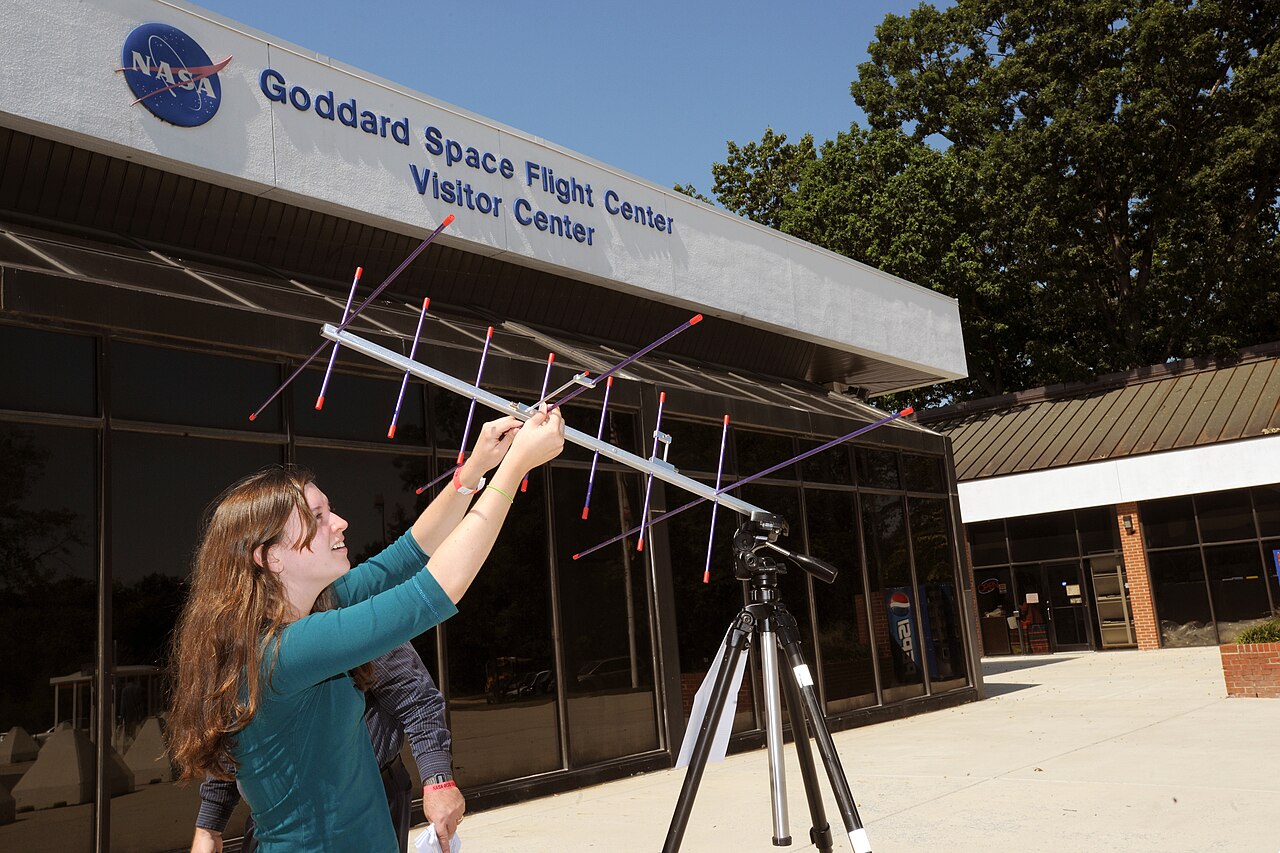
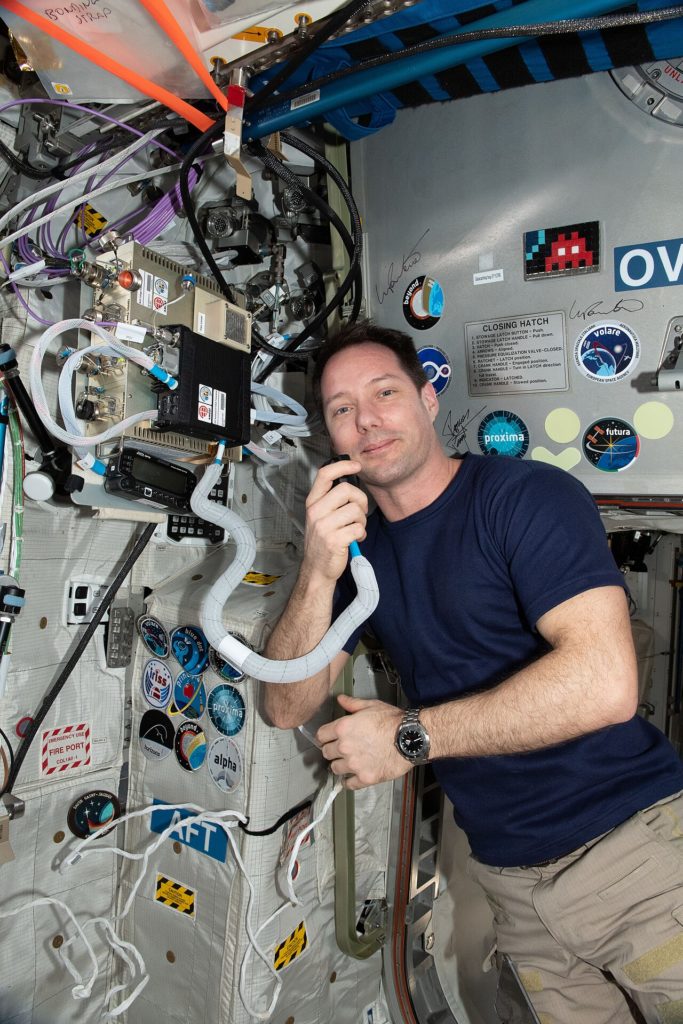
For 25 years, ARISS has enabled pupils to talk live with astronauts on the ISS. (Photo: NASA Goddard, CC BY 2.0)
🛰️ ARISS: 25 years of radio in space
ARISS (Amateur Radio on the International Space Station) is an international volunteer organisation, founded in 1996, which operates amateur radio stations aboard the ISS. Its flagship mission: enabling pupils all over the world to talk live, by radio, with astronauts in orbit. Since the first school contact in December 2000, more than 100 crew members have spoken with more than 250,000 participants on the ground.
Amateur radio in space goes back even further: in 1983, aboard the Space Shuttle Columbia, Owen Garriott (W5LFL) became the first radio amateur to operate from space, as part of the SAREX experiment. A tradition of experimentation that has never faltered.
⚠️ The ISS has a use-by date: the space station is due to be deorbited around 2030. ARISS therefore has to prepare for life after the ISS, in both government and commercial spaceflight. The Moon is the next logical step.
📡 AREx: amateur radio heads for deep space
At Hamvention 2026 (the largest amateur radio gathering in the world, in Xenia, Ohio), ARISS and AMSAT officially announced the creation of AREx: Amateur Radio Exploration. The goal is clear: to develop and operate amateur radio systems for deep space, first to the Moon, then to Mars.
AREx is not an isolated project but a genuine international consortium bringing together teams in the United States (University of Southern California, Dayton), the United Kingdom (Goonhilly station), Germany and Poland, with the support of the AMSAT societies (AMSAT-NA, AMSAT-UK, AMSAT-DL) and the Canadian Space Agency (CSA).
“Many ideas are still at the conceptual stage. But they show everything that modern amateur radio technology now makes possible.”
According to ARISS, Hamvention 2026
🎥 CAVIAR: voice, data, images and video from the Moon
The technical heart of AREx has a tasty name: CAVIAR, for Communications, Audio, Video, Imaging using Amateur Radio. A fairly advanced hardware prototype already exists. The idea: to give young people active involvement in lunar exploration, with the chance to communicate with astronauts during their activities and to capture images and video, just as is done today from the ISS.
🗣️ Voice and data
Long-distance voice and digital links between the Moon and a network of ground stations.
🖼️ Images and video
Transmission of images and video streams, to experience lunar exploration up close.
📶 SHF bands
Links planned on 5 GHz and 10 GHz, supported by a network of ground stations.
🎓 Education
In the spirit of ARISS: inspiring young people to take an interest in science, technology and radio.
🌙 A technical challenge: talking to the Moon
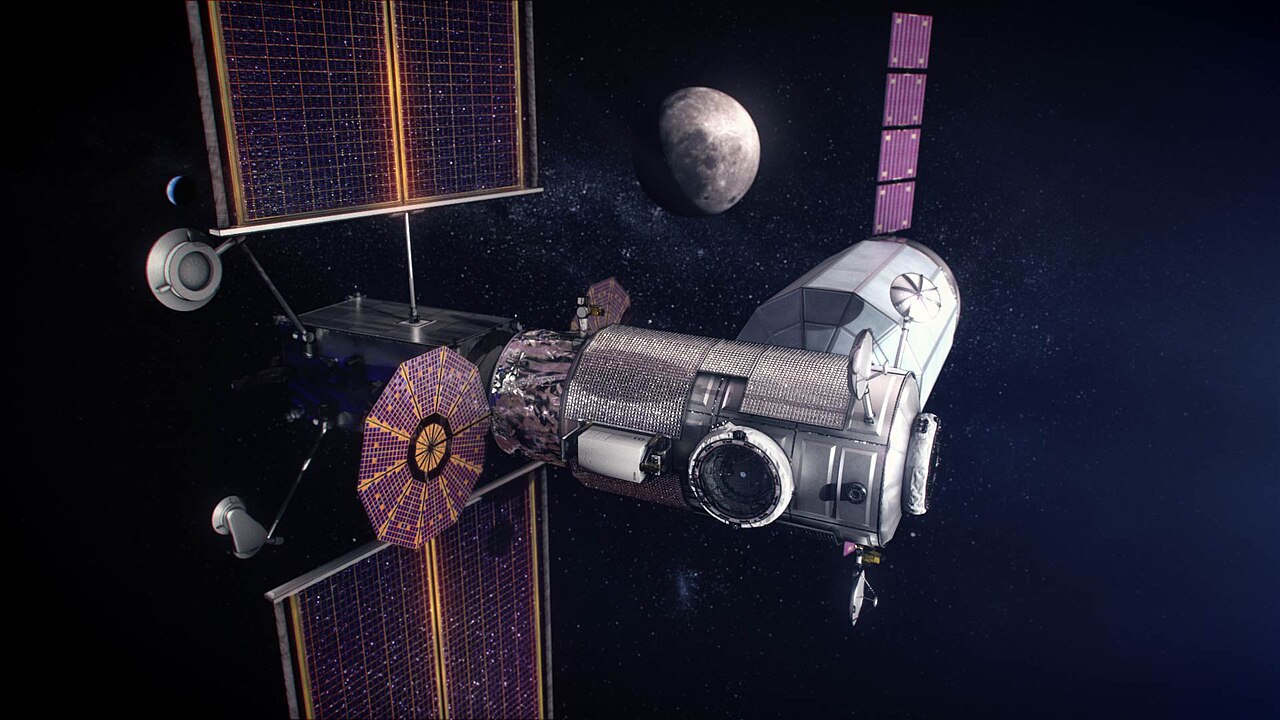
Artist's impression of the Lunar Gateway, the future small station in lunar orbit from NASA and its partners. (Image: NASA, public domain)
AMSAT and ARISS are working in particular on an amateur radio system for the Lunar Gateway, the small station that NASA and its partners will place in orbit around the Moon. The challenge is considerable: compared with a link to low Earth orbit (like the ISS), you have to cope with around 60 dB of additional signal loss, since the Moon is roughly a thousand times further away. Initial link budget studies nevertheless show that the project is realistic with current technology.
💡 60 dB is huge: it represents attenuation by a factor of one million. To compensate, you need high-gain antennas, very sensitive receivers and robust digital modes. That is exactly the favourite playground of radio amateurs, who are used to pulling tiny signals out of the noise.
🚀 Artemis II: three radio amateurs around the Moon
The link between amateur radio and lunar exploration is already very real. The crew of Artemis II, which in April 2026 made the first crewed flight of the Orion spacecraft around the Moon, included three licensed radio amateurs among its four members:

The Artemis II crew. Three of its four members are radio amateurs. (Photo: NASA / Josh Valcarcel, public domain)
| Astronaut | Role | Callsign |
|---|---|---|
| Reid Wiseman | Commander | KF5LKT |
| Victor Glover | Pilot | KI5BKC |
| Jeremy Hansen (CSA) | Mission specialist | KF5LKU |
| Christina Koch | Mission specialist | (not licensed) |
No amateur radio equipment was carried on this test flight, but two of these astronauts already appear in the ARISS log for school contacts made from the ISS. Plenty to fuel exciting prospects for future missions.
🎬 Artemis II on video (NASA)
To set the scene, here is NASA's official presentation of the Artemis II mission, the flight that took humans around the Moon for the first time since Apollo.
📅 Amateur radio in space: some milestones
🇨🇭 And from Switzerland? Talking to the Moon is something we already do
Rest assured: radio amateurs did not wait for Artemis to aim for the Moon. At HB9V and all over Switzerland, enthusiasts practise EME (Earth-Moon-Earth), or “moonbounce”: they bounce their VHF, UHF or microwave signals off the surface of the Moon to communicate from one continent to another. It is one of the most demanding and most rewarding disciplines in the hobby.
Likewise, contacting the ISS or decoding amateur satellites is within reach of a modest station. The AREx and CAVIAR projects open up the prospect of going one step further: no longer bouncing off the Moon, but setting up an amateur radio station there. A wonderful source of inspiration for young people preparing for their HB3 or HB9 licence.
✅ A remarkable laboratory: as the history of ARISS reminds us, amateur radio remains a unique test bed for space communication technologies. Antennas, digital modes, low power: what amateurs experiment with today inspires the systems of tomorrow.
🚀 Follow the AREx adventure
ARISS and AMSAT document the progress of amateur radio beyond Earth orbit. A project to keep a close eye on.
Discover ARISS →🤝 Our partners

Phonicom.ch, amateur radio specialist in Switzerland
Phonicom is an amateur radio dealer in Switzerland: Yaesu and Anytone radios, Diamond antennas, tuners, power supplies, cables and connectors. Everything you need to equip and complete your station, on VHF/UHF as well as HF. Personal advice and delivery within Switzerland.
Visit phonicom.ch →📚 Also on HB9V
- 🛰️ A radio amateur decodes the signal from the Tianwen-2 probe: amateur radio listening to deep space
- 📊 Radio Propagation Conditions: Complete Guide: understanding how radio waves travel
- 📡 Guglielmo Marconi, the father of wireless radio: the origins of long-distance communication
- 🗺️ Swiss Amateur Radio Band Plan: the VHF, UHF and SHF bands used for space communication
📖 Sources: Original article by John DK9JC (dk9jc.de). ARISS International, AMSAT, ARRL, Amateur Radio Newsline, NASA (Artemis programme). Images: NASA / NASA Goddard (public domain and CC BY 2.0), Wikimedia Commons. Video: NASA (YouTube).