What is PSK Reporter?
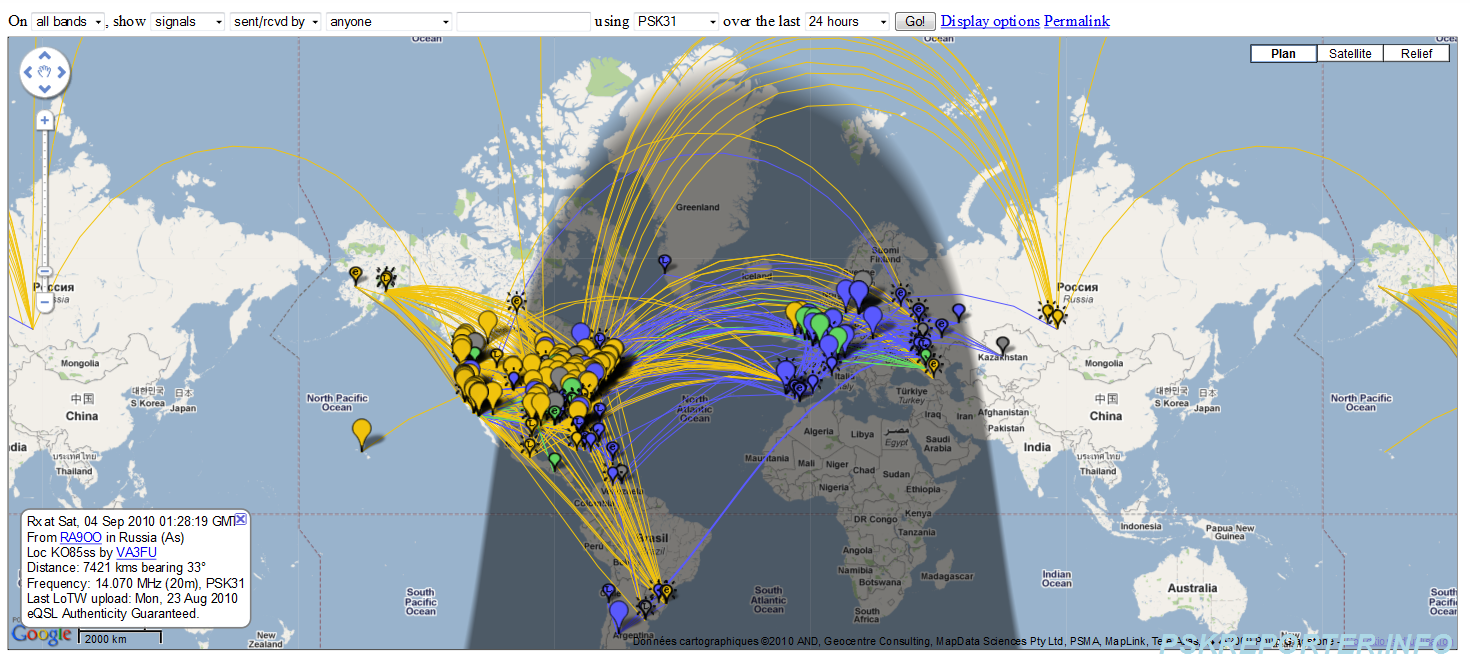
PSK Reporter is a collaborative amateur radio propagation monitoring system that makes use of the signals operators all over the world transmit anyway. Unlike other beacon systems, it takes up no extra bandwidth: it simply analyses existing CQ calls and maps where they are received.
The tool is available free of charge from any web browser through an interactive map interface based on Google Maps. This innovative approach gives an instant, global picture of propagation conditions on all HF bands.
Go to PSK ReporterHow it works
The system relies on a worldwide network of listening stations (monitors) that automatically decode amateur radio signals and send this information over the Internet to the PSK Reporter servers. The data is then aggregated and displayed in real time on the interactive map.
🌍 Worldwide coverage
Hundreds of listening stations spread across every continent keep a constant watch on the HF bands.
⚡ Real time
Reception reports are sent instantly and displayed with a delay of just a few seconds.
📊 Detailed analysis
View your station's full history: who heard you, when, and on which band.
Advantages over traditional beacons
Conventional beacon systems need dedicated transmitters that permanently occupy specific frequencies. PSK Reporter, on the other hand, cleverly uses existing amateur radio traffic, providing much denser and more varied coverage without consuming any extra resources. Every OM calling CQ unknowingly becomes a valuable source of information on propagation conditions.
Joining the PSK Reporter network
Equipment needed
The minimum set-up to take part in the network is very affordable. All you need is a properly installed HF antenna, a receiver or transceiver connected to your computer, compatible decoding software and a stable Internet connection. No specialist equipment is required: your usual station is perfectly adequate.
Installation and configuration
On Windows with Ham Radio Deluxe
Good news for Ham Radio Deluxe users: PSK Reporter is already built into the software, more precisely into the Digital Master 780 (DM780) module. If you are using version 5.24.38 or later, the tool is already there and you just need to enable it.
- Launch the
DM780module from Ham Radio Deluxe - Click
Program Optionsin the main menu - Go to the
PSK Reportertab - Tick both options:
Enable updatesandLog updates - Confirm and close the configuration window
As soon as you transmit or receive signals in a digital mode, your reports are sent to PSK Reporter automatically. There is nothing else to do: the system runs in the background, completely seamlessly.
Download Ham Radio DeluxeOn Linux with Fldigi
Linux users can use Fldigi, an excellent free and open-source program that has had PSK Reporter built in since version 3.1. Fldigi supports a very wide range of digital modes and offers a polished, efficient interface.
Once Fldigi is installed, PSK Reporter is configured from the preferences menu, in the section dedicated to online reporting. As with the Windows version, you simply enable automatic report sending and enter your callsign.
Download FldigiOn macOS with WSJT-X
Mac users have several excellent options for joining the PSK Reporter network. The most popular program is WSJT-X, developed by Joe Taylor K1JT, which runs natively on macOS and integrates PSK Reporter seamlessly.
WSJT-X supports a wide range of weak-signal digital modes, including FT8, FT4, JT65, JT9, Q65, MSK144 and WSPR. Installation is simple: download the DMG file from SourceForge and follow the instructions in the included ReadMe file. A few Terminal commands are needed to complete the installation properly.
- Launch WSJT-X and open Preferences (Cmd+,)
- In the
Generaltab, enter your callsign and your Maidenhead grid (preferably 6 characters) - In the
Reportingtab, tick theEnable PSK Reporter Spottingbox - Confirm and close the preferences
WSJT-X automatically sends PSK Reporter the standard messages containing a callsign and a grid locator. The system works perfectly on Intel Macs as well as on the newer Macs with Apple Silicon chips (M1, M2, M3).
Download WSJT-X for MaciOS apps (iPhone and iPad)
Although PSK Reporter is primarily a web service available from any mobile browser, several iOS apps use PSK Reporter data to offer advanced features to radio amateurs on the move.
HamAlert
Companion app to the hamalert.org website that sends push notifications when a station you are looking for shows up on PSK Reporter, the Reverse Beacon Network, SOTAwatch or the DX cluster. Essential if you never want to miss a DX opportunity.
WSPR Watch
A free app that can fetch data from PSK Reporter as well as WSPRnet. Particularly handy for monitoring propagation in real time from your iPhone or iPad.
SDR Control Mobile
A comprehensive app for controlling Icom transceivers from an iPhone. It includes an FT8/FT4 tool that automatically sends reports to PSK Reporter every five minutes.
Android apps
Android users can also make use of PSK Reporter through several specialised apps. Although there are fewer than on iOS, these apps offer useful features for mobile amateur radio operation.
HamAlert
The Android version of the popular app, offering the same notification features for PSK Reporter, the Reverse Beacon Network, POTA, SOTAwatch and DX clusters. Advanced filtering by DXCC, callsign, band, mode and more.
DroidPSK
A BPSK31 and BPSK63 decoding app for Android. It decodes PSK signals through the built-in microphone of your smartphone or tablet. Ideal for portable operation.
Ham Solar
A propagation forecasting app that uses data from several sources, including PSK Reporter, to give comprehensive information on current and forecast HF conditions.
Configuration with ROS Mode
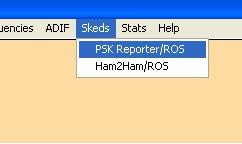
The ROS mode (named after its creator, José Alberto Nieto Ros, EA5HVK), which is particularly effective in difficult conditions, also has native PSK Reporter integration. This feature is configured from the Skeds menu of the ROS software.
Advanced features
Active frequency analysis
PSK Reporter offers a particularly useful tool: a real-time list of the most active frequencies, calculated according to your geographical location and local time. This feature lets you quickly identify where amateur radio activity is concentrated at any given moment.
View the active frequenciesStatistics and rankings
PSK Reporter's statistics section is a goldmine of fascinating information for DX and propagation enthusiasts. In particular, you will find a ranking of rare DXCC entities recently active, so you can quickly spot hard-to-work countries that are currently on the air.
Go to the statistics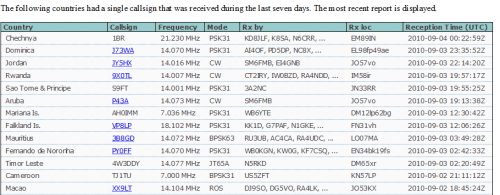
Network of monitor stations
The ranking of the most active listening stations shows the scale of the network: the best-performing monitors decode several tens of thousands of signals a day. These stations, equipped with efficient antennas and high-performance receivers, form the backbone of the system.
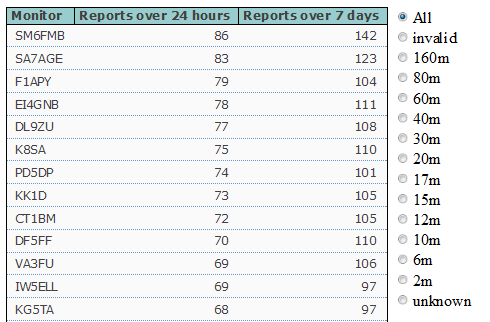
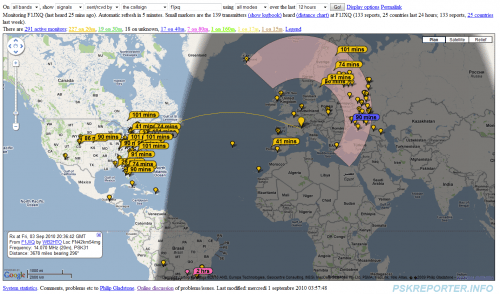
The network has between 200 and 400 active listening stations depending on the day of the week, with peaks of activity at weekends and during major contests. This coverage means reports come in from every continent. On average, the system detects activity from more than 100 different DXCC entities every week.
Using PSK Reporter to get more out of your QSOs
Beyond simply observing propagation conditions, PSK Reporter becomes a genuine strategic tool for improving your DX performance. By checking the map regularly before starting a session, you can see straight away which bands are open and in which directions.
Analysing your own station
By checking your personal statistics on PSK Reporter regularly, you get valuable information on how effective your installation is. The coverage map clearly shows in which directions your signal gets out well, and at what times. This data helps you optimise your antennas and identify the best time slots for each continent.
Integration with other tools
PSK Reporter can be used alongside other propagation monitoring systems such as the WSPR network (Weak Signal Propagation Reporter) or the traditional NCDXF beacons. As each system has its own strengths, using them together gives a very complete picture of ionospheric conditions.
Many modern logging programs now offer direct links to PSK Reporter, so you can instantly check whether a callsign you want to work is currently active and audible from your area. This feature is particularly useful during DXpeditions.
Privacy and security
Conclusion
PSK Reporter has established itself as an essential tool for all radio amateurs interested in propagation and DX. Its ease of use, combined with the wealth of information it provides, makes it an ideal companion for experienced operators and newcomers to the world of digital modes alike.
The system's success relies entirely on the voluntary participation of thousands of radio amateurs around the world. By setting up your station to contribute to the network, you join this collaborative community and in return benefit from an invaluable tool for optimising your QSOs and understanding the mysteries of ionospheric propagation.
Whether you are in Switzerland, the UK or anywhere else in the world, PSK Reporter gives you a unique window on worldwide amateur radio activity. Don't wait any longer to try it: head to pskreporter.info and discover in real time how far amateur radio signals are reaching across the planet.