📡 When a radio amateur picks up a Chinese probe speeding towards an asteroid
Tens of millions of kilometres from Earth, the Chinese probe Tianwen-2 is speeding towards a curious near-Earth asteroid. Meanwhile, from the Netherlands, Spanish radio amateur Daniel Estévez (EA4GPZ) has managed to pick up and decode its telemetry in the X band, using a historic radio telescope dating from 1956. A striking demonstration that observing interplanetary probes is no longer the preserve of the big space agencies. Here is a technical deep dive into this feat, and into the extraordinary mission it lets us follow.
In May 2026, a piece of news did the rounds among radio amateurs and space enthusiasts: an independent operator had just decoded the telemetry of a Chinese probe on its way to an asteroid. The story, picked up in particular by Hackaday and Korben.info, is worth a closer look, because behind the anecdote lies a real lesson in radio, signal processing and space exploration. This article takes the original news and adds a great deal to it: who this radio amateur is, how the decoding actually works, what Tianwen-2 is, and why this kind of feat is now within reach of a community of enthusiasts.
📻 Daniel Estévez (EA4GPZ), deep-space radio amateur
Behind this feat is Daniel Estévez, callsign EA4GPZ, a Spanish radio amateur and mathematician by training who specialises in digital signal processing (DSP) applied to satellites and space probes. On his blog destevez.net, long followed by the community, he documents in public and in detail the decoding of signals from space: low Earth orbit satellites, lunar missions, interplanetary probes.
Daniel Estévez is also the creator of gr-satellites, an open-source library for GNU Radio that has become a worldwide reference for decoding telemetry from hundreds of amateur and scientific satellites. When he tackles a new signal, he publishes its exact parameters, the GNU Radio flowgraphs, the Jupyter analysis notebooks and the pitfalls he came across. For the community, it is a goldmine of learning.
💡 What is a probe's “telemetry”? It is the stream of technical data that a spacecraft continuously sends back to Earth: battery status, temperature, attitude, instrument status… Decoding telemetry is not “hacking” the probe: you are simply receiving and interpreting a radio signal that travels freely through space. It is passive listening, perfectly legal, just like listening to a weather station or a satellite.
🔭 Dwingeloo: a 1956 radio telescope brought back to life by enthusiasts
To pick up a signal this distant and this weak, the ear of an ordinary receiver is not enough: you need a large antenna. Daniel Estévez relied on the Dwingeloo radio telescope in the Netherlands, a dish 25 metres in diameter with a remarkable history.

The Dwingeloo radio telescope (25 m), in the Netherlands. Built in 1956, it is now operated by the amateur association CAMRAS. (Wikimedia Commons, CC BY-SA)
Built between 1954 and 1956, Dwingeloo was, when completed, the largest radio telescope in the world, a title it held for only a year before being overtaken in 1957 by the Lovell telescope (76 m) at Jodrell Bank. After decades of loyal service to Dutch radio astronomy, the instrument was decommissioned. It could have ended up as scrap.
This is where CAMRAS (the “C.A. Muller Radio Astronomy Station” foundation), set up in 2007, comes in. This association of radio amateurs and amateur astronomers fully restored the dish, with the agreement of its owner, ASTRON. Today, enthusiasts use it for a variety of projects: EME communication (Earth-Moon-Earth, or “moonbounce”), radio astronomy and, above all, tracking distant space missions.
✅ A telescope that talks to the edge of the solar system: in 2024, the Dwingeloo team managed to detect the very weak carrier signal of Voyager 1, the most distant human-made object, more than 24 billion kilometres from Earth. Picking up Tianwen-2, “only” a few tens of millions of kilometres away, is part of the same effort by amateurs to listen to deep space.
📡 Anatomy of the signal: everything the radio reveals
This is where it gets exciting for anyone interested in radio and DSP. Daniel Estévez published the exact parameters of the Tianwen-2 signal. Here is what the probe transmits, taken apart.
The X-band carrier
The probe transmits in the X band, the frequency range (around 8 to 8.5 GHz) used by almost every interplanetary spacecraft to communicate with Earth. Tianwen-2's carrier sits at around 8428.19 MHz, practically the same frequency as its big sister Tianwen-1 (the Chinese Mars mission). At the time of the recordings, the probe was about 1.1 degrees from the asteroid in the sky, and its signal was arriving with an excellent signal-to-noise ratio.
💡 Why the X band? Frequencies around 8 GHz offer a good compromise: high enough to allow directional antennas and high data rates, while being little affected by the atmosphere and ionosphere. It is the band of choice for NASA's Deep Space Network and most interplanetary probes. At these frequencies the wavelength is only ~3.5 cm, which calls for very precise antenna pointing.
Modulation and frame structure
The signal uses PCM/PSK/PM modulation, the same as Tianwen-1. In practice, the digital data modulate a subcarrier, which is itself phase-modulated onto the main carrier. The measured parameters are as follows:
| Parameter | Measured value |
|---|---|
| Carrier frequency | ≈ 8428.19 MHz (X band) |
| Modulation | PCM / PSK / PM |
| Subcarrier frequency | 65,536 Hz (2¹⁶) |
| Telemetry rate | 16,384 baud (2¹⁴) |
| Frame length | 892 bytes (exact duration: 1 second) |
| Frame format | CCSDS AOS (no frame error control field) |
| Spacecraft identifier (SCID) | 0xED |
| Active virtual channel | VC 1 only |
| Insert zone | 8 bytes (purpose unknown) |
| Data packets | CCSDS packets of 100 to 200 bytes, several dozen APIDs |
Note that the subcarrier (65,536 Hz) and the rate (16,384 baud) are powers of 2, an elegant engineering choice that is common in space systems. The frame structure follows the CCSDS standard (Consultative Committee for Space Data Systems), the “Esperanto” of space telecommunications used by almost every agency in the world, which makes the signals fairly decipherable for anyone who knows the rules.
🧩 The coding: Reed-Solomon, and why Tianwen-2 does better than Tianwen-1
When a signal travels hundreds of millions of kilometres, it reaches Earth buried in noise. To recover the data without errors, error-correcting codes are used. Tianwen-2 uses concatenated coding: the data are first protected by a Reed-Solomon code (outer code), then by a convolutional code (inner code), a classic architecture recommended by the CCSDS.
The juicy detail lies in the comparison with Tianwen-1. The Mars probe also used Reed-Solomon, but with a somewhat “improvised” trick: to fit the data into a 256-byte frame, 3 bytes had to be omitted from each codeword, a shortening that made decoding harder for amateurs.
Tianwen-2, on the other hand, uses a better-designed frame length: four interleaved Reed-Solomon codewords fit exactly, without having to truncate anything. A detail that may seem trivial, but one that makes life much easier for any radio amateur who wants to follow the mission from home.
🛰️ Tianwen-1 (Mars)
Reed-Solomon with a 256-byte frame, obtained by omitting 3 bytes per codeword. A workaround that called for extra contortions when decoding.
☄️ Tianwen-2 (asteroid)
Concatenated coding with 4 interleaved Reed-Solomon codewords that fit perfectly into the frame. Cleaner, more standard, easier to decode.
💡 What is a Reed-Solomon code? Invented in 1960, it is the same type of error-correcting code that protects your CDs, DVDs, QR codes and hard drives against scratches and errors. It makes it possible to rebuild lost or corrupted bytes from redundancy bytes. In space, where retransmitting costs minutes of delay and precious energy, correcting errors “on the fly” is vital.
🛠️ The tools: GNU Radio and open source at the heart of the decoding
To turn a raw radio signal into readable data, Daniel Estévez relies mainly on GNU Radio, an open-source digital signal processing framework. The idea is to assemble, graphically (or in Python), a chain of blocks (demodulator, filter, clock recovery, Viterbi decoder, deinterleaver, Reed-Solomon decoder) that processes the recording sample by sample.

GNU Radio Companion: you build the signal processing chain by connecting blocks. It is the go-to tool for decoding space telemetry. (Wikimedia Commons)
Frame analysis and “reverse engineering” of the data structure are then done in Jupyter notebooks, which make it possible to visualise, sort and interpret the CCSDS packets. Everything is documented publicly, step by step, on the author's blog, so that anyone can reproduce or continue the work.
⚠️ A small disappointment, a big promise: at the time of this capture, the probe was in its cruise phase (coast phase), with minimal activity, so the data content was nothing spectacular. But that is not the point: mastering the decoding chain now means being ready to capture the crucial moments ahead, such as the insertion manoeuvre around the asteroid and, later, the return of the sample capsule to Earth.
🚀 Tianwen-2: an unprecedented double mission
So what is this probe doing, and why is it worth listening to? Tianwen-2 (天问二号, “Questions to Heaven No. 2”) is the second mission of China's planetary exploration programme, after Tianwen-1, which put an orbiter and a rover on Mars in 2021. Launched on 28 May 2025 by a Long March 3B rocket from the Xichang centre, it has a double objective of rare ambition.

A Long March 3B rocket lifting off. This launcher sent Tianwen-2 on its way on 28 May 2025. (Wikimedia Commons)
Phase 1: collecting a sample from Kamo'oalewa (2025-2027)
After about 13 months in transit, the probe is due to reach the near-Earth asteroid 469219 Kamo'oalewa in June-July 2026. The aim: to collect a sample from its surface and bring it back to Earth, a feat that only Japan (Hayabusa and Hayabusa2) and the United States (OSIRIS-REx) had achieved until now. According to the mission plan, the probe would leave the asteroid in April 2027 and release its sample capsule to Earth around November 2027.

Diagram of the Tianwen-2 mission sequence: sample collection on Kamo'oalewa, return of the sample, then on to the comet 311P/PANSTARRS. (Wikimedia Commons / CNSA)
Phase 2: exploring a main-belt comet (until 2035)
And this is where the mission breaks new ground: once the capsule has been released, the mothership does not stop. It sets off on a journey of several years to the comet 311P/PANSTARRS, a rare object known as a “main-belt comet” (located between Mars and Jupiter). Arrival is planned for around 2035, for a year of close observation with its instruments. In all, the mission spans almost ten years.
✅ Why it is so exciting: a single probe, two radically different celestial bodies (a near-Earth asteroid AND an active comet), with a sample return. The very design of the mission is a world first. China's space programme is thus delivering one leading-edge technology demonstration after another.
☄️ Kamo'oalewa: a fragment of the Moon escorting the Earth?
The target of phase 1 is anything but ordinary. 469219 Kamo'oalewa (formerly designated 2016 HO3) was discovered on 27 April 2016 by the Pan-STARRS 1 survey telescope on the summit of Haleakalā, Hawaii. Its name, taken from a Hawaiian creation chant, roughly means “the oscillating celestial fragment”, a poetic reference to its motion across the sky.

Discovery image of Kamo'oalewa (2016 HO3) by Pan-STARRS, 27 April 2016. The asteroid is the dot in the centre, tracked as it moves. (Wikimedia Commons)
A “quasi-satellite” of the Earth
Kamo'oalewa is what is known as a quasi-satellite of the Earth: it does not orbit our planet (it is not gravitationally bound to it), but it orbits the Sun on a path so close to ours that it seems to “accompany” us. It oscillates above and below the plane of the Earth's orbit, staying between 38 and 100 times the Earth-Moon distance away. It is one of the most stable and closest known quasi-satellites of the Earth.
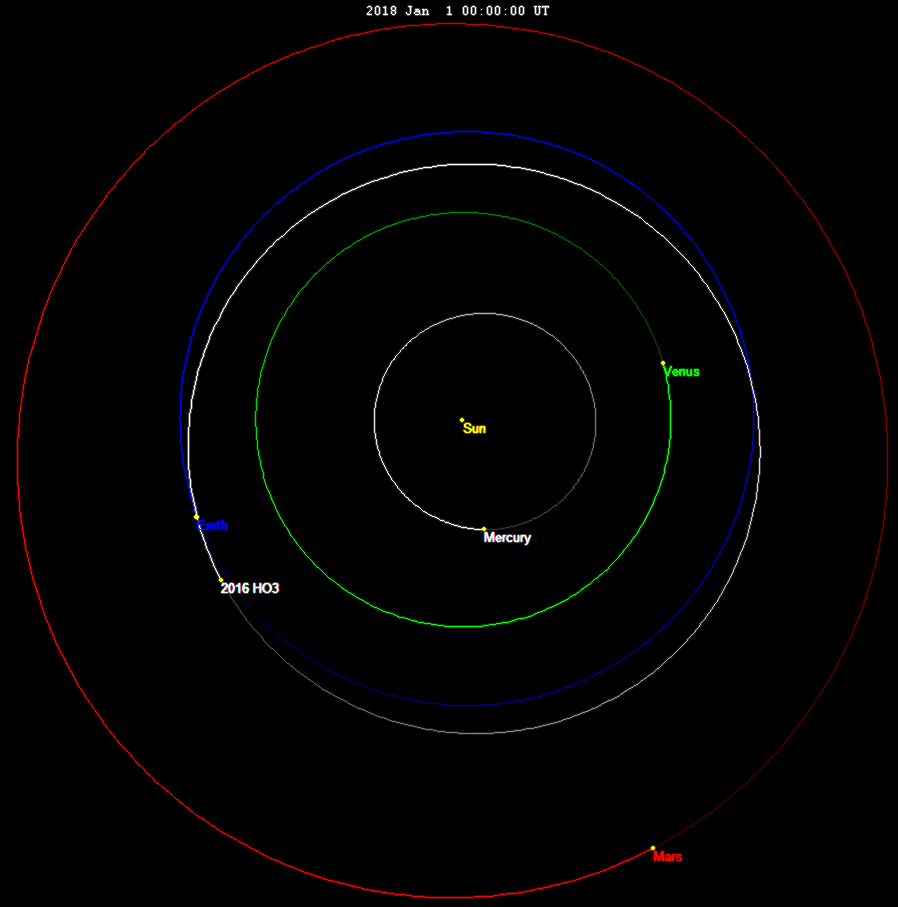
The orbit of Kamo'oalewa (in yellow) compared with that of the Earth (in blue): a quasi-satellite escorting our planet around the Sun. (Wikimedia Commons)
A piece of the Moon?
The object is small: between 40 and 100 metres across, elongated, and it spins very fast, completing one rotation about every 28 minutes. But its most intriguing feature lies elsewhere: its light spectrum resembles that of lunar material weathered by space. Several studies suggest it could be a fragment ejected from the Moon by an impact 1 to 10 million years ago, one possible candidate being the lunar crater Giordano Bruno (22 km across).
“If Kamo'oalewa really is a piece of the Moon, then Tianwen-2 would bring back to Earth an entirely new kind of lunar sample, torn off by an impact and frozen in time for millions of years. Enough to rewrite a page in the history of our natural satellite.”
🤖 How do you collect a sample from a tiny asteroid?
On a body a few tens of metres across, gravity is almost nil: “landing” in the usual sense is impossible. Tianwen-2 therefore carries two sampling techniques, one of which has never been tried on an asteroid:
👆 “Touch-and-go”
The probe brushes the surface for a few seconds, using a gas jet or a mechanism to kick dust up into a collector, then immediately climbs away. This is the method proven by Hayabusa2 (JAXA) and OSIRIS-REx (NASA).
⚓ “Anchor-and-attach”
A world first on an asteroid: the probe anchors itself to the surface using four robotic arms fitted with drills, then takes its sample directly. Ideal for a fast-spinning body like Kamo'oalewa.

The “anchor-and-attach” method: Tianwen-2 anchors itself with its drilling arms to collect the sample. A technique never before used on an asteroid. (Wikimedia Commons / CNSA)
To carry out its delicate manoeuvres and its long journey, Tianwen-2 has a hybrid propulsion system (solar-electric ion propulsion for the long cruises and chemical thrusters for quick manoeuvres) and an array of scientific instruments: multispectral cameras, infrared and thermal emission spectrometers, radar, magnetometer, particle analysers, navigation sensors… enough to study both its targets from every angle.

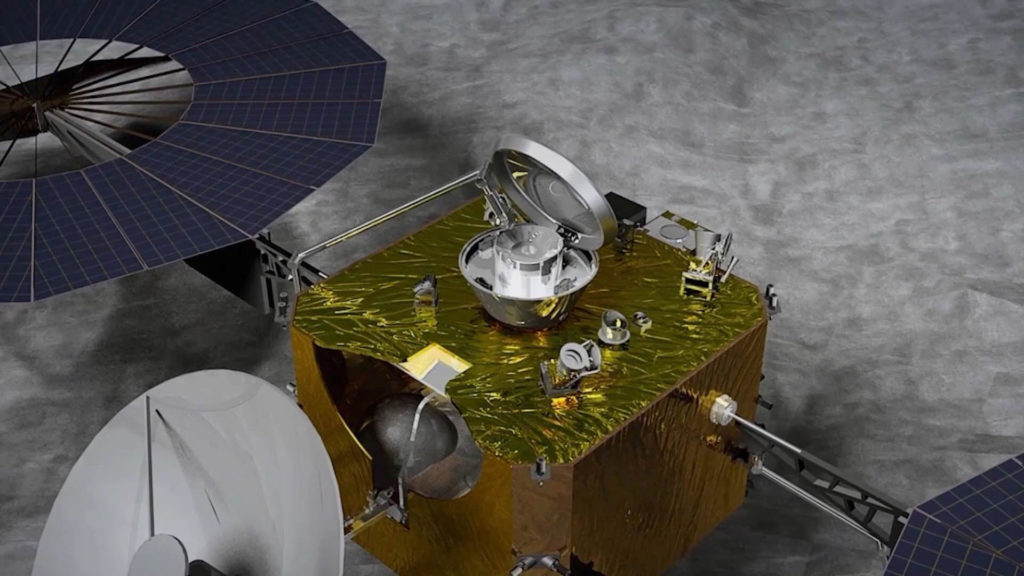
Diagram of the Tianwen-2 probe and its main components. (Wikimedia Commons / CNSA)
💡 An inspiring precedent: in December 2020, the Japanese probe Hayabusa2 successfully brought fragments of the asteroid Ryugu back to Earth. Its capsule passed through the atmosphere and landed in Australia. This is exactly the kind of feat Tianwen-2 aims to repeat, with a comet to explore afterwards as a bonus.

Artist's impression of Hayabusa2 releasing its capsule of Ryugu samples towards Earth (2020). Tianwen-2 will follow a similar scenario in 2027. (Wikimedia Commons)
🎯 Picking up an interplanetary probe: within reach of amateurs?
Daniel Estévez's feat illustrates a deep-seated trend: observing deep space is no longer the preserve of government agencies. But let us be honest: decoding a probe tens of millions of kilometres away is still a serious challenge that calls for equipment and skills.
The main issue is sensitivity. The signal arrives extremely weak: you need a large antenna and a very low-noise receiver. The Canadian radio amateur Scott Tilley (VE7TIL), famous for tracking down “lost” satellites, also tried to pick up Tianwen-2, but with a dish of only 1.5 m the signal-to-noise ratio was too low to lock on and decode the data. Hence the value of a large shared antenna like Dwingeloo, or of antenna networks.
What you need, in theory
Antenna : large dish (several metres), precisely pointed
Front-end : X-band feed (~8.4 GHz) + very low-noise LNA (LNB)
SDR : wideband sampling receiver (USRP, etc.)
Software : GNU Radio + gr-satellites (PCM/PSK/PM demod)
Decoding : Viterbi + deinterleaving + Reed-Solomon (CCSDS)
Analysis : Jupyter notebooks to interpret the frames
For the vast majority of radio amateurs, picking up an interplanetary probe will remain out of reach as individuals. On the other hand, collaborative projects (associations such as CAMRAS, amateur antenna networks, sharing of I/Q recordings) make these experiments accessible to anyone who wants to get involved. Above all, the DSP skills used here (demodulation, clock recovery, error-correcting codes, CCSDS) are exactly the ones you develop by decoding far more modest satellites in low Earth orbit, or by working EME.
✅ Where to start, more modestly? Before aiming for a Mars probe, you can learn space decoding with an RTL-SDR dongle costing CHF 30 and a simple antenna: receiving weather images from NOAA/Meteor satellites on VHF, cubesat telemetry, signals from the ISS… GNU Radio and gr-satellites work from this level up. It is the best school for one day aiming higher and further.
📅 Tianwen-2 mission timeline
📻 What this feat says about modern amateur radio
Beyond the technical anecdote, this story is emblematic of what amateur radio has become in the 21st century:
🌍 Citizen science
Amateurs make a real contribution: tracking missions, detecting anomalies, archiving signals. When it comes to DSP, the line between amateur and professional is blurring.
💻 Software-defined radio
SDR and open source (GNU Radio, gr-satellites) have democratised processing that was once the preserve of laboratories. Knowledge circulates freely and is documented online.
🤝 Sharing and transparency
Daniel Estévez publishes everything: parameters, code, methods, failures. That is the very essence of the ham spirit, carried over into the digital and space age.
🔭 Heritage put back to use
A 1956 radio telescope saved from the scrapheap by an association of amateurs is now used to listen to Voyager 1 and Tianwen-2. The past serving the exploration of tomorrow.
🇨🇭 And in Switzerland? Space reception among HB9 operators
Swiss radio amateurs are not to be outdone when it comes to space reception and signal processing. Several members of HB9 clubs practise EME (bouncing signals off the Moon) on the VHF/UHF and SHF bands, receive amateur satellites and listen to the most distant probes, Voyager included, with increasingly capable stations. The skills used to decode Tianwen-2 (SDR, GNU Radio, high-gain antennas) are precisely the ones we cultivate in our clubs.
Switzerland, with its tradition of precision watchmaking and engineering, also has very active amateurs on the microwave bands (23 cm, 13 cm and above), where the X band is not so far away. USKA and regional clubs such as HB9V encourage these experiments, which push back the limits of what an amateur can achieve. Decoding an interplanetary probe from your garden may not be on the cards for everyone just yet, but listening to satellites is well within your reach.
📊 Fact sheet
| Information | Detail |
|---|---|
| The feat | Decoding of Tianwen-2's telemetry (May 2026) |
| Radio amateur | Daniel Estévez, callsign EA4GPZ (Spain) |
| Antenna used | Dwingeloo radio telescope (25 m, Netherlands), operated by CAMRAS |
| Frequency | ≈ 8428.19 MHz (X band) |
| Modulation | PCM/PSK/PM, 65,536 Hz subcarrier, 16,384 baud |
| Coding | Concatenated (Reed-Solomon + convolutional), 4 interleaved RS codewords, 892-byte frame |
| Tools | GNU Radio, gr-satellites, Jupyter notebooks (open source) |
| The probe | Tianwen-2 (China), launched on 28 May 2025 (Long March 3B) |
| Target 1 | Asteroid 469219 Kamo'oalewa (2016 HO3), 40-100 m, quasi-satellite of the Earth |
| Target 2 | Comet 311P/PANSTARRS (main belt), arrival ~2035 |
| Sample return | Around November 2027 |
❓ Frequently asked questions
Is it legal to listen to a space probe?
Yes. It is passive listening to a radio signal that travels freely through space. You are only receiving and interpreting: you transmit nothing to the probe and you do not “hack” it. It is as legal as listening to a weather satellite.
Why such a large antenna (25 m)?
Because the signal arrives extremely weak after tens of millions of kilometres. The gain and collecting area of a large dish are essential to pull the data out of the noise. A 1.5 m dish was not enough for other amateurs.
What did we learn from the decoding?
As the probe was in its cruise phase, the telemetry contained nothing spectacular. The value lies in the method: validating the decoding chain so as to be ready for the critical phases (insertion, sampling, return).
How do I get started with satellite reception?
With an RTL-SDR dongle (~CHF 30), a suitable antenna and free software (SDR#, GNU Radio, gr-satellites), you can receive NOAA weather images, cubesat telemetry and signals from the ISS. It is the ideal way in.
🤝 Our partners

Phonicom.ch, amateur radio specialist in Switzerland
Keen to get into satellite reception and signal decoding? Phonicom has the equipment to get started and progress: SDR receivers, VHF/UHF and microwave antennas, low-noise preamplifiers (LNA), quality cables and connectors, as well as Yaesu, Icom and Anytone transceivers. Personal advice and delivery within Switzerland.
Visit phonicom.ch →📚 Also on HB9V
- 📊 Radio Propagation Conditions: Complete Guide: ionosphere, solar indices, real-time tools and DX guide from HB9
- 📡 Swiss Amateur Radio Band Plan: all HF, VHF, UHF and microwave frequencies with visual diagrams
- 📻 FT8 Digital Mode: Complete Guide: decoding weak signals with WSJT-X and PSK Reporter
- 🏆 Guglielmo Marconi, the Father of Radio: from the first transatlantic transmission to modern radio
📖 Sources: Daniel Estévez (destevez.net, “Decoding Tianwen-2”, May 2026), Hackaday, Korben.info, Wikipedia (Tianwen-2, 469219 Kamo'oalewa, Dwingeloo Radio Observatory), CAMRAS (camras.nl), The Planetary Society, NASA/JPL. Images: Wikimedia Commons (public domain / CC BY-SA) and CNSA mission diagrams.