The UN agency that shares out the frequencies of the whole world is headquartered in Geneva. And since 2023, it has been led by a radio amateur.
On 12 November 2026, the Member States of the International Telecommunication Union (ITU) re-elected Doreen Bogdan-Martin as Secretary-General for a second four-year term. An American who has held an amateur radio licence since 2015 under the callsign KD2JTX, she won 164 votes out of 173 at the Plenipotentiary Conference in Doha, Qatar. The ARRL, the national association for amateur radio in the United States, welcomed the news on 18 November. For us in Switzerland, the story has a special flavour, because it all happens in Geneva.
An almost unanimous re-election
The ITU is the United Nations agency for digital technologies. It has 194 Member States and more than a thousand companies, universities and organisations. Every four years, its Plenipotentiary Conference sets the strategy and budget, then elects the management team. The 2026 edition, called PP-26, is being held from 9 to 27 November at the Doha convention centre.
Doreen Bogdan-Martin has more than thirty years of experience in international telecommunications policy. Before taking the helm of the organisation in January 2023, she headed the Telecommunication Development Bureau from 2018 to 2022, which helps countries lacking infrastructure. She is the first woman to have held both of these elected posts.
Her programme for this second term can be summed up in a few words. It is about connecting the roughly two billion people who still have no Internet access, making sure that artificial intelligence benefits everyone, and strengthening network resilience and cybersecurity.
“I am deeply honoured by the trust the Member States have placed in me for a second term. The digital world has changed enormously in four years, and it will change even faster in the future. Our job is to make sure this change serves everyone, especially the two billion people who are not connected.”
Doreen Bogdan-Martin, KD2JTX, in the ITU press release of 12 November 2026
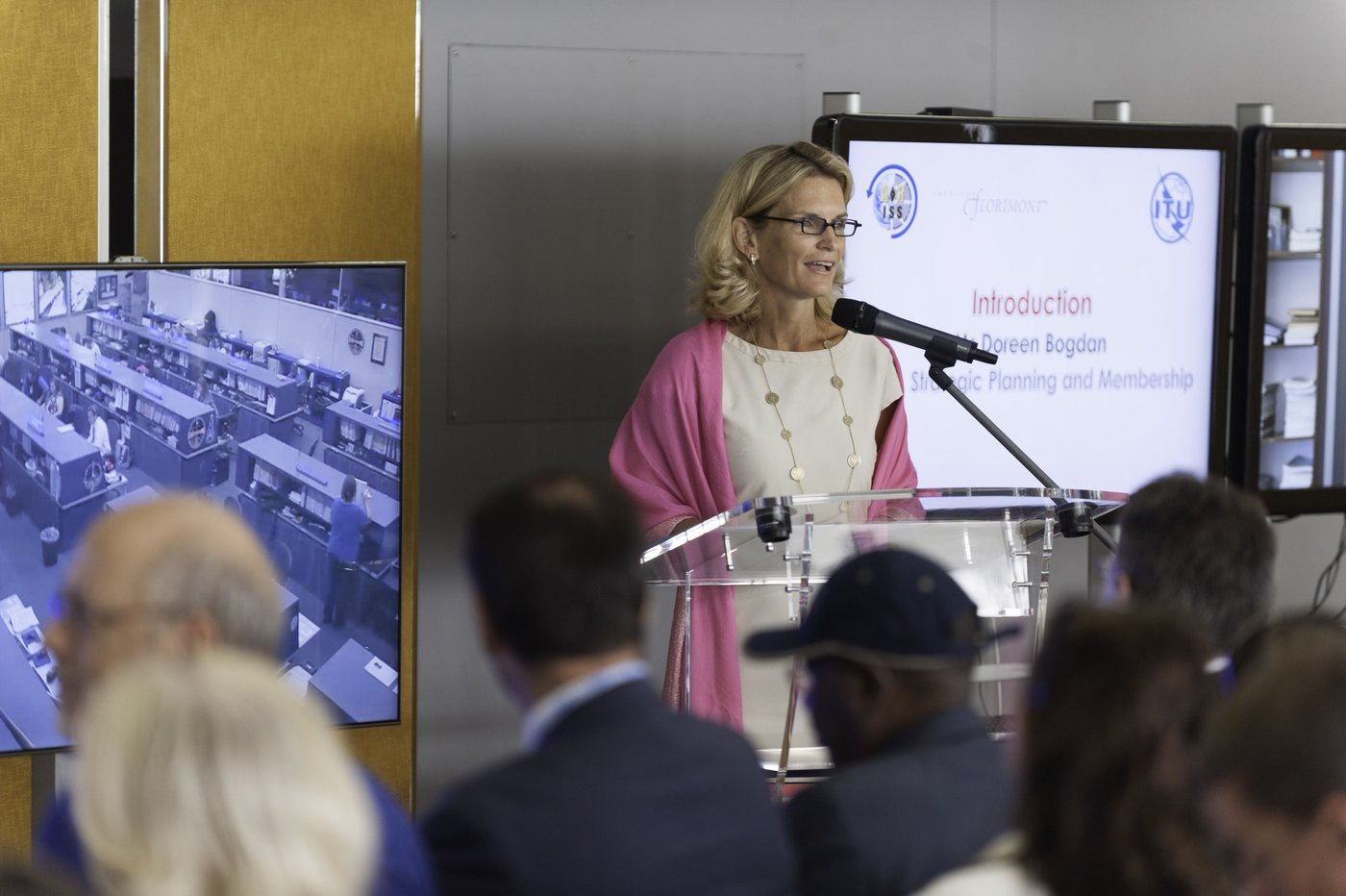
Geneva, 17 September 2014. Doreen Bogdan-Martin, then Chief of Strategic Planning at the ITU, opens the event ahead of the radio contact between Geneva pupils and the International Space Station, from the 4U1ITU amateur radio station. Photo: ITU/F. Scotti, Wikimedia Commons, CC BY 2.0.
Why the ITU matters so much to radio amateurs
It is easy to forget when you switch on your rig, but every band we use exists because an international treaty provides for it. That treaty is the ITU Radio Regulations. It divides the spectrum between services (aviation, maritime, satellites, broadcasting, mobile telephony and, among them, the amateur service). It is revised at the World Radiocommunication Conferences, which generally meet every three or four years.
The amateur service is defined there as a service of self-training, intercommunication and technical investigation, carried out by authorised persons interested in radio technique solely with a personal aim and without pecuniary interest. The basic rules of our hobby (the obligation to transmit your callsign, the ban on encrypting messages, emergency communications) are set out in its Article 25. Even callsign prefixes come from there. If Swiss stations begin with HB, it is because the ITU allocated that series to Switzerland.
A decision taken in Geneva can therefore have tangible effects in your shack. Radio amateurs experienced this with the 23 centimetre band. At the 2023 conference, they had to defend their place against the Galileo satellite navigation system, which uses the same frequencies. The band remained open to the amateur service, but with recommendations to avoid interfering with navigation.
That is the whole point of the reaction from Rick Roderick, K5UR, President of the ARRL.
“Doreen Bogdan-Martin's re-election is good news for radio amateurs around the world. The ITU plays a decisive role in the international management of spectrum, and its decisions can weigh for a long time on the frequencies available to us. Having a radio amateur at the head of the ITU brings a valuable perspective on what our service contributes to society.”
Rick Roderick, K5UR, President of the ARRL (excerpt)
The ARRL also points out what, in its view, the amateur service brings beyond the hobby. It introduces people to radio technology, encourages innovation and trains people who can provide emergency communications when networks go down.
Three radio amateurs at the head of the ITU
Doreen Bogdan-Martin is not the first radio amateur to lead the organisation. She is the third licence holder to hold this post.
- Gerald C. Gross, W3GG (SK). An American engineer, he led the ITU on an interim basis from 1958 to 1959, then as Secretary-General from 1960 to 1965. It was under his authority, and that of UN Secretary-General U Thant, that the ITU amateur radio station came into being on 5 May 1962.
- Hamadoun Touré, HB9EHT. A Malian engineer, Secretary-General from 2007 to 2014. His callsign is Swiss, which is hardly surprising for someone who lived and worked in Geneva for years.
- Doreen Bogdan-Martin, KD2JTX. Licensed since 2015, ARRL member, Secretary-General since 2023 and now until the end of 2030.
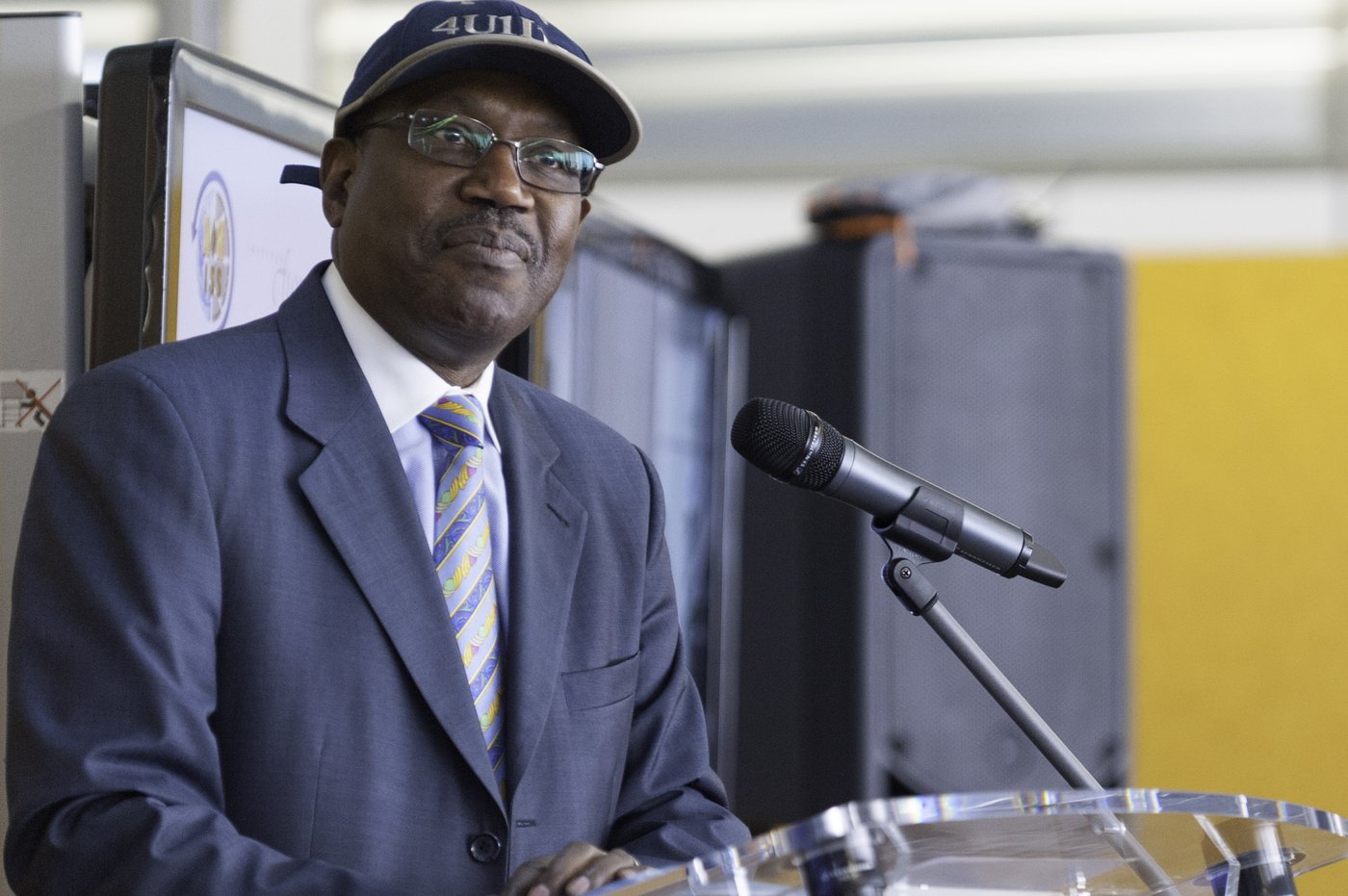
Hamadoun Touré, HB9EHT, ITU Secretary-General, wearing the 4U1ITU cap on the day of the ARISS contact in September 2014. Photo: ITU/F. Scotti, Wikimedia Commons, CC BY 2.0.
4U1ITU, the amateur radio station at the Geneva headquarters
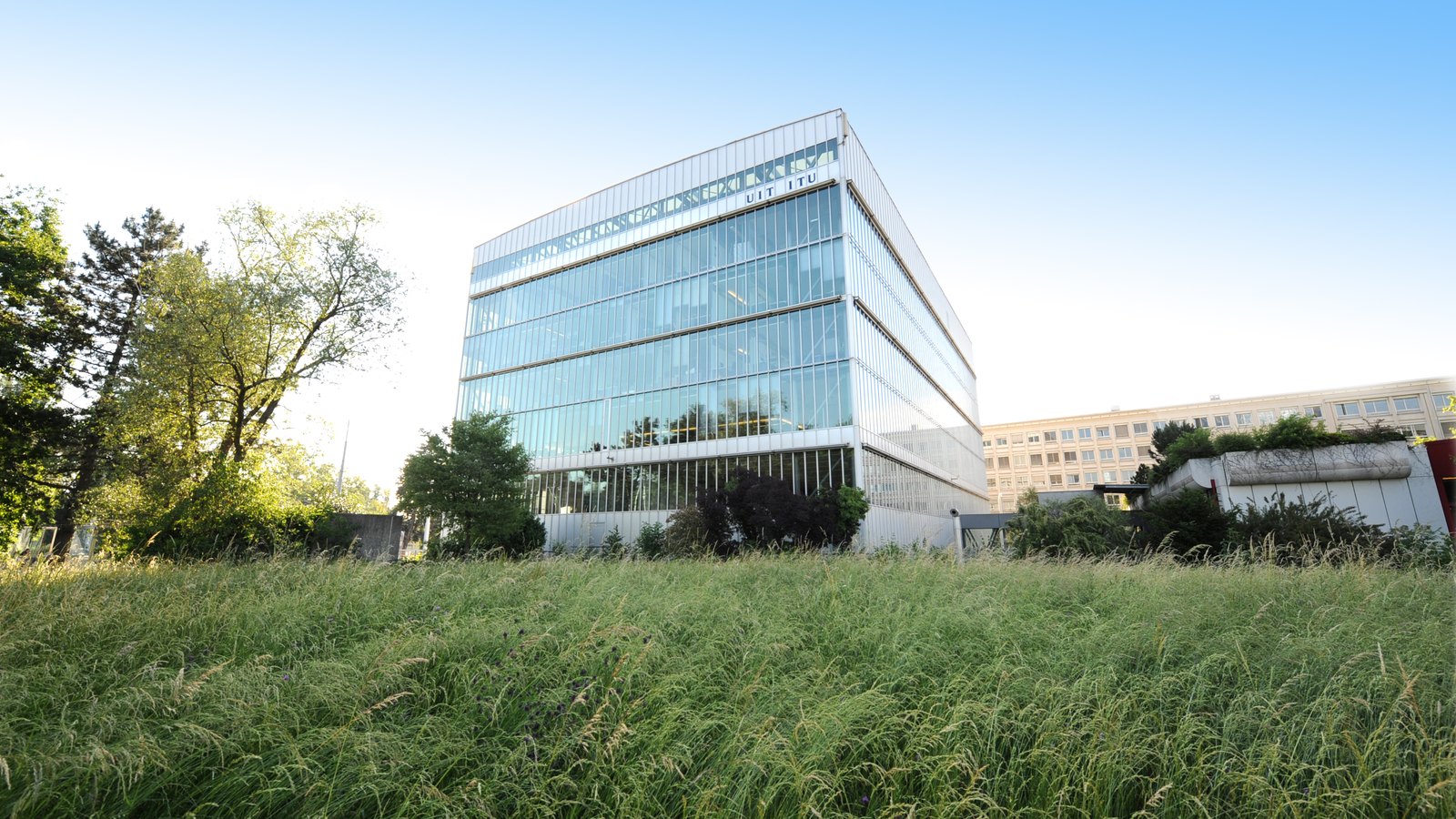
The ITU has not always been based in Geneva. Founded in Paris in 1865 as the International Telegraph Union, it first set up its office in Bern, before moving to Geneva in 1948. Today it occupies several buildings near the Place des Nations, including the tower and the glass Montbrillant building.
Since 1962, an amateur radio station has operated within its walls. It is run by the International Amateur Radio Club, the club for staff and delegates, under the callsign 4U1ITU. The 4U prefix is reserved for the United Nations. For the DXCC programme, the ITU headquarters counts as an entity in its own right, separate from the Switzerland that surrounds it. A QSO with 4U1ITU is therefore highly sought after by DX hunters. The station operates thanks to privileges granted by the Swiss Confederation and by the ITU. It has also worked EME (Earth-Moon-Earth links, bouncing signals off the Moon), notably on 23 centimetres, and the club even mounted an expedition to Mont Blanc in 2011 under the callsign TM74UIT.
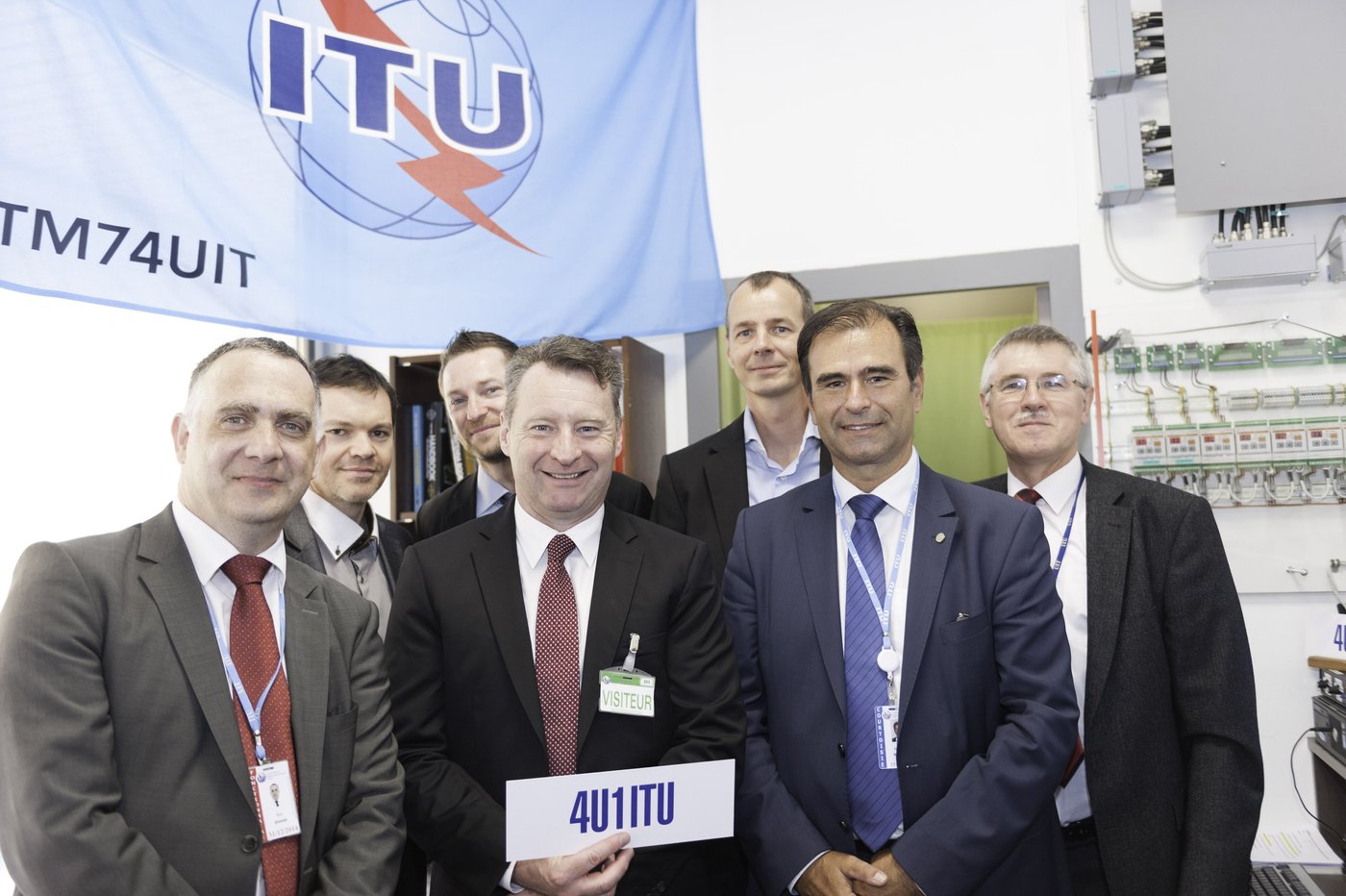
The 4U1ITU team poses with the callsign plaque, beneath an ITU flag marked TM74UIT, the callsign of the club's 2011 expedition to Mont Blanc. Photo: ITU/F. Scotti, Wikimedia Commons, CC BY 2.0.
The day Geneva pupils talked to the ISS
On 17 September 2014, 4U1ITU hosted an ARISS (Amateur Radio on the International Space Station) contact with pupils from the Institut Florimont, a Geneva school. The principle is the same as for ARISS contacts organised in schools all over the world. During the few minutes when the space station is above the horizon, the pupils put their questions to an astronaut by radio, on VHF. Hamadoun Touré, HB9EHT, was there, as was Doreen Bogdan-Martin, who spoke before the link. She would obtain her amateur radio licence the following year.
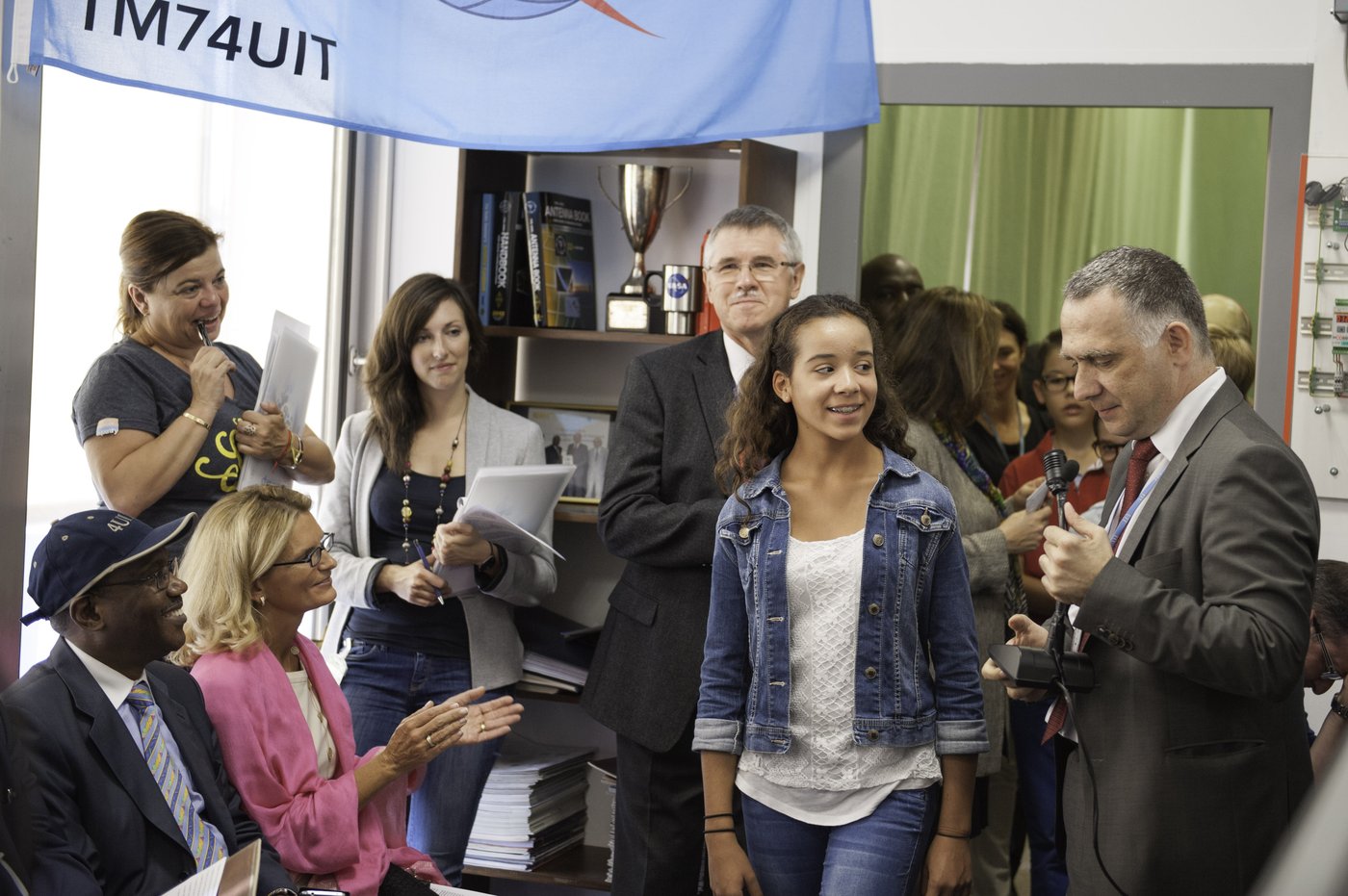
A pupil from the Institut Florimont at the 4U1ITU station, on the day of the contact with the International Space Station. Photo: ITU/F. Scotti, Wikimedia Commons, CC BY 2.0.
The IARU, our voice at the ITU
Radio amateurs are not mere spectators of these decisions. The International Amateur Radio Union (IARU), which brings together national societies such as the USKA in Switzerland and the ARRL in the United States, takes part in the work of the ITU and defends our bands there. Its president, Timothy Ellam, VE6SH, was in Doha.
“The IARU is delighted by Ms Bogdan-Martin's re-election for a second term. I was able to congratulate her personally and thank her for her support for the amateur services. We also discussed several projects the IARU will be working on with the ITU next year. Ms Bogdan-Martin has truly been a game changer at the ITU.”
Timothy Ellam, VE6SH, President of the IARU
In an interview filmed by the ITU during the conference, Timothy Ellam highlights the role of radio amateurs in emergency communications, the value of the hobby for acquiring real technical skills, and how open our activity is to new technologies, including artificial intelligence (video in English).
The other elections in Doha are also of interest to radio amateurs. Frenchman Eric Fournier was elected Director of the Radiocommunication Bureau, which keeps the Radio Regulations up to date and prepares the world conferences. He won 94 votes out of 169. Adel Darwish, from Bahrain, becomes Deputy Secretary-General.
And in Switzerland? OFCOM transposes ITU and CEPT rules into Swiss law. The bands and power levels authorised here follow directly from them. To find out what you may do on each band, see our Swiss amateur radio band plan and, if in doubt, the official OFCOM texts, which are authoritative.
A word from HB9V
We find this news heartening, and not only out of pride at seeing a fellow amateur at the top of a major international organisation. A Secretary-General who has sat the exam herself and learnt to put out a call knows what a frequency band means to a radio amateur. She also knows what our service can offer when everything else fails.
What we like even more is that this story is unfolding a few dozen kilometres from home. The rules governing every one of our QSOs are discussed in Geneva, and an amateur radio station has been operating at the very heart of the ITU for more than sixty years. Next time you hear 4U1ITU on the air, take the time to answer. You will be working a fully fledged DXCC entity, right on your doorstep.
If you feel like taking the plunge, remember that Doreen Bogdan-Martin got her licence in 2015, in mid-career, long after starting out in telecommunications. It is never too late to get your callsign.
Find out more
The official ITU press release and the website of the headquarters amateur radio station.
Also on HB9V
- Swiss amateur radio band plan: all HF, VHF and UHF frequencies
- Amateur radio on the Moon: ARISS prepares for the future
- HB9HIN, Hans's Swiss station: from CB to the QO-100 satellite
- Swiss HAM / Crypto / Électronique: two days of radio in Derendingen
Sources: ARRL, “Doreen Bogdan-Martin, KD2JTX, Re-elected ITU Secretary-General”, 18 November 2026; ITU, press releases “ITU Member States re-elect Doreen Bogdan-Martin as Secretary-General” (12 November 2026) and “ITU elects senior leaders in radiocommunication, standardization and development” (13 November 2026); International Amateur Radio Club, “IARC History” (4U1ITU); ITU, interview with Timothy Ellam, VE6SH, YouTube. Accessed on 24 November 2026.
Photos: all by the ITU (ITU Pictures), published on Wikimedia Commons under a CC BY 2.0 licence: Doreen Bogdan-Martin in 2014, Hamadoun Touré, 4U1ITU team and pupil at the station, ITU/F. Scotti; header image, Montbrillant building at the ITU headquarters in Geneva, ITU/V. Martin, cropped.
© 2026 HB9V · Club Radioamateur Suisse All rights reserved. No reproduction, even partial, without the written permission of HB9V. Photos and trademarks mentioned remain the property of their respective owners.