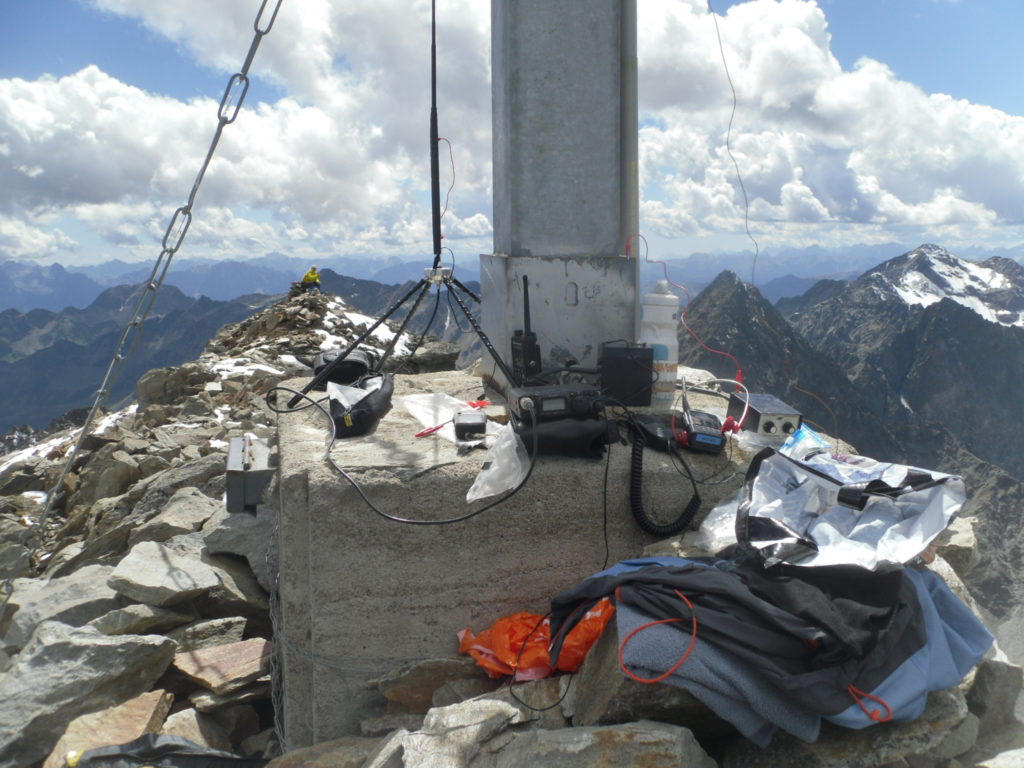
⛰️📡 SOTA Activations in Switzerland: Summits On The Air
The SOTA programme brings together two wonderful passions: mountain hiking and amateur radio. With its majestic Alps, the green Jura and the panoramic Prealps, Switzerland offers SOTA activators an unrivalled playground. Climb a summit, set up your portable station, make at least 4 radio contacts and earn points. From the Alpine ridges, the whole world is within reach of your antenna, sometimes with just 5 watts and a length of wire!
📚 What is SOTA?
Summits On The Air (SOTA) is an international amateur radio programme created in 2002 by John Linford (G3WGV) and Richard Eastwood (G3CWI) in the United Kingdom. The idea is simple but brilliant: encourage radio amateurs to climb summits and make radio contacts from them, while enjoying nature and some physical exercise.
SOTA works with two complementary roles:
⛰️ The Activator
The radio amateur who climbs a listed summit, sets up a portable station within the activation zone (25 m vertically below the highest point) and makes at least 4 QSOs. They earn the points awarded to the summit according to its height. No motorised vehicle for the final part of the ascent: it is all down to leg power!
📡 The Chaser
The radio amateur who contacts an activator on a summit from a fixed, mobile or portable station. Chasers also earn points, but only once per summit and per band/mode. Chasers are essential: without them, no activation would be possible!
The points system is based on altitude. In Switzerland, with many summits above 2000 m, activators regularly earn the maximum of 10 points. A winter bonus of +3 points applies from 1 December to 15 March.
SOTA points by altitude
| Points | Minimum altitude | Examples in Switzerland |
|---|---|---|
| 1 point | < 1000 m | Hills of the Swiss Plateau, Jorat (Tour de Gourze) |
| 2 points | ≥ 1000 m | Jura, lower Prealps (Dent de Vaulion, Mont Pèlerin) |
| 4 points | ≥ 1500 m | Chasseron, Mont Tendre, La Dôle |
| 6 points | ≥ 1750 m | Prealps (Dent de Corjon, Cape au Moine) |
| 8 points | ≥ 2000 m | Moléson, Vanil Noir, Rochers-de-Naye |
| 10 points | ≥ 2500 m | Wildhorn, Diablerets, Dufourspitze |
💡 Did you know? Thanks to the winter bonus of +3 points (1 December to 15 March), a 10-point summit is then worth 13 points! The bonus rewards the extra effort and the tough conditions of the mountains in winter.
🇨🇭 SOTA in Switzerland (HB9)
Switzerland is a true paradise for SOTA activations. With the Alps covering about 60% of its territory, the Jura in the north-west and the Prealps offering summits that are accessible all year round, the country has one of the highest densities of SOTA summits in Europe.
The programme is organised into two associations: HB (Switzerland) with more than 1300 summits, and HB0 (Liechtenstein) with 9 summits. References follow the format HB/XX-nnn (XX = region code, nnn = summit number).
| Code | Canton | Summits | Characteristics |
|---|---|---|---|
| HB/BE | Bern | ~140 | Bernese Oberland, Emmental. Eiger, Jungfrau, Mönch |
| HB/GR | Graubünden | ~360 | Largest canton. Piz Bernina (4049 m) |
| HB/VS | Valais | ~250 | Highest summits. Dufourspitze (4634 m), Matterhorn |
| HB/VD | Vaud | ~45 | Vaud Jura, Prealps. Chasseron, Mont Tendre |
| HB/FR | Fribourg | ~40 | Prealps. Moléson, Vanil Noir, Berra |
| HB/LU | Lucerne | ~20 | Pilatus, Rigi, Napf |
| HB/SG | St. Gallen | ~50 | Alpstein. Säntis (2502 m) |
| HB/TI | Ticino | ~150 | Ticino Alps. Monte Generoso |
This geographical diversity means SOTA can be enjoyed all year round: Jura summits are accessible even in winter, while spectacular high Alpine summits await in summer. Some activators combine mountaineering and radio to reach 4000 m peaks!
Why SOTA in Switzerland is unique
🏔️ Exercise and radio combined
SOTA turns hiking into a radio adventure. Every outing combines physical activity, discovering nature and the pleasure of making radio contacts. A great motivation to explore the Swiss mountains.
⛰️ Discover the Swiss mountains
With more than 1300 listed summits, SOTA takes you along trails you would never have explored otherwise. From the Jura to the Alps, every activation is a new discovery.
📡 No repeater needed
SOTA works in simplex (direct HF and VHF). From a summit, VHF FM with 5 watts covers 100-200 km. On HF, the whole world is within reach.
🌟 A 100% free programme
Registration, the database, SOTAwatch, logs and awards are completely free. All you need is a valid amateur radio licence (HB9 or HB3).
📡 Equipment for a SOTA activation
SOTA equipment needs to be light, compact and reliable. Every gram counts when you carry everything on your back. Here are the essential components for successful SOTA activations in Switzerland.
📻 Portable HF transceivers
HF allows long-distance contacts with very little power. The 40m, 30m and 20m bands are SOTA favourites.
- Yaesu FT-818ND: the classic. HF/VHF/UHF, 6W, rugged. The most widely used rig in SOTA worldwide
- Elecraft KX2: ultra-compact (400g), 10W, built-in tuner. The demanding SOTA operator’s dream
- Xiegu G90: good value for money, 20W, built-in tuner
- Xiegu X6100: HF+6m, touch screen, 10W. Modern and versatile
- Icom IC-705: HF/VHF/UHF, 10W, D-STAR, Bluetooth. The portable Swiss Army knife
📡 VHF/UHF handhelds and antennas
A simple 5W VHF handheld is enough to get started. From a summit, the range on 145.500 MHz is remarkable.
- Yaesu FT-65E / FT-60E: rugged, 5W FM, good sensitivity
- EFHW (End-Fed Half-Wave): HF wire antenna covering 40-10m, ~200g. Very popular in SOTA
- Linked dipole: multiband HF, ~300g, home construction recommended
- J-pole / Slim Jim VHF: omnidirectional gain on the 2m band, made from lightweight wire
- 6m telescopic fibreglass mast: ~500g, essential for wire antennas
Recommended equipment with weight and price
| Equipment | Weight | Price | Notes |
|---|---|---|---|
| Yaesu FT-818ND | 1.2 kg | ~CHF 400 | HF/VHF/UHF, 6W. The SOTA classic |
| Elecraft KX2 | 0.4 kg | ~CHF 1400 | HF 10W, ATU. Ultra-light |
| Xiegu X6100 | 0.7 kg | ~CHF 500 | HF/6m, 10W, touch screen |
| Icom IC-705 | 1.0 kg | ~CHF 1300 | HF/VHF/UHF, 10W, D-STAR |
| EFHW antenna 40-10m | 0.2 kg | ~CHF 80 | Wire + 49:1 transformer, covers 40m to 10m |
| Linked dipole | 0.3 kg | ~CHF 60 | Lightweight wire, banana connectors |
| 6m telescopic mast | 0.5 kg | ~CHF 50 | SOTAbeams Tactical or similar |
| 3Ah LiFePO4 battery | 0.35 kg | ~CHF 60 | 12.8V, 2-3 hours of operation |
| Short coax cable (3m) | 0.1 kg | ~CHF 15 | Lightweight RG-174, BNC connectors |
| Headphones + paper log | 0.1 kg | ~CHF 25 | A paper backup is essential in the mountains |
💡 A complete SOTA station on a small budget: with an FT-818ND (~CHF 400), a home-made EFHW (~CHF 30), a mast (~CHF 50) and a LiFePO4 battery (~CHF 60), you have a complete HF station for under CHF 550 and ~2.3 kg. On VHF, a 5W handheld (~CHF 100) with a home-made J-pole is all you need!
🗺️ Planning an activation
Good planning is the key to a successful activation. Check the SOTA database at sotadata.org.uk to identify summits, then use SOTAwatch3 (sotawatch.sota.org.uk) to post an alert. Check the weather forecast (MeteoSwiss) and plan your route with SwissTopo or SwitzerlandMobility.
The 8 steps to a successful activation
- Choose a summit: check the SOTA database. Start with easy summits (Jura, Prealps) before tackling the Alps. Check accessibility for the season.
- Register on sotadata.org.uk: create a free account. You will receive a unique activator ID and access to all the tools.
- Check your route and the weather: SwissTopo maps (1:25,000), forecast 48 hours ahead and on the morning of departure. Set off early to avoid thunderstorms.
- Post a SOTAwatch alert: publish it the day before or that morning: target summit, estimated time, planned frequencies/modes. The chasers will be ready.
- Climb to the summit on foot: the final part without a motorised vehicle. Public cable cars and funiculars are allowed.
- Set up within the activation zone: a zone 25 metres vertically below the highest point. Find a flat spot and deploy your antenna.
- Make at least 4 QSOs: call on the SOTA frequencies or self-spot via SMS/mobile app. Note every contact in your log.
- Log and submit: once home, enter your contacts on sotadata.org.uk. The points will be credited automatically.
⚠️ Mountain safety: always the priority!
- ⚠️ Check the weather before every outing and turn back if conditions deteriorate
- ⚠️ Tell someone your route and expected return time
- ⚠️ Take water and food, more than the bare minimum
- ⚠️ Set off early in the morning: in summer, thunderstorms are frequent from early afternoon
- ⚠️ Do not take risks for the sake of radio: a summit not activated is better than an accident
- ⚠️ Take with you: a first-aid kit, a survival blanket, a charged phone, the REGA app (1414)
📻 SOTA frequencies and modes
SOTA has no reserved frequencies, but the community uses conventional calling frequencies:
| Band | Frequency | Mode | Notes |
|---|---|---|---|
| 80m | 3.557 MHz | CW | Regional contacts, NVIS propagation |
| 80m | 3.690 MHz | SSB | Good conditions late in the day |
| 60m | 5.3545 MHz | CW/SSB | Excellent NVIS propagation |
| 40m | 7.032 MHz | CW | The most popular SOTA CW frequency in Europe |
| 40m | 7.090 MHz | SSB | European SOTA SSB frequency |
| 30m | 10.118 MHz | CW | CW band, very popular (little QRM) |
| 20m | 14.060 MHz | CW | Excellent SOTA DX band |
| 20m | 14.285 MHz | SSB | Intercontinental contacts possible |
| 17m | 18.095 MHz | CW | Good propagation at solar maximum |
| 2m | 145.500 MHz | FM | VHF calling frequency, range 100-200 km |
| 2m | 144.300 MHz | SSB | VHF DX, contacts >300 km possible |
| 70cm | 433.500 MHz | FM | UHF calling frequency |
CW: the king of SOTA
Telegraphy (CW / Morse) is the preferred mode in SOTA:
- Power efficiency: CW gets through where SSB fails, with ten times less power
- Minimal equipment: no microphone, just a paddle. Less weight
- Narrow bandwidth: 200 Hz versus 2400 Hz for SSB. Less QRM
- Speed: a SOTA QSO in CW takes 30-60 seconds versus 2-3 minutes in SSB
- Range: with 5W in CW, contacts over 3000+ km are common
💡 What about FT8? Generally not recommended for SOTA. It requires a laptop (weight, power consumption, fragility) and a synchronised clock, and the exchanges are standardised. Some operators use it from easily accessible summits.
💻 SOTAwatch and digital tools
The SOTA ecosystem has excellent free tools:
📡 SOTAwatch3
The heart of the community: sotawatch.sota.org.uk. Post alerts (beforehand) and spots (in real time). Chasers keep a constant eye on SOTAwatch.
📱 SOTA Goat (iOS)
A complete app: summit map, alerts, spots, offline database, logging, self-spotting. The reference app. Created by WW1X.
📱 SOTA Spotter (Android)
The Android equivalent of SOTA Goat. Real-time spots, alerts, self-spotting by SMS or data. A clear, functional interface.
📊 sotadata.org.uk
The official database: sotadata.org.uk. Log submission, statistics, rankings, history, references for every summit in the world.
💡 Self-spotting is allowed in SOTA! Use your phone (SMS or app) to spot yourself on SOTAwatch as soon as you are ready on the summit. It is the best way to attract chasers and quickly make your minimum 4 QSOs.
⛰️ Popular summits in French-speaking Switzerland
French-speaking Switzerland offers a wide variety of SOTA summits, from the ridges of the Jura to the high peaks of Valais. Here are the most popular ones in the cantons of Vaud, Valais, Geneva and Fribourg:
| SOTA ref. | Summit | Altitude | Points | Difficulty | Access |
|---|---|---|---|---|---|
| HB/VD-035 | Chasseron | 1607 m | 4 pts | Easy | From Sainte-Croix, 1h30. Restaurant at the summit |
| HB/VD-032 | Mont Tendre | 1679 m | 4 pts | Easy | Highest point of the Swiss Jura. From Le Pont, 2h |
| HB/VD-034 | La Dôle | 1677 m | 4 pts | Easy | From the ski resort, 45 min. View of Mont Blanc |
| HB/VD-036 | Le Suchet | 1588 m | 4 pts | Easy | From Baulmes, 1h30. SAC hut at the summit |
| HB/VD-023 | Rochers-de-Naye | 2042 m | 8 pts | Fair | Rack railway or a 4-hour walk |
| HB/FR-001 | Vanil Noir | 2389 m | 8 pts | Difficult | Highest summit in the canton of Fribourg. 4-5h |
| HB/FR-019 | Moléson | 2002 m | 8 pts | Easy | Funicular + cable car available |
| HB/FR-028 | La Berra | 1719 m | 4 pts | Easy | From the Col de la Berra, 1h. Accessible all year round |
| HB/VS-001 | Dufourspitze | 4634 m | 10 pts | Very difficult | The highest in Switzerland! Mountaineering, 2 days minimum |
| HB/VS-026 | Allalinhorn | 4027 m | 10 pts | Difficult | The “easy” 4000 m peak of Valais. Metro Alpin from Saas-Fee |
| HB/VS-175 | Bella Tola | 3025 m | 10 pts | Fair | Val d’Anniviers, 4h. Well-marked trail |
| F/JU-001 | Crêt de la Neige (France) | 1713 m | 4 pts | Fair | Neighbour of the Reculet, accessible from Geneva. View over Lake Geneva |
🏆 SOTA awards
The programme offers progressive awards:
- Mountain Goat: 1000 activator points. The SOTA operator’s Holy Grail!
- Shack Sloth: 1000 chaser points. The reward for dedicated chasers
- Mountain Explorer: activate summits in 5 different associations (countries)
- Summit-to-Summit (S2S): a contact between two activators on summits. Double points!
Many Swiss radio amateurs have reached Mountain Goat status thanks to the exceptional density of summits. Some have passed 5000 or even 10000 points!
🇨🇭 Swiss section: the HB9 SOTA community
The Swiss SOTA community is one of the most active in Europe. The USKA (Union Schweizerischer Kurzwellen-Amateure) actively supports SOTA:
🇨🇭 USKA and the SOTA group
The USKA has an active SOTA interest group that organises meetings, advice and special activations. The uska.ch website regularly publishes articles about SOTA activations in Switzerland.
📡 HB9SOTA: a special callsign
The callsign HB9SOTA is used for special events and group activation days. These special activations attract many chasers from all over the world.
👥 An active community
Dozens of HB9 activators are regularly out on Swiss summits. Signal and Telegram groups and the USKA forums make it easy to coordinate outings.
📚 Resources and getting started
Local USKA sections hold SOTA workshops for beginners: equipment, portable antennas, CW techniques, safety. The HB9V club organises group SOTA outings.
As Switzerland is multilingual, SOTA activations here take place in French, German, Italian and often English. The HB association manager coordinates the summit database and maintains the link with the international community.
💡 HB9 national SOTA day: every year, dozens of activators climb summits all over the country at the same time. It is the ideal opportunity to get started or to try Summit-to-Summit (S2S) contacts!
🤝 Our partners
Phonicom.ch: amateur radio specialist in Switzerland
Phonicom offers portable transceivers that are perfect for SOTA (Yaesu FT-818ND, FTX-1 FIELD), lightweight antennas, compact LiFePO4 batteries and all the accessories for your mountain activations. Personal advice and delivery within Switzerland.
Visit phonicom.ch →📖 Also on HB9V:
🔗 Yagi Antenna: The Complete Guide for Radio Amateurs: including portable designs for SOTA
🔗 OCF / Windom Dipole: Complete Guide 80-10m: build your portable HF antenna
🔗 The Complete Guide to the QTH Locator: find your position from the summit
🔗 PSK Reporter: Real-Time Propagation: check propagation before your activation