📡 Marconi's Beam Wireless Station at Dorchester
In 1927, Guglielmo Marconi opened one of the most ambitious radio stations of his time: the Dorchester Beam Wireless Station, in Dorset (England). Designed to send telegrams around the world by shortwave, the station operated for 52 years, through the Second World War, nationalisation and successive technological revolutions. Here is its fascinating story, told in pictures.
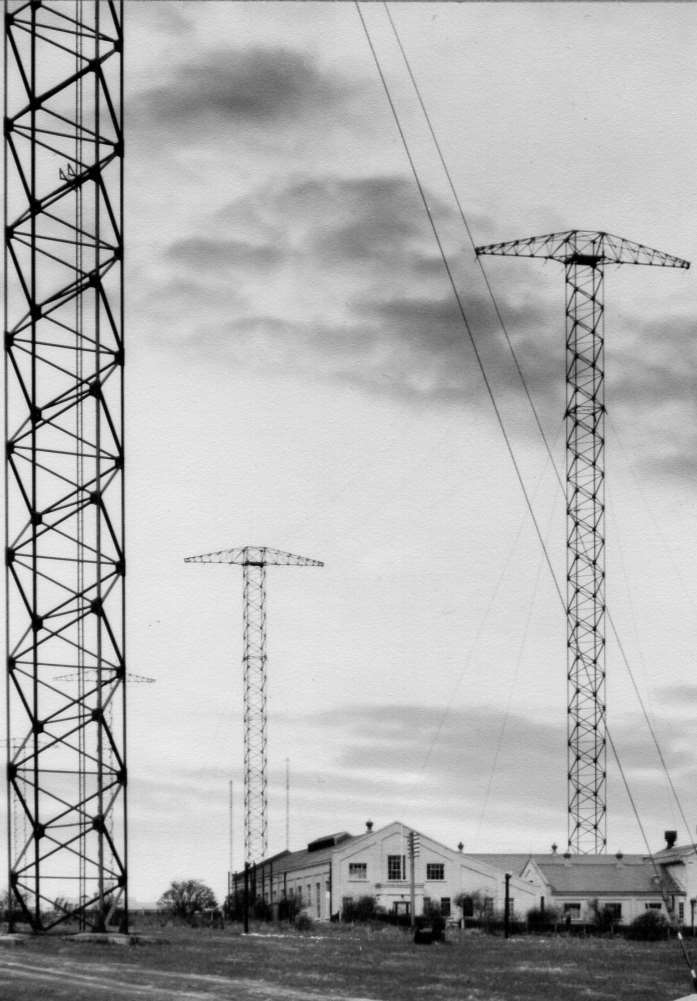
View of Dorchester radio station in 1930, with the T-shaped masts of the New York Beam antenna in the background.
📻 The background: the discovery of shortwave
Twenty years after his historic first transatlantic radio transmission in 1901, Marconi was still pushing back the frontiers of radio communication. In the early 1920s, ahead of his rivals, Marconi and his team discovered the properties of shortwave: signals sent from one point on the globe could be received thousands of kilometres away, reflected by an invisible layer of the upper atmosphere, the ionosphere.
To exploit this discovery, Marconi planned to build a network of radio stations providing telegraph communications between Britain, its Empire, Europe and the Americas. The British government decided that imperial communications should remain under state control and entrusted those stations to the GPO (General Post Office). However, the Marconi Company was allowed to build and operate commercial telegram services between Britain and countries outside the Empire. It was for this purpose that a new transmitting station was built near Dorchester.
💡 Why Dorchester? The station stands proudly on Fordington Down, just west of the town, in rural Dorset. Its location allowed the directional antennas to be pointed towards New York, Cairo, Japan and South America without obstruction.
🏗️ Building the station (1925-1927)
Construction of Dorchester radio station began in 1925. At a dinner in July that year, Marconi Company executives explained to members of the Dorchester Rotary Club that advances in science and the discovery of shortwave made it possible to offer the public a high-speed telegram service to New York and South America, via this new transmitting station being built on the Bridport Road, three kilometres west of the town.
The signals were to be focused towards their destination by an antenna system made up of wires suspended between an impressive line of T-shaped masts, designed by Charles Franklin, one of Marconi's closest collaborators.
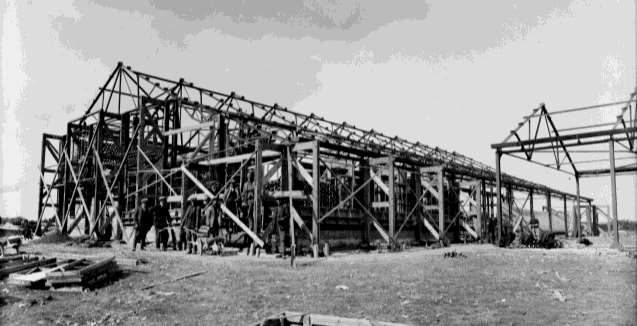
Construction of the Power House and the first transmitter hall (right), around 1925-1926.
Initially, the station consisted of two main buildings: a relatively small one for the transmitters and a much larger one for the power generating equipment. Charles Franklin was the chief designer of the Beam System, and R.N. Vyvyan, another member of Marconi's inner circle, oversaw the construction and installation of the equipment. A second, larger transmitter building was also begun and completed in 1930.
⚠️ A risky bet: When the station was built, Marconi had barely proved shortwave technology. But the race against rival companies in Germany and the United States to establish a worldwide wireless telegraphy system justified the risks. Dorchester and its sister receiving station at Somerton (Somerset) were to extend Marconi's telegram services to countries outside the Empire, such as the United States, and to open new routes to South America, the Middle East and beyond.
📡 Franklin's Beam antennas
Charles Franklin was an accomplished engineer with as much experience in shortwave antenna design as anyone at the time. The Beam antenna used a huge array of vertical wires suspended between the distinctive T-shaped masts.
For the first service to New York, the antenna was suspended between five masts 87 metres high (287 feet), spaced 200 metres (650 feet) apart. Because the antenna produced a very narrow beam, precise alignment was needed during construction to make sure the transmitted signal was aimed exactly along the bearing of the distant receiving station at Riverhead on Long Island, near New York.
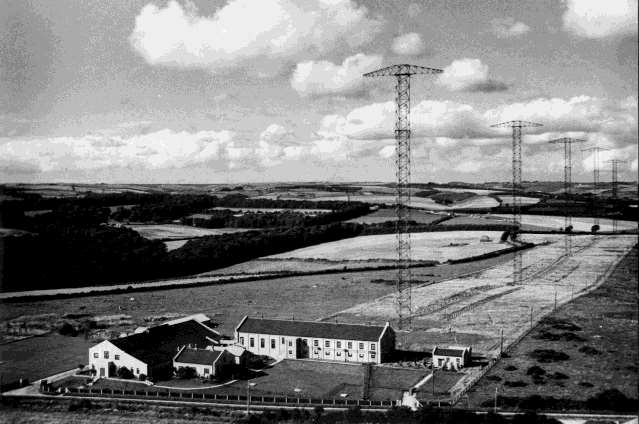
Aerial view of Dorchester radio station, showing the buildings and the T-shaped Beam masts, around 1930.
The civil engineering was a major challenge. Each mast weighed about 45 tonnes, supported by some 98 cubic metres of concrete in its base. The same antenna design was used all over the world and had to be robust enough to last for decades in a wide variety of climates.
A clever saving on masts was made: since Cairo lay almost exactly in the opposite direction to New York, the Cairo Beam antenna was hung on the other side of the New York masts. The same principle applied to the beams towards Japan and South America.
⚡ The Beam shortwave transmitters
Franklin had to meet three challenges to make Marconi's Beam System work: the design of the antenna, the design of the transmitter, and a way of connecting the transmitter to the antenna.
The SWB1 transmitter (“Swab One”)
Franklin designed a transmitter made up of three or four units called “Panels”. The valves and components of each panel were mounted on glass insulators and supported by an open brass frame. Each panel had meters and tuning controls, with the operator protected from the high voltages by mesh doors.
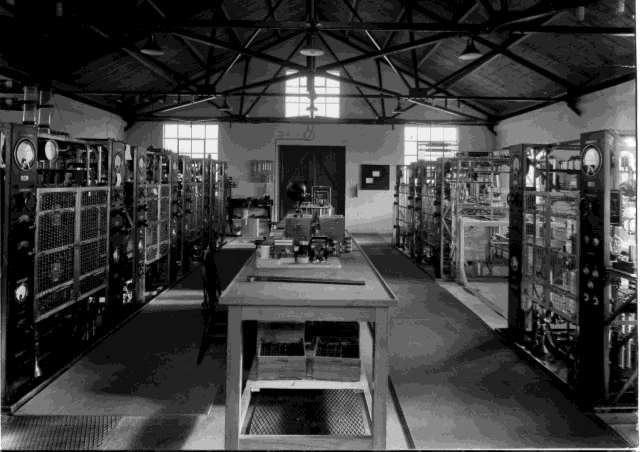
The first Beam shortwave transmitters (SWB1) in the Dorchester transmitter hall. Each “Panel” amplified the signal in turn.
| Panel | Function | Description |
|---|---|---|
| Panel A | Final amplifier (No.1 Magnifier) | Produced the transmitted signal at 10 kW |
| Panels B and C | Intermediate amplifiers (No.2 and No.3) | Amplified the signal from the master oscillator |
| Panel D | Keying unit | Controlled the Morse code being sent |
The transmitter was named “Short Wave Beam 1”, shortened to SWB1, and soon nicknamed “Swab One” by the staff. Pumps circulated coolant around the valves to keep them at their operating temperature.
The coaxial cable
To connect the transmitters to the antennas, Franklin invented a coaxial cable system using concentric copper tubes. The overall diameter of the cable was 89 mm (3.5 inches), with a 22 mm (7/8 inch) inner conductor supported by porcelain insulators. Junction boxes in the field near the antenna split and distributed the transmitter's power among the many wires of the Beam array.
💡 Did you know? The “coax” we use every day in amateur radio descends directly from this invention by Charles Franklin. The principle of concentric conductors separated by a dielectric has remained fundamentally unchanged since the 1920s.
🔌 Power generation
When the station was built, there was no local electricity supply. Power had to be generated on site by five Ruston and Hornsby engines producing direct current at 440 volts. This was then converted by motor-generator sets to provide the various supplies needed by the transmitter valves.
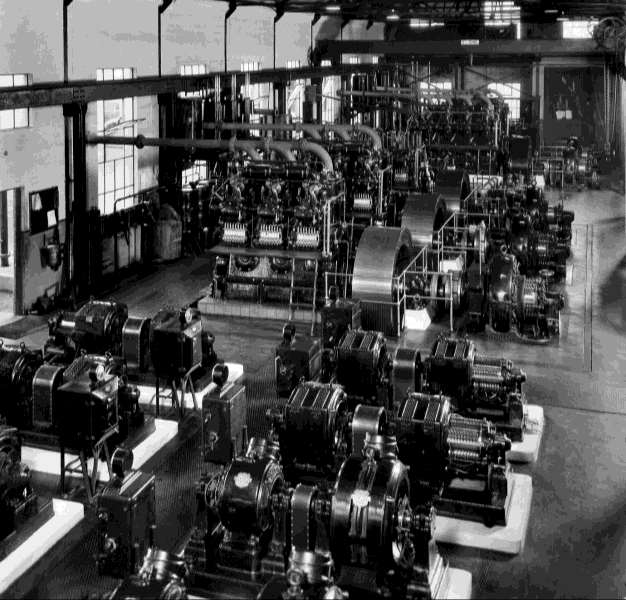
The Power House around 1935, with the Ruston and Hornsby generators and the motor-generator sets.
The generators were mounted on concrete plinths with cork dampers. Great care was taken to keep the generator building separate from the transmitter building, so that noise and vibration would not interfere with the transmitters or affect their stability.
📨 Opening and first services (1927)
The station opened in August 1927. When the first Morse characters were sent to the receiving station in the United States at speeds of up to 200 words per minute, it was as cutting-edge as any modern technology. This speed was twice what submarine cable systems could achieve, and with competitive telegram rates, the cable companies soon came under intense pressure.
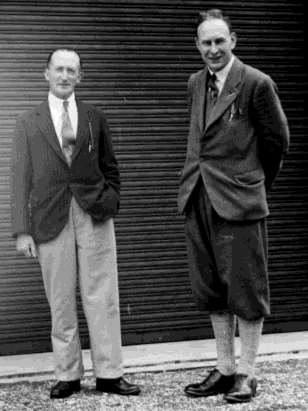
Station manager P.J. Woodward (left) and his deputy C.C. Redshaw, around 1930.
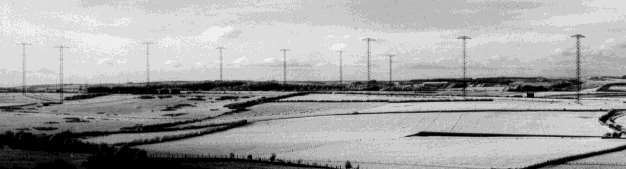
Panoramic view from Maiden Castle in 1935, showing the station's vast antenna field.
Radiotelephony experiments were also carried out at Dorchester. Using the Cairo transmitter, voice contact was made with Marconi aboard his steam yacht Elettra in the Mediterranean. Marconi was soon able to offer international telephone services by radio, but the GPO enforced its statutory monopoly on telephony: Marconi had to stick to telegraphy. He was, however, allowed to provide voice circuits for relaying broadcasts abroad.
🔄 Cable and Wireless: the forced merger (1929-1934)
By the end of 1929, Marconi's Beam services, together with the Beam stations operated by the GPO to the Dominions, were threatening to drive the cable companies out of business. The combination of new technology, lower operating costs and therefore cheaper telegram rates put the rather conservative cable companies in jeopardy.
The governments of the United Kingdom and the Empire were forced to recognise the strategic value of the cable companies (an enemy could jam or intercept radio signals) and imposed a compulsory merger of cable and radio communications. Before Marconi had even had time to fully enjoy the fruits of his work, ownership of Dorchester and the other Beam stations changed hands, becoming part of the joint system under the name “Imperial and International Communications”. In 1934, the company was renamed “Cable and Wireless Ltd”.
With the completion of the second transmitter building in 1930, new transmitters were installed and services opened via Dorchester to Rio de Janeiro, Buenos Aires and Bogotá in South America, then to Cairo and Japan. Throughout the 1930s, services were extended to Santiago, Maracay and Shanghai.
🕊️ The death of Marconi (20 July 1937)
On 20 July 1937, the pioneering era of wireless telegraphy came to an end with the death of Guglielmo Marconi from a heart attack. At Dorchester and many other stations, flags were flown at half mast.
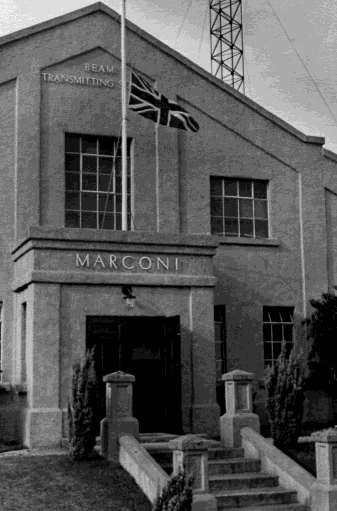
The station building with “MARCONI” and “BEAM TRANSMITTING” inscribed on the pediment and the Union Jack at half mast, July 1937.
Interestingly, although the station had belonged to the Cable & Wireless group since the 1929 merger, the name “MARCONI” had remained above the entrance porch and was only removed a respectful time after his death.
👷 The staff and working conditions
With its roots in the Marconi era, a number of staff had been transferred to Dorchester from other Marconi stations in the United Kingdom and Ireland. The Marconi Company was a fairly close-knit organisation, and even after the Cable & Wireless takeover, visitors from the company would usually seek out former colleagues to chat about the good old days.
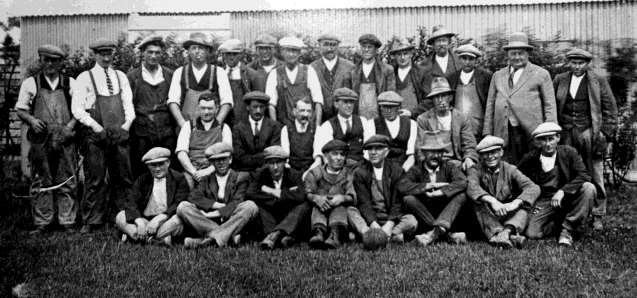
A group of radio station workers, around 1930. Cloth caps, waistcoats and hobnailed boots were the standard dress.
The station employed a wide range of skills:
⚡ Technical staff
Transmitter operators, electricians responsible for the electrical machinery and equipment.
🔧 Mechanics
Maintenance of the generators. The workshop could make any part: turning, welding, casting.
🧗 Riggers
Maintenance of the masts and antennas, sometimes having to climb the 87 metres of iron ladder on a Beam mast.
🔩 Coppersmiths
Responsible for the kilometres of coaxial cable connecting the transmitters to the antennas.
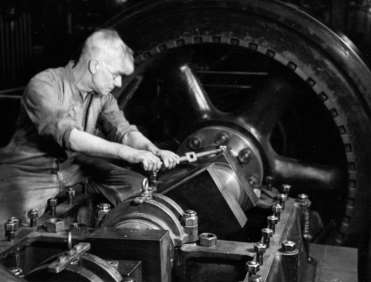
Rebuilding the generators: tightening the main bearings.
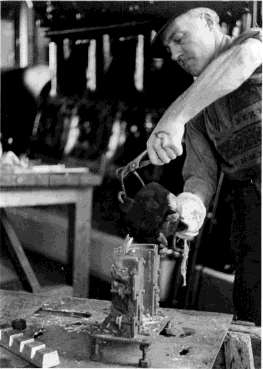
Pouring white metal for the generators' big-end bearings.
Wages and conditions in the 1930s
With the economic depression, people were glad to have a job, and the telecommunications industry was a relatively decent employer.
| Position | Annual salary (1938) |
|---|---|
| Station manager | ~900 £ |
| Technical staff | £300 to £400 (depending on seniority) |
| Manual workers | £130 to £234 (£2.50 to £4.50/week) |
As for safety, there was little equivalent of today's “Health and Safety Executive”. Men working outside, climbing masts or digging holes, wore hobnailed boots, overalls, a cap and perhaps a sou'wester if it was raining. Protection from high voltages in the transmitter halls was minimal: staff were expected to be able to read signs marked “DANGER”. Accidents did happen, but people were generally aware of the risks.
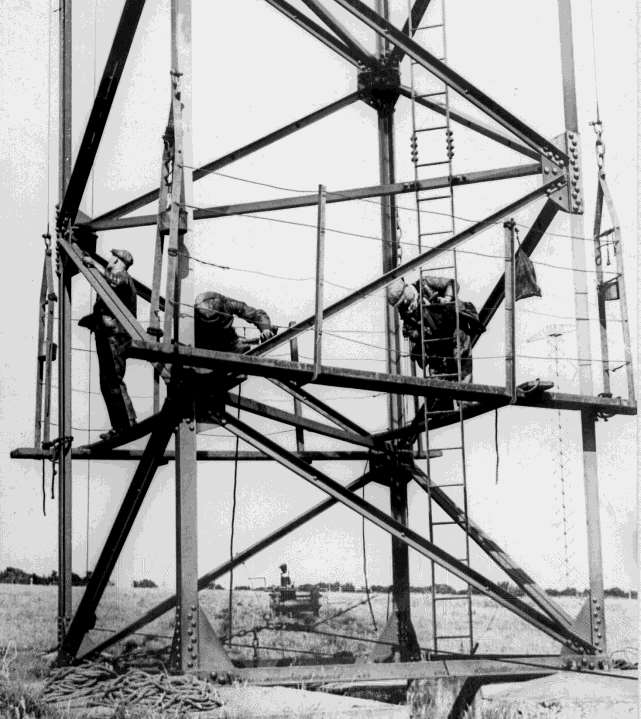
Painting a Beam mast in 1938. The riggers worked 87 metres up, often without modern safety equipment.
🏗️ Expanding the station (1938)
In 1938, a new transmitter hall was added to the existing “Lower Hall”, as part of a rationalisation that would lead to the closure of Bodmin radio station and the permanent transfer of the Cape Town and Montreal services to Dorchester. The new building had two floors and a basement.
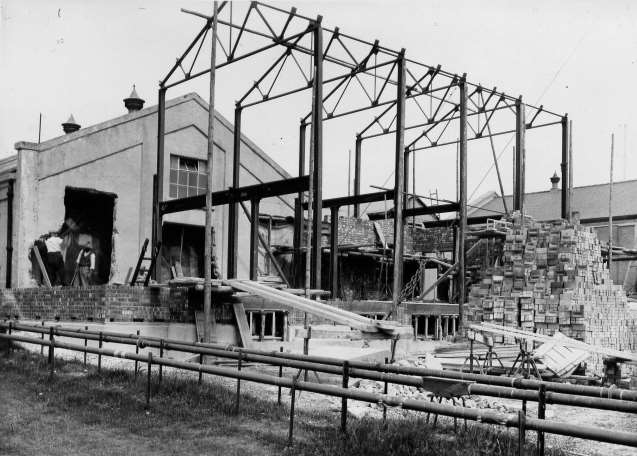
Construction of the Lower Hall extension in June 1938. The existing building can be seen on the left, along with the steel frame of the extension.
New Marconi transmitters were installed, of the SWB8 and SWB8-10 types. New antennas were also erected, including a diamond-shaped horizontal antenna known as a “Rhombic”, which appeared for the first time at Dorchester.
⚔️ The Second World War
After the outbreak of the Second World War, the risk of the station becoming a target for enemy bombing had to be minimised. The roofs of some buildings were first painted in camouflage colours, then a more elaborate method was adopted: a huge camouflage net supported by scaffolding was draped over the buildings. The windows were also blacked out.
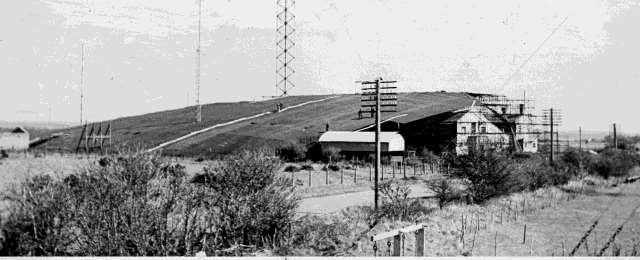
The station with the camouflage partly completed during the Second World War. The net was meant to hide the buildings from the air.
Luckily, no bomb ever fell on the station, although there was one near miss. A lone German bomber, believed to be returning from a raid on Bristol, decided it was worth dropping its remaining load on the station to lighten itself, but the bomb landed in a nearby field. The blast broke a few windows and, so the story goes, killed a rabbit.
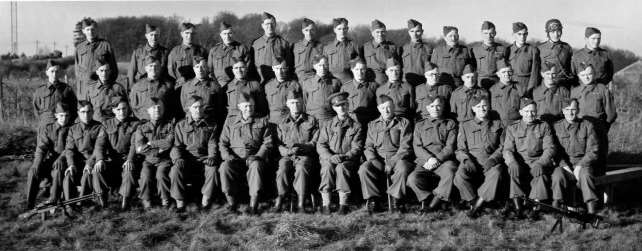
The Dorchester radio station Home Guard unit (the civilian defence militia). Staff did their Home Guard duty when they were not on shift at the station.
Increased demand for telegrams from the press and government departments during the war led to a further extension of the main building and the construction of a new transmitter building one kilometre to the south-east, on the south side of the A35 road. Five new SWB8-10 transmitters were installed in what became “Station B”. The main station naturally became “Station A”.
A remarkable innovation at Station B was the remote control of the transmitters from the main building. In 1941, this was yet another demonstration of innovative technology at Dorchester, reducing manpower requirements in wartime. The site then grew to 465 acres to accommodate the new antennas for services to Australia, Singapore, Barbados, Ceylon (Sri Lanka) and South Africa.
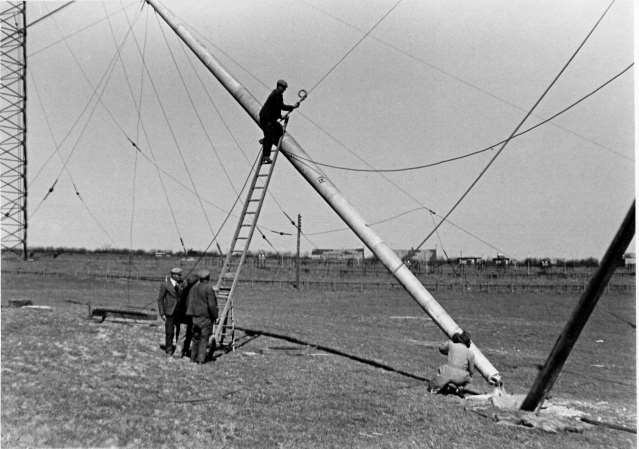
Erecting a new mast in the 1940s.
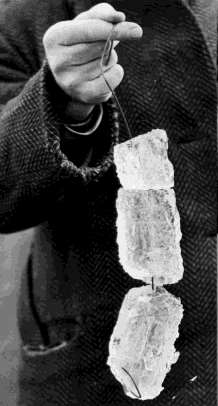
This is what happens to antenna wires in a real winter! The winter of 1947 caused serious damage to the antennas.
🏛️ The post-war years and nationalisation (1947-1955)
The station had escaped the Luftwaffe during the war, but not the rigours of Mother Nature in the winter of 1947. The build-up of ice on many of the antenna wires caused several antenna systems to break. The riggers and field team had to work in freezing conditions to carry out repairs and keep service interruptions to a minimum.
After the war, Britain took the path of nationalisation. Under the Telecommunications Act of 1949, the Cable & Wireless stations in the United Kingdom were transferred to the GPO on 1 April 1950. The staff became civil servants.
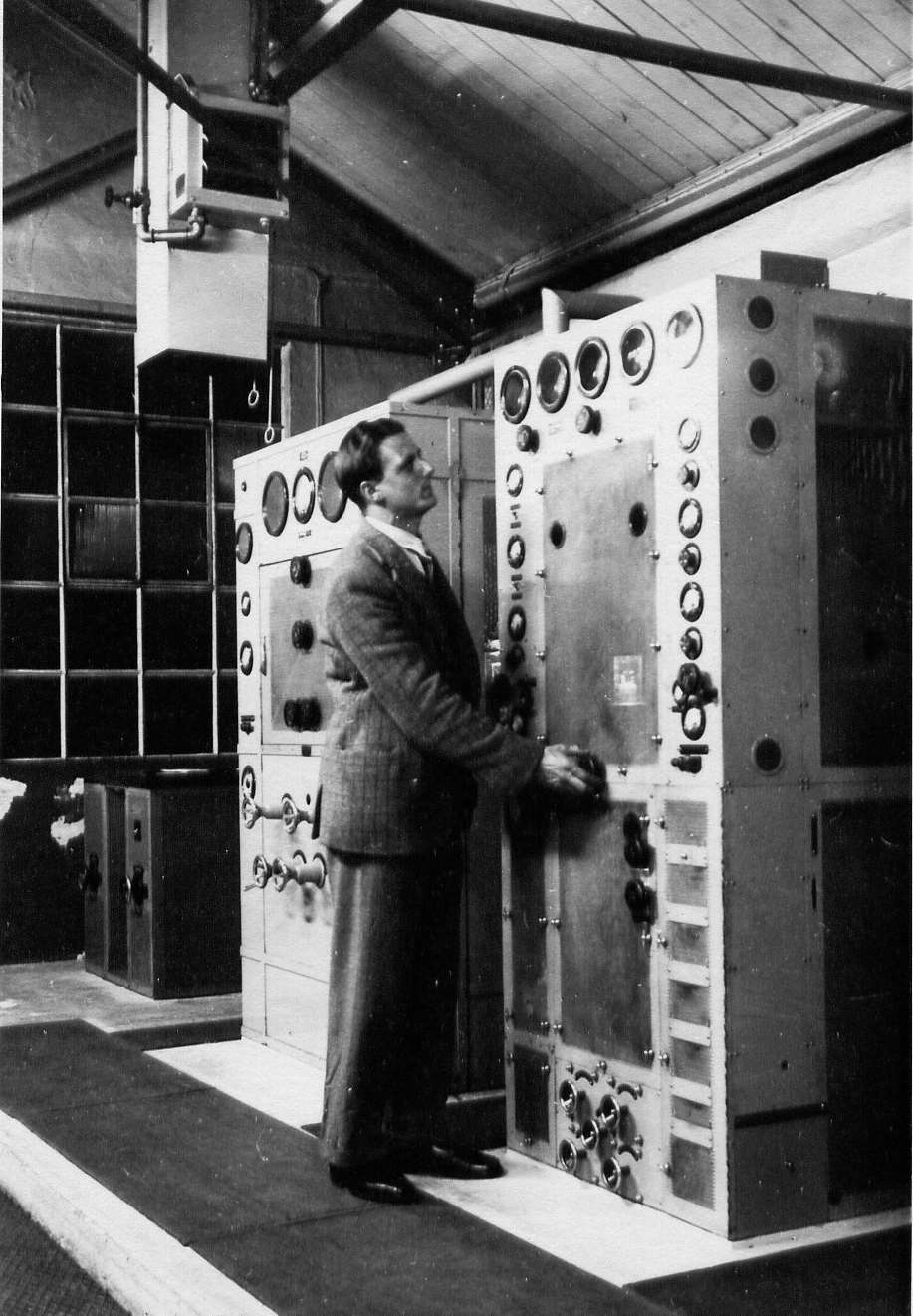
Phil Savage tuning transmitter No.11, a Marconi SWB8-10. Operators had to be thoroughly skilled at tuning these imposing machines.
The GPO invested heavily: Dorchester received an extension to Station B with four new 30 kilowatt transmitters supplied by S.T.C. Ltd. The master oscillators of the Marconi transmitters were replaced with more modern designs. The original Ruston and Hornsby generators were replaced by two new 550 kVA English Electric generators, used only in the event of a mains power failure.
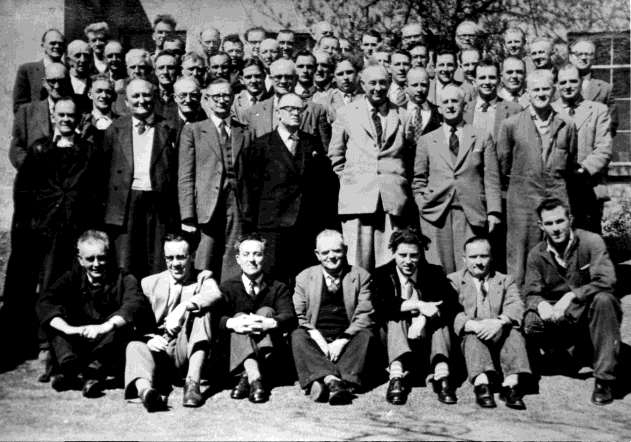
The radio station staff, around 1955. The team included technicians, mechanics, riggers, electricians and administrative staff.
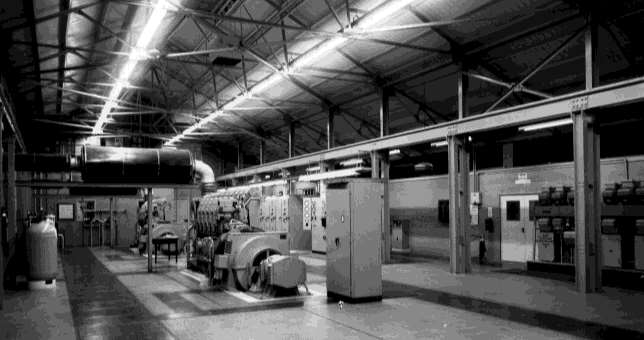
The power house with the new 550 kVA English Electric generators.
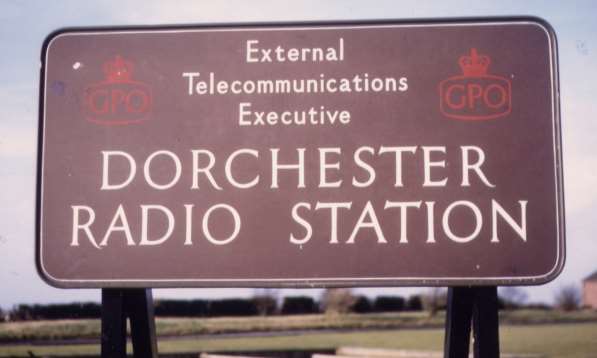
The “GPO - External Telecommunications Executive - Dorchester Radio Station” sign in the 1960s.
New technology made it possible to convert the Morse telegraph systems to teleprinters, and single-channel transmissions were upgraded to frequency-division multiplex systems. New services were opened to Asmara, Accra, Lagos, Tangier and Ascension Island.
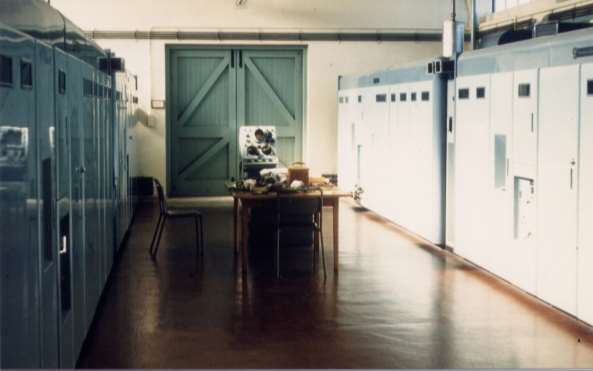
The S.T.C. 30 kW transmitters in Station B.
📉 The beginning of the end
With the development of long-distance submarine telephone cables in the mid-1950s, followed by the arrival of Telstar and satellite communications in 1962, the end of shortwave radio telecommunications was in sight. Now it was the radio stations' turn to be overtaken by new technology.
In 1963, the New York telegraph circuits were transferred to the transatlantic cable. After 35 years of service, Franklin's Beam antennas had reached the end of their life. The five original T masts were felled in spectacular fashion, and Dorchester lost a familiar landmark. Next came the felling of the three Beam masts of the Australian service, which had moved to the new COMPAC (Commonwealth-Pacific) cable.
In 1966, in a move the other way, the station took on three new teleprinter broadcast services for the Associated Press agency, with three new “log-periodic” antennas covering an arc from the Middle East to southern Africa.
The last two Franklin Beam masts were felled in October 1967, although some of the original SWB1 transmitters were still working.
⚓ The final decade: the maritime service (1970-1979)
In 1970, all the international point-to-point circuits were transferred to the more modern stations at Rugby and Ongar. Dorchester was converted to handle the growing traffic of the long-range maritime service, run from the famous Portishead station.
The directional rhombic antennas were replaced by new dipole arrays, a rotatable log-periodic and various conical systems, designed to give the wider coverage needed for maritime communications. Some transmitters were converted back to Morse.
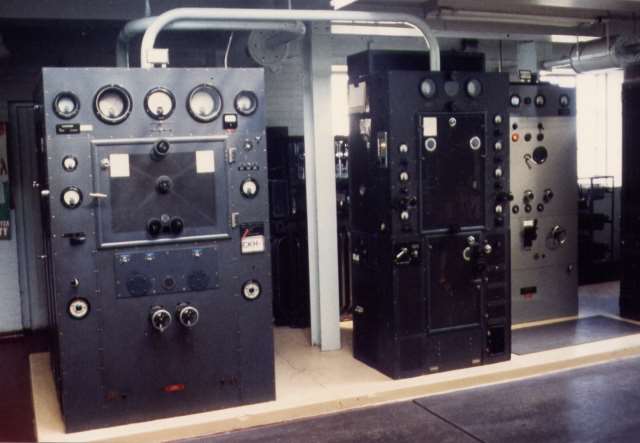
Marconi SWB 8-10 transmitter (No.17) operating under the callsign GKH for the maritime service.
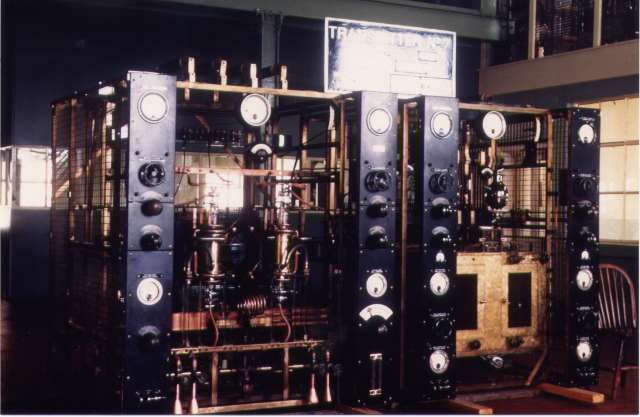
Transmitter No.7, restored to its original 1927 condition, ready to be shipped to the Science Museum in Kensington (London).
The original SWB1 transmitters, obsolete for years, were finally scrapped, with the exception of No.7. This transmitter was restored to its 1927 form for display at the Science Museum in Kensington, where part of it can still be found today. It is a credit to Franklin and Marconi that these transmitters, dating from the dawn of shortwave operation, stayed in service for so long.
The station continued to operate as part of the Portishead service until July 1979, at a time when satellites were starting to make an impact on maritime communications. In 1977, for its 50th anniversary, the station opened its doors to the public and local dignitaries.
“Dorchester radio station lived for 52 years, and if you have ever visited a transmitting station, you will understand the word ‘alive’. The constant hum of the cooling systems, pumps and fans, the glow of the PA valves and the humid heat given off by some twenty high-power transmitters gave the place a ‘soul’. After it closed, the building felt cold and empty.”
Paul M. Hawkins, author of the booklet Marconi's Beam Wireless Station at Dorchester
🏭 The station today
In 1979, the last masts were taken down and farming once again became the main use of the surrounding land. The transmitters were scrapped and the building stood empty and neglected for a few years.
Since 1984, the station has been back in the world of communication, this time in the form of the printed word. The current owners, Friary Press, produce a wide range of printed material, including high-quality magazines and brochures. The building has been extended in keeping with Marconi's original architecture.
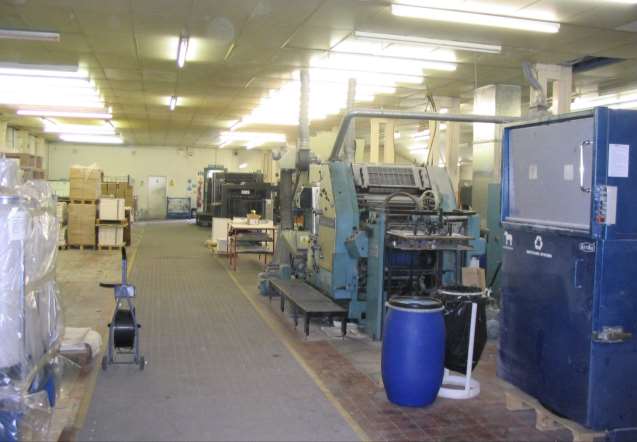
Friary Press printing machines now occupy the former power house.
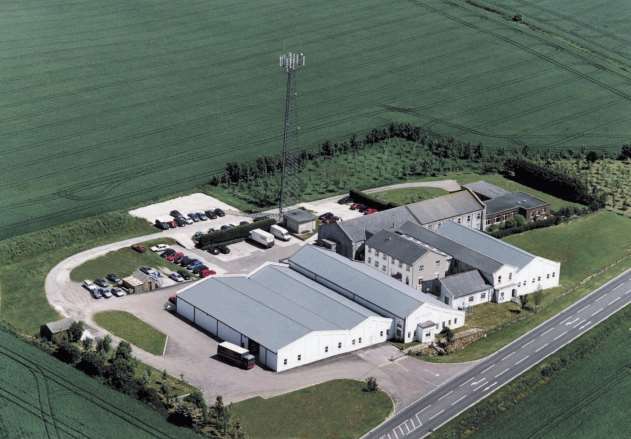
Aerial view of the former station in 2004, converted into a printing works.
One final anecdote: on a recent visit by the author, Friary Press staff reported that the basement of the Lower Hall is considered a rather unsettling place, used only for storage and avoided because of its “strange presence”. What most people do not know is that in the 1950s, a member of the radio station staff sadly died in that rather gloomy spot. Any conclusions are left to the reader's imagination...
📅 Timeline of Dorchester station
📻 Legacy and link with amateur radio
The story of the Dorchester Beam Wireless station strikes a deep chord with the amateur radio community:
📡 Ionospheric propagation
Propagation via the ionosphere, which Marconi and Franklin exploited at Dorchester, is what allows radio amateurs today to make DX QSOs on the HF bands.
🔌 Coaxial cable
The “coax” invented by Franklin to connect the transmitters to the antennas has become a fundamental part of every amateur radio station.
📐 Directional antennas
The Beam, Rhombic and log-periodic antennas used at Dorchester are the ancestors of the modern Yagi and log-periodic antennas used by OMs.
⚡ Valve transmitters
Franklin's “Magnifiers”, with their valves and water cooling, are the ancestors of the linear amplifiers that some OMs still use with valves.
💡 The callsign GKH: When the station was converted to the maritime service in the 1970s, it operated under the callsign GKH. Radio amateurs and shortwave listeners in Britain at the time regularly heard this signal.
❓ Frequently asked questions
📚 Source
This article is based on the booklet “Marconi's Beam Wireless Station at Dorchester” by Paul M. Hawkins, published by the Dorchester Association in 2004 (revised in 2022). All historical photographs are reproduced by kind permission of Mr A.G. Short, Friary Press and the families of C.C. Redshaw and P.E. Savage.
📚 Also on HB9V:
📡 Phonicom.ch, your radio partner in Switzerland
Whether you are an HB3/HB9 radio amateur or a radio enthusiast, Phonicom.ch is the go-to shop in Switzerland for all your radio equipment: Yaesu transceivers, antennas, accessories and much more.