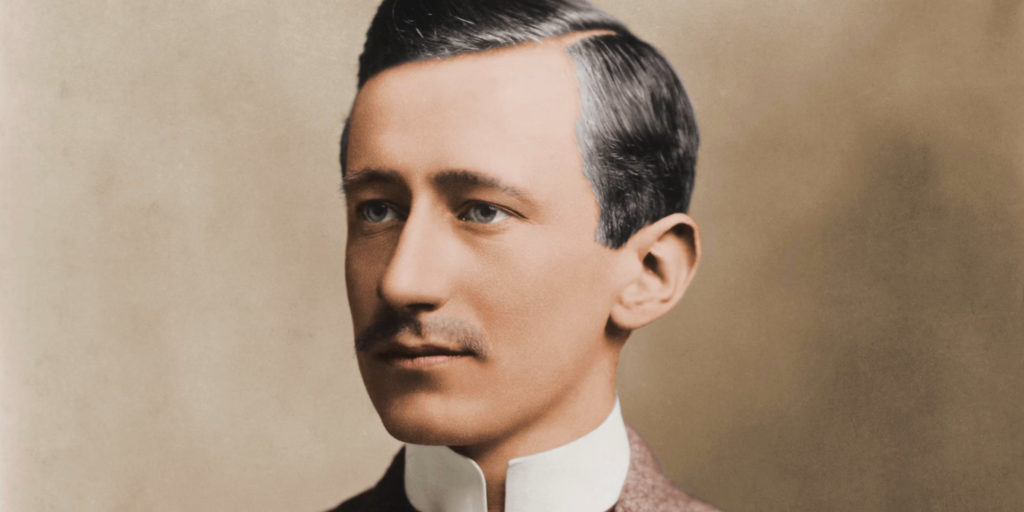
📡 Guglielmo Marconi, the father of radio
He proved to a sceptical world that the atmosphere could carry human messages across oceans. Guglielmo Marconi (1874-1937), Italian engineer and inventor, turned the theoretical work of Maxwell and Hertz into a practical communication system that revolutionised the world. Winner of the 1909 Nobel Prize in Physics, father of wireless telegraphy and shortwave pioneer, his legacy is the very foundation of our passion: radio.

Guglielmo Marconi (1874-1937), Italian engineer and inventor, father of wireless telegraphy. (Public domain)
💒 Early life and education
Guglielmo Giovanni Maria Marconi was born on 25 April 1874 in Bologna, Italy. His father, Giuseppe Marconi, was a wealthy Italian landowner. His mother, Annie Jameson, was Irish, a member of the famous Jameson whiskey-distilling family. This dual heritage would play a decisive role in his career.
From an early age, Marconi showed a passionate interest in science and electricity. He studied physics in Bologna under Professor Augusto Righi, a specialist in electromagnetic waves who carried on the work of Heinrich Hertz. It was while reading Hertz's papers on radio waves, after Hertz's death in 1894, that Marconi came up with the bold idea of using these waves for wireless communication over long distances.
💡 The scientific background: In 1864, James Clerk Maxwell had predicted the existence of electromagnetic waves mathematically. In 1887, Heinrich Hertz had demonstrated them experimentally in the laboratory. But no one had yet thought of using them to communicate. This is where Marconi's practical genius came in.
🏠 The Villa Griffone experiments (1894-1895)
In the summer of 1894, aged just 20, Marconi began his experiments in the attic of Villa Griffone, the family home at Pontecchio, near Bologna. It was in what was known as the silkworm room, where silkworms had once been reared, that he built his first apparatus, helped by his loyal butler Mignani.
His first device was rudimentary but ingenious: a storm detector made up of a battery, a coherer (Branly tube) and an electric bell that rang whenever there was lightning nearby. He soon managed to ring a bell on the other side of the room by pressing a telegraph key.

Reconstruction of Marconi's first radio transmitter, built at Villa Griffone in 1895. (Public domain)
In the summer of 1895, Marconi moved his experiments outdoors. He made a crucial discovery: by extending the antennas vertically and connecting them to earth, the range increased considerably. He managed to send signals over the Celestini hill, a distance of about 2.4 kilometres, the first natural obstacle ever crossed by a radio transmission.
According to legend, Mignani signalled that a signal had been received by firing a rifle shot from the other side of the hill. This moment marks the birth of practical radio communication.

Villa Griffone at Pontecchio (Sasso Marconi), near Bologna. This is where Marconi carried out his first experiments in 1894-1895. Today it is the Marconi museum. (CC BY-SA 3.0)
“I was given a cold reception in Italy. The government was not interested in my experiments. So I turned to England, where I found the support I needed.”
Guglielmo Marconi
🇬🇧 Leaving for England (1896)
Despite the success of his experiments, the Italian government showed no interest in his work. Marconi received neither funding nor encouragement from the authorities in his own country. It was his Irish mother who persuaded him to try his luck in England, where the British Empire, with its powerful merchant navy, had an obvious need for wireless communication.
In February 1896, Marconi arrived in London with his equipment in his luggage. Thanks to his mother's connections, he was introduced to Sir William Preece, chief engineer of the British General Post Office. Preece, impressed by the young Italian's demonstrations, gave him valuable institutional support.
On 2 June 1896, Marconi filed his first patent in England, patent no. 12039 for a “wireless telegraphy system”. It was the world's first patent for a practical radio communication system.
In 1897, on the strength of his growing success, Marconi founded the Wireless Telegraph & Signal Company (later the Marconi Company), based in London. At just 23, he was at the head of a company that would transform global communications.

Marconi with his wireless telegraphy equipment. Image published in the Finnish periodical Uusi Kuvalehti in October 1906. (Public domain)
🌊 Crossing the Atlantic (12 December 1901)
This is the feat that made Marconi famous worldwide. While the scientists of the day maintained that radio waves could not follow the curvature of the Earth and were therefore limited to line of sight, Marconi set out to prove them wrong.
At Poldhu, in Cornwall (south-west England), he had a transmitter built that was 100 times more powerful than anything that had existed before, feeding a huge antenna system. On the other side of the Atlantic, at Signal Hill in St. John's, Newfoundland (Canada), he set up a rudimentary receiving station with an antenna held aloft by a kite.
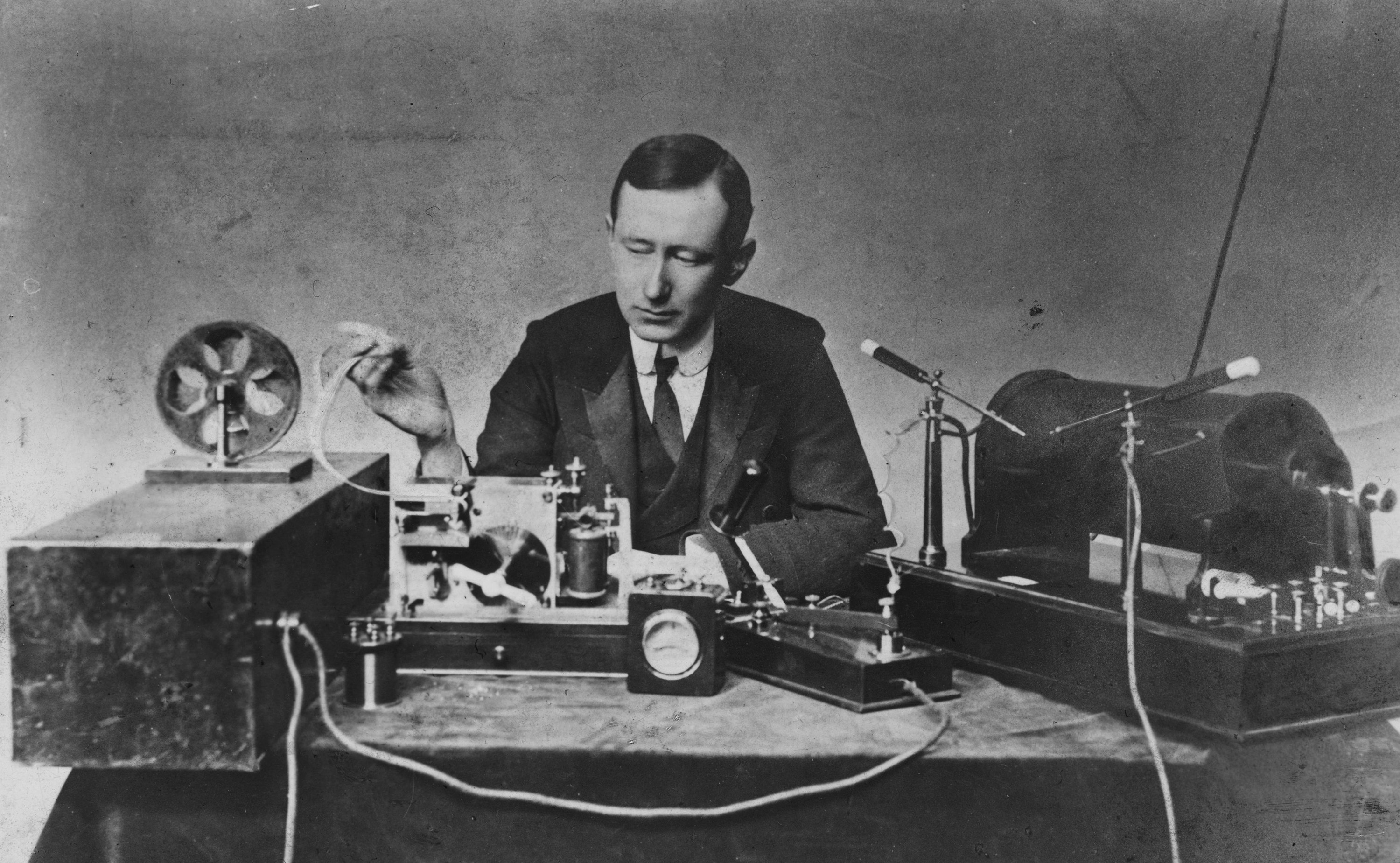
Marconi (right) with his assistants George Kemp and P.W. Paget at Signal Hill, St. John's, Newfoundland. This is where the first transatlantic signal was received on 12 December 1901. (Public domain)
On 12 December 1901, at 12:30, Marconi heard three faint clicks, the letter “S” in Morse code (three dots: · · ·), sent from Poldhu, some 3,500 kilometres away. That moment changed the history of communications. The distance the experts had judged impossible had just been bridged.
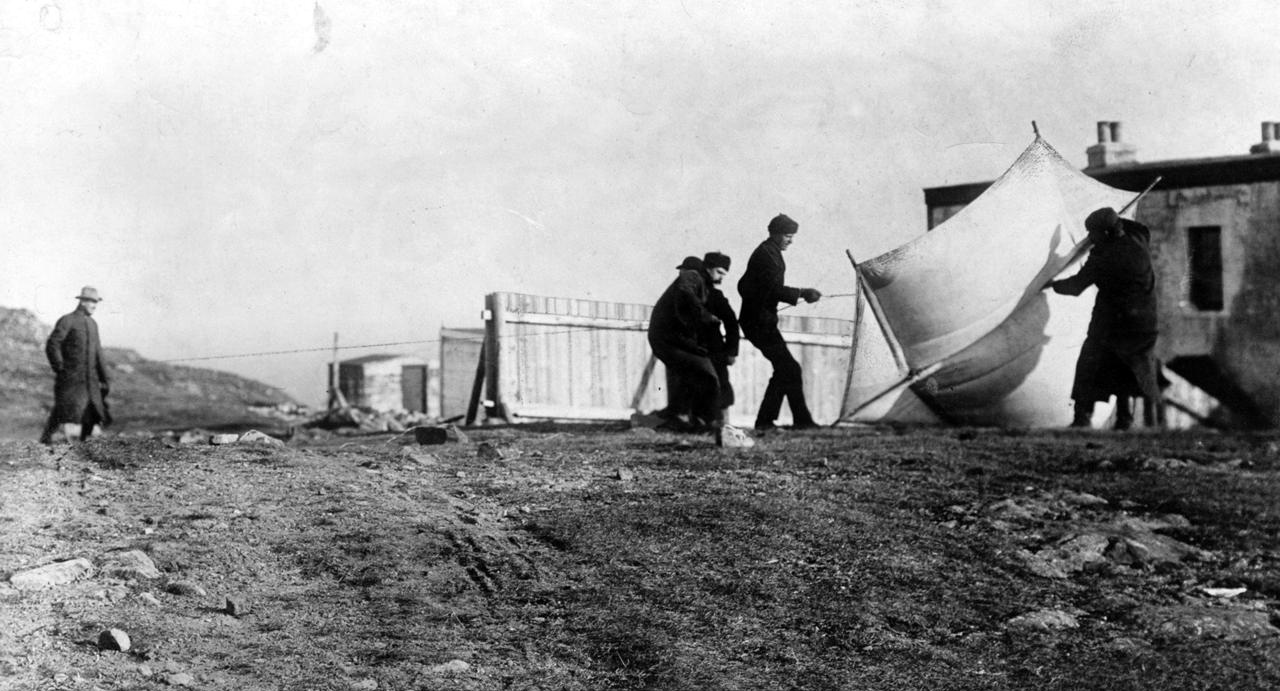
Marconi and his instrument inside Cabot Tower, Signal Hill, St. John's, Newfoundland, on 12 December 1901. (Public domain)
💡 Why did it work? Scientists believed that radio waves could not follow the Earth's curvature. What Marconi did not yet know was that the ionosphere, an electrically charged layer of the atmosphere, reflects radio waves back towards the Earth. This phenomenon of ionospheric propagation, the very basis of the HF DX that radio amateurs enjoy today, was only explained in theory later, by Kennelly and Heaviside.
⚠️ Historical controversy: Some historians question the validity of the 1901 experiment. The signal received (three clicks) was at the limit of audibility and there was no objective way of confirming it. However, the reliable, documented transatlantic transmissions that followed in 1902 and 1903 conclusively proved that the concept worked.
🏆 The Nobel Prize in Physics (1909)
In 1909, Marconi was awarded the Nobel Prize in Physics, shared with the German physicist Karl Ferdinand Braun. Braun was honoured for his contribution to the development of wireless telegraphy, in particular his invention of the coupled circuit, which greatly improved the efficiency of radio transmitters.
The Nobel committee's citation is unambiguous: the prize was awarded to them “in recognition of their contributions to the development of wireless telegraphy”. Marconi was 35. At the time, he was the youngest Nobel laureate in physics in the prize's history.
💡 Inventor or integrator? Strictly speaking, Marconi did not “invent radio”. He brilliantly combined Maxwell's theoretical work, Hertz's experiments, Branly's coherer and Lodge's research into a practical, commercially viable system. His genius lay in his entrepreneurial vision and his determination to turn science into usable technology. It is this ability to move from the laboratory to the real world that makes him the “father of radio”.
🚢 The Titanic: radio saves lives (1912)
On the night of 14 to 15 April 1912, RMS Titanic struck an iceberg in the North Atlantic. What followed was one of the greatest maritime tragedies in history, but also the most dramatic demonstration of the importance of wireless radio.
The Titanic was equipped with a Marconi transmitter, operated by two telegraphists employed by the Marconi Company: Jack Phillips (senior operator) and Harold Bride. As the ship began to sink, Phillips frantically sent the distress signal CQD (the Marconi distress code), then, at Bride's half-joking suggestion, switched to the new international signal SOS. “Send SOS, it's the new call, and it may be your last chance to send it,” Bride told him.
The signal was picked up by Harold Cottam, radio operator of the Carpathia, a Cunard liner about 60 nautical miles away. The Carpathia immediately headed for the Titanic and rescued 712 survivors out of the 2,224 people on board.
“Those who have been saved, have been saved through one man, Mr. Marconi... and his marvellous invention.”
British inquiry into the Titanic disaster
Jack Phillips died that night, having stayed at his post until the very end. The Titanic tragedy led directly to the Radio Act of 1912 in the United States and to the SOLAS Convention (Safety of Life at Sea), which made radio equipment compulsory on all passenger ships and required a continuous 24-hour radio watch.
💡 Anecdote: Marconi himself was due to sail on the Titanic's maiden voyage, but changed his plans at the last minute. He had taken the Lusitania three days earlier because his stenographer was available on that crossing and he had letters to dictate during the voyage.
📡 Shortwave pioneer (1920s)
In the 1920s, while the radio industry was focused on long waves, Marconi took a visionary turn. He tasked his assistant Charles Samuel Franklin with an in-depth study of shortwave (HF), frequencies that most experts considered useless for long-distance communication.
In September 1924, Marconi arranged day and night transmissions on 32 metres (about 9.4 MHz) from Poldhu to his yacht anchored in the port of Beirut. He was “astonished” to find that he could receive the signals throughout the day. This confirmed that shortwave, with a fraction of the power needed for long waves, could cover intercontinental distances.
Franklin developed the directional curtain array antenna system, and together they created the Marconi-Franklin Beam System. On 25 October 1926, the first commercial “Beam Wireless” service between the United Kingdom and Canada went into operation. By the end of the 1920s, half of all the world's long-distance communications went via shortwave.
✅ The legacy for radio amateurs: HF shortwave lies at the heart of amateur radio. Every DX QSO we make today on 20m, 40m or 10m is a direct tribute to the work of Marconi and Franklin. The principle of ionospheric propagation that they exploited commercially is the same one we use for our intercontinental contacts.
Microwaves and radar
A tireless experimenter, Marconi turned to even higher frequencies in the 1930s. In 1932, he opened the world's first microwave radiotelephone link, connecting Vatican City to the Pope's summer residence at Castel Gandolfo. In 1934, at Sestri Levante, he demonstrated a microwave radio beacon for maritime navigation. In 1935, he gave a practical demonstration of the principles of radar, a technology that would play a crucial role in the Second World War.
📅 Timeline of Marconi's life
📻 Marconi's legacy for radio amateurs
Without Marconi, amateur radio as we know it would simply not exist. His legacy is everywhere in our day-to-day activity:
🌍 HF propagation and DX
By proving that radio waves could travel thousands of kilometres via the ionosphere, Marconi established the fundamental principle of DX. Every intercontinental contact on HF is an echo of his 1901 experiment.
📡 Shortwave (HF)
His work on shortwave in the 1920s opened up the HF bands (3-30 MHz) we use every day: 80m, 40m, 20m, 15m, 10m. The Beam System is the ancestor of our directional antennas.
🔧 Technical innovation
Marconi was an experimenter first and foremost, just like today's radio amateurs. He built his own equipment, tested it, improved it and started again. This spirit of experimentation lies at the heart of amateur radio.
🚢 Safety radio
The Titanic rescue showed that radio could save lives. Today, radio amateurs carry on this legacy through emergency networks (ARES, USKA Notfunk) and emergency frequencies.
📊 Fact sheet
| Information | Detail |
|---|---|
| Full name | Guglielmo Giovanni Maria Marconi |
| Born | 25 April 1874, Bologna, Italy |
| Died | 20 July 1937, Rome, Italy (aged 63) |
| Nationality | Italian (Irish mother) |
| Education | Self-taught, student of Augusto Righi in Bologna |
| First patent | No. 12039, June 1896, London |
| Company | Wireless Telegraph & Signal Company (1897), later the Marconi Company |
| Greatest feat | First transatlantic signal, 12 December 1901 (Poldhu → Signal Hill, 3,500 km) |
| Nobel Prize | Physics, 1909 (shared with Karl Ferdinand Braun) |
| Titanic | 712 lives saved thanks to Marconi radio equipment (1912) |
| Shortwave | Beam System with C.S. Franklin (1924-1926) |
| Microwaves | First link, Vatican to Castel Gandolfo (1932) |
| Titles | Marquis of Italy (1929), Senator (1914), GCVO, Fellow of the Royal Society |
❓ Frequently Asked Questions
Did Marconi really invent radio?
Marconi did not invent radio waves (Maxwell/Hertz) or the components (Branly/Lodge). His contribution was to combine these technologies into a practical system and to have the entrepreneurial vision to market it. He held the first patent for a practical wireless telegraphy system (1896).
Why did he leave for England?
The Italian government did not back his research. The British Empire, with its powerful merchant navy, had an obvious strategic need for wireless communication. His mother's Irish family connections made it easier for him to settle in London.
Was the 1901 signal real?
Doubts remain about the experiment of 12 December 1901 (weak signal, subjective confirmation). However, the reliable, documented transatlantic transmissions that followed in 1902-1903 proved it was feasible. The 1901 feat remains a symbolic founding moment.
What is his connection with amateur radio?
Marconi demonstrated intercontinental HF propagation, the very principle of DX. His work on shortwave in the 1920s opened up the bands that radio amateurs use every day. He is regarded as the founding father of all radio communication.
🤝 Our partners

Phonicom.ch: amateur radio specialist in Switzerland
Carry on Marconi's legacy with quality equipment. Phonicom stocks HF, VHF and UHF transceivers for your DX contacts. Yaesu, Icom and Anytone equipment and accessories. Personal advice and delivery within Switzerland.
Visit phonicom.ch →📚 Also on HB9V
- 📊 Radio Propagation Conditions: Complete Guide: ionosphere, solar indices, real-time tools, DX guide from HB9
- 📡 Swiss Amateur Radio Band Plan: all HF, VHF and UHF frequencies with visual diagrams
- 📻 FT8 Digital Mode: Complete Guide: WSJT-X, frequencies, setup, PSK Reporter
- 🌐 Brandmeister: Complete Guide to the DMR Network: talkgroups, Self-Care, Hoseline, Swiss infrastructure
📖 Sources: DXZone (dxzone.com), Encyclopaedia Britannica, Nobel Prize Foundation, Wireless History Foundation, Science Museum UK, Library of Congress. Images: Wikimedia Commons (public domain / CC BY-SA).