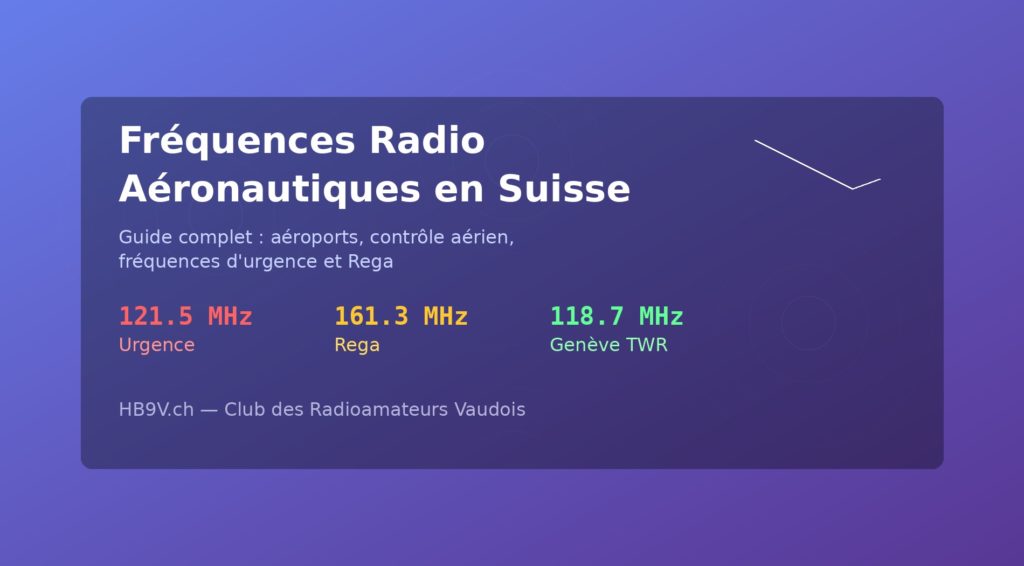
✈️ Complete guide to aeronautical radio frequencies in Switzerland
Aeronautical communications use specific VHF frequency bands (118-137 MHz) to ensure the safety and coordination of air traffic. This complete guide presents all the radio frequencies used by Swiss airports, air traffic control services and the emergency frequencies. Whether you are a curious radio amateur, a pilot or an aviation enthusiast, you will find here all the information you need to understand and listen to aeronautical communications in Switzerland.
📡 An introduction to aeronautical communications
Radio communication is essential to aviation safety. Unlike amateur radio, where we use various HF, VHF and UHF bands, civil aviation mainly uses the aeronautical VHF band between 118 MHz and 137 MHz.
💡 Important point for radio amateurs: these frequencies are reserved exclusively for aeronautical communications. Listening is allowed, but any transmission on these frequencies without proper authorisation is strictly prohibited and a serious offence.
🎯 Characteristics of the aeronautical VHF band
📻 Frequency band
118.0 - 137.0 MHz
25 kHz (formerly) and 8.33 kHz (modern) channel spacing
🔊 Transmission mode
AM (amplitude modulation)
Unlike the FM used in VHF amateur radio, aviation uses AM so that several stations can be received at the same time
📏 Typical range
Line of sight
Around 200-300 km for aircraft at altitude, less on the ground (50-80 km depending on the terrain)
⚡ Power
5 to 25 watts
Aircraft radios generally use 10-25W; ground stations may use more power
🚨 International emergency frequencies
Some frequencies are reserved worldwide for emergencies. They must be monitored continuously by the emergency services.
| Frequency | Service | Use | Type |
|---|---|---|---|
| International distress (VHF) | Civil aviation emergencies, distress beacons (ELT), emergency communications | 🚨 EMERGENCY | |
| Military distress (UHF) | Military emergencies, military SAR (Search and Rescue) coordination | ⚠️ MILITARY | |
| SAR (auxiliary) | Auxiliary search and rescue frequency (ICAO), on-scene coordination between aircraft and the rescue services | 🚁 SAR |
⚠️ IMPORTANT WARNING: the 121.5 MHz frequency must ALWAYS be kept clear and available. It is monitored 24/7 by every air traffic control centre in the world. NEVER use this frequency except in a genuine aeronautical emergency.
🚁 Rega radio frequencies (Swiss Air-Rescue)
The Rega (Swiss Air-Rescue) is the largest air rescue organisation in Switzerland. Founded in 1952, it provides helicopter rescue 24/7 throughout Switzerland. As well as the emergency telephone number 1414, the Rega can be reached by radio through a network of fixed stations covering the whole country.
📡 The Rega radio network: the Rega network is designed so that a handheld radio of only 2.5 watts can reach the operations centre from anywhere in Switzerland. Calls are automatically relayed to the Rega operations centre in Zurich or to the KWRO/OCVS centre for the canton of Valais.
📻 Frequencies of the Swiss rescue network
| Frequency | Channel | Use | Type |
|---|---|---|---|
| Channel E (Emergency) | The main distress channel, allowing anyone in Switzerland to alert the rescue services by radio in an emergency when the telephone is unavailable | 🚨 DISTRESS | |
| Channel R (Rescue) | Rescue channel reserved for mountain rescue and air rescue services (SAC, rescue teams) | 🏔️ RESCUE | |
| Channel K (Koordination) | Inter-agency coordination channel at the scene of an operation between the various rescue services | 🤝 COORDINATION | |
| REGA (operational) | Operational frequency used by Rega helicopters to communicate with the operations centre | 🚁 HELICOPTERS |
📞 How to alert Rega
📱 By telephone
Emergency number: 1414
The main number, available 24/7 from anywhere in Switzerland. From abroad: +41 333 333 333
📻 By radio (Channel E)
161.300 MHz
Can be used when the telephone network is unavailable (mountains, areas without coverage). ZVEI-1 selective call: 21414 for a direct alarm
📱 Rega app
iOS / Android app
The official Rega app lets you raise the alarm with automatic transmission of your GPS position
🔊 CTCSS sub-tone
123.0 Hz
A 123.0 Hz CTCSS sub-tone is required on transmit to be received by the operations centres, particularly in border regions
⚠️ Important, emergency radio: emergency radio on Channel E (161.300 MHz) does not replace the telephone. Use it only in a genuine emergency when every other means of communication is impossible. The connection test is done with the selective call 21301 (you will receive 2 long beeps in return).
🏔️ Rega bases in Switzerland
Rega has 14 helicopter bases strategically spread across Switzerland, enabling it to reach any point in the country within 15 minutes at most. Each base operates an air ambulance helicopter (AgustaWestland Da Vinci or Airbus H145) ready to take off within minutes.
🚁 Main bases
- Zurich, main base and headquarters of the operations centre (Rega Centre)
- Bern, Bern-Belp Airport
- Lausanne, serves western French-speaking Switzerland
- Sion, covers central Valais, coordination with KWRO/OCVS
- Wilderswil (Interlaken), Bernese Oberland and central Alps
- Erstfeld, central Switzerland, Uri, Gotthard
- Untervaz, Graubünden
- Samedan, Engadine
- Locarno, Ticino, Italian-speaking Switzerland
- St. Gallen, eastern Switzerland
- Basel, north-western Switzerland
- Mollis, Glarus, eastern Switzerland
- Zweisimmen, western Bernese Oberland
- Geneva, partner base (HUG)
✅ Good to know: Rega helicopters also communicate on the standard aeronautical frequencies (118-137 MHz) when operating in controlled airspace. So you can sometimes hear them on airport frequencies during medical missions.
🇨🇭 Organisation of Swiss Airspace
Swiss airspace is managed by Skyguide, the national air navigation service provider. The country is divided into several control sectors.
Control of western Switzerland (Geneva, Lausanne, Valais)
Control of eastern and central Switzerland (Zurich, Bern, East)
General radar service covering the whole of Switzerland
✈️ Main Swiss Airports: Complete Frequencies
🏙️ Geneva International (LSGG)
✈️ Geneva International Airport (Cointrin)
🌍 International ✈️ Commercial
| Service | Frequency | Use |
|---|---|---|
| Control Tower | Take-off/landing clearances, traffic circuit | |
| Approach | Final approach and departure guidance | |
| Approach (secondary) | Alternative/additional approach frequency | |
| Ground | Ground movements, taxiways, parking | |
| ATIS (Information) | Weather information, runway in use (automatic) |
💡 Point of interest: Geneva is Switzerland's second airport, with heavy international traffic. Communications are mainly in French and English.
🏙️ Zurich International (LSZH)
✈️ Zurich International Airport (Kloten)
🌍 International ✈️ Main Hub
| Service | Frequency | Use |
|---|---|---|
| Control Tower | Take-off and landing control | |
| Approach | Final approach from the east | |
| Approach (secondary) | Alternative approach/western sector | |
| Ground | Ground taxiing, taxiway traffic | |
| ATIS (Information) | Weather report and aerodrome information |
💡 Point of interest: Zurich is Switzerland's largest airport and the main hub of Swiss International Air Lines. Communications mainly in German and English.
🏙️ Bern-Belp (LSZB)
✈️ Bern-Belp Airport
🛩️ Regional 📍 Light Aviation
| Service | Frequency | Use |
|---|---|---|
| Control Tower | Take-off/landing control | |
| Approach | Approach and departure | |
| ATIS (Information) | Automatic aerodrome information |
💡 Point of interest: The airport of the Swiss capital, used for regional traffic, light aviation and a few charter flights.
🏙️ Lugano (LSZA)
✈️ Lugano-Agno Airport
🛩️ Regional 🏔️ Alpine
| Service | Frequency | Use |
|---|---|---|
| Tower/Approach | Combined tower and approach service | |
| ATIS (Information) | Aerodrome information |
💡 Point of interest: Located in Ticino, this airport serves Italian-speaking Switzerland in a distinctive Alpine setting.
🏙️ Sion (LSGS)
✈️ Sion Airport
🛩️ Regional ⚔️ Former military base
| Service | Frequency | Use |
|---|---|---|
| Control Tower | Civil and military traffic control |
💡 Point of interest: A civil airport in Valais and former military air base (regular army flights ended in late 2017, kept as a backup base if needed), used by light aviation and rescue helicopters.
🏙️ Lausanne - La Blécherette (LSGL)
✈️ La Blécherette Aerodrome
🛩️ Light Aviation 🪂 Gliding
| Service | Frequency | Use |
|---|---|---|
| AFIS (Flight Information) | Flight information service (uncontrolled) |
💡 Point of interest: An aerodrome north of Lausanne, very busy with light aviation, gliding and pilot training. Unlike the major airports, La Blécherette operates with an AFIS (Aerodrome Flight Information Service) rather than a full control tower.
ℹ️ What is AFIS? AFIS (Aerodrome Flight Information Service) is a flight information service that provides information to pilots but does not issue control clearances like a conventional tower. Pilots make their own decisions based on the information received.
🗼 Skyguide Area Control Services
Skyguide controls Swiss airspace through several area control centres. Here are the main frequencies used:
📡 Geneva Control (West Area Control)
| Service | Frequency | Area Covered |
|---|---|---|
| Geneva Control | West region, main sector | |
| Geneva Control | West region, alternative sector |
📡 Zurich Control (East Area Control)
| Service | Frequency | Area Covered |
|---|---|---|
| Zurich Control | East/central region, main sector | |
| Zurich Control | East/central region, alternative sector |
💡 Technical note: Control centres use several frequencies depending on the sector and the aircraft's altitude. Aircraft change frequency as they progress so as to stay in contact with the right controller.
📻 Other Useful Frequencies in Switzerland
| Service | Frequency | Description |
|---|---|---|
| VOLMET Switzerland | Automatic looped weather broadcast for Swiss aerodromes | |
| Air-to-air VFR | International air-to-air frequency for communication between aircraft flying under visual flight rules | |
| Geneva Information | Flight information service, west region | |
| Zurich Information | Flight information service, east region |
📻 VOLMET: what is it? VOLMET is an automatic service that continuously broadcasts the weather conditions at the main airports. It is very useful for pilots, who can get weather information without calling ATC.
📋 Structure of the Aeronautical Frequency Ranges
The aeronautical VHF band is organised by type of service. Here is the complete structure:
| Frequency Range | Main use |
|---|---|
| 118.0 - 121.4 MHz | Air traffic control communications (general traffic) |
| 121.5 MHz | 🚨 International emergency frequency |
| 121.6 - 121.9 MHz | Airport ground communications (Ground, taxiing) |
| 122.0 - 123.6 MHz | Air traffic control communications |
| 123.45 MHz | Air-to-air frequency for VFR flights (visual flight rules) |
| 123.5 MHz | Helicopter frequency (in some countries) |
| 124.0 - 128.8 MHz | Air traffic control communications |
| 128.825 - 132.0 MHz | Air traffic control communications |
| 132.025 - 136.975 MHz | Air traffic control communications |
📻 Listening to Aeronautical Frequencies: Equipment Needed
As a radio amateur, you can easily listen to aeronautical communications. Here is what you need:
🔧 Reception Options
📻 VHF/UHF Scanner
A standard scanner covering 118-137 MHz is ideal. Many models include the airband.
Popular models: Uniden Bearcat, Icom IC-R6, Yaesu VR-500
📡 Amateur VHF Transceiver
Your 2m VHF radio can often receive the aeronautical frequencies (check the specifications).
Mode: set it to AM, not FM!
💻 RTL-SDR / SDR
An RTL-SDR dongle (<€20) connected to a PC lets you listen to all the VHF bands with SDR software.
Software: SDR#, GQRX, CubicSDR
📱 Mobile Apps
iOS/Android apps stream communications from receivers all over the world.
Apps: LiveATC, Flightradar24, AirNav RadarBox
⚠️ Important, AM mode: Aeronautical communications use amplitude modulation (AM) and NOT FM as in VHF amateur radio. Make sure your receiver can operate in AM mode on these frequencies.
🔊 Recommended Receiver Setup
⚙️ Basic Settings
- Band: 118-137 MHz (aeronautical VHF)
- Mode: AM (Amplitude Modulation)
- Channel spacing: 25 kHz (older) or 8.33 kHz (modern)
- Bandwidth: typically 6-12 kHz for airband AM
- Squelch: adjust to remove background noise
🌐 Online Services: Listening to Aeronautical Frequencies
To listen to aeronautical communications without any equipment, several websites offer live audio streams from receivers located all over the world.
🌍 LiveATC.net
⭐ Recommended 🆓 Free
The world's largest ATC streaming network. Many Swiss airports available live.
Swiss coverage: Geneva, Zurich, Bern available
✈️ AirNav RadarBox
📡 ADS-B 🗺️ Mapping
Radar combined with ATC audio. Follow aircraft in real time along with the associated communications.
✈️ Flightradar24
🌍 Worldwide 📱 Mobile
Real-time flight tracking. The premium version includes ATC audio for some airports.
📻 Broadcastify Aviation
📡 Scanners 🎧 Audio
A scanner streaming platform. Aviation section with several international airports.
✅ The advantage of online services: no radio equipment needed! You can listen from your computer, smartphone or tablet. Perfect for getting started or for listening to airports far from home.
🎓 Understanding Aviation Language
Aeronautical communications use an internationally standardised vocabulary to avoid any ambiguity. Here are the basics:
📞 ICAO Phonetic Alphabet
The phonetic alphabet used in aviation is the same as the one used by radio amateurs (NATO/ICAO alphabet):
| Letter | Word | Letter | Word |
|---|---|---|---|
| A | Alpha | N | November |
| B | Bravo | O | Oscar |
| C | Charlie | P | Papa |
| D | Delta | Q | Quebec |
| E | Echo | R | Romeo |
| F | Foxtrot | S | Sierra |
| G | Golf | T | Tango |
| H | Hotel | U | Uniform |
| I | India | V | Victor |
| J | Juliett | W | Whiskey |
| K | Kilo | X | X-ray |
| L | Lima | Y | Yankee |
| M | Mike | Z | Zulu |
🗣️ Common Phrases
💬 Essential Vocabulary
- Roger: understood, message received
- Wilco: will comply
- Affirm: yes, affirmative
- Negative: no
- Say again: repeat your message
- Standby: wait
- Cleared: authorised (e.g. cleared for takeoff)
- Hold short: stop and hold before...
- Contact: call (another frequency)
- Flight level: altitude in hundreds of feet
✈️ Typical Communication Example
[PILOT] “Geneva Tower, Swiss 1234, ready for departure, runway 23”
[TOWER] “Swiss 1234, Geneva Tower, runway 23, cleared for takeoff, wind 240 at 10 knots”
[PILOT] “Cleared for takeoff runway 23, Swiss 1234”
⚖️ Legal and Regulatory Aspects
🚨 IMPORTANT: Swiss Regulations
✅ Permitted:
- Listening to aeronautical frequencies is entirely legal in Switzerland
- You may use a scanner or a radio capable of receiving these frequencies
- Listening is even encouraged for aviation enthusiasts
❌ STRICTLY PROHIBITED:
- NO TRANSMITTING on aeronautical frequencies without the appropriate licence
- Jamming or disrupting aeronautical communications (a very serious offence)
- Impersonating a pilot or a controller
- Transmitting false information
⚠️ Penalties: Offences involving aeronautical communications are punished with very heavy fines and prison sentences. Air safety tolerates no negligence.
💡 For radio amateurs: Your amateur radio licence does NOT authorise you to transmit on aeronautical frequencies. These bands are reserved exclusively for certified pilots and air traffic controllers. Stay on your authorised bands (144-146 MHz for 2m).
📚 Further Resources
💡 Listening Tips
🎧 Getting the Most out of Listening
- Traffic hours: most traffic between 06:00 and 22:00. Geneva and Zurich are busy all day
- Best times: morning (07:00-09:00) and late afternoon (17:00-20:00) for commercial traffic
- Antenna: a simple vertical or dipole antenna works well for airband VHF
- Location: the higher you are, the better the reception (VHF = line of sight)
- Scanner: program the main frequencies and let it scan to discover the traffic
- Apps: combine radio listening with tracking on Flightradar24 to see the aircraft
- Weather: listen to the ATIS or VOLMET first to know the conditions
🎯 Radio amateur's tip: If you have a 2m VHF radio with extended receive, try programming the aeronautical frequencies into separate memories. Some VHF transceivers can receive AM on 118-137 MHz: check your manual!
❓ Frequently asked questions (FAQ)
❓ Can I listen with my 2m VHF radio?
Answer: It depends on your model. Some VHF transceivers have extended receive covering 118-137 MHz. Check in your manual whether the radio can receive in AM mode on these frequencies.
❓ Why do aircraft use AM and not FM?
Answer: AM allows several stations to transmit at the same time and still be heard (mixing effect). In an emergency, several aircraft can call at once without blocking each other.
❓ What range can I expect on airband VHF?
Answer: For an aircraft in flight: 200-300 km. For ground communications: 50-80 km depending on the terrain and your elevation. VHF works by line of sight.
❓ Can I record the communications?
Answer: Yes, recording for personal use is permitted. However, public or commercial broadcasting without permission may be a problem.
❓ Does the military use the same frequencies?
Answer: No. The military mainly uses UHF frequencies (225-400 MHz) and encrypted systems. Swiss military communications are generally not accessible to the public.
❓ What does ATIS mean?
Answer: Automatic Terminal Information Service. It is an automatic looped message giving the weather, the runway in use and other important airport information.
🔧 Troubleshooting: Common Problems
🚨 Problems and Solutions
❌ Problem: I only hear static
✅ Solution: Check that you are really in AM mode (not FM). Adjust the squelch. Make sure your antenna works on 118-137 MHz.
❌ Problem: The sound is very weak
✅ Solution: Airband AM signals are sometimes weak. Increase the RF gain. Try a better antenna or move to higher ground.
❌ Problem: I can't hear anyone talking
✅ Solution: That's normal! Communications are not continuous. Be patient, especially at small aerodromes. Try Geneva or Zurich Tower at peak times.
❌ Problem: The sound is distorted
✅ Solution: Reduce the AM filter bandwidth. Try 6-8 kHz instead of 12 kHz. Check that you are not overmodulating.
📊 Summary of the Main Frequencies
🎯 Essential Frequencies to Memorise
| Service | Frequency | Priority |
|---|---|---|
| International Emergency | 🚨 CRITICAL | |
| Rega, Channel E (Distress) | 🚁 REGA | |
| Rega, Channel R (Rescue) | 🏔️ RESCUE | |
| Geneva Tower | ⭐ Main | |
| Zurich Tower | ⭐ Main | |
| VOLMET Switzerland | 📡 Weather | |
| Air-to-air VFR | 🛩️ Light aviation | |
| La Blécherette | 📍 Lausanne |
🤝 Our partners
Phonicom.ch: amateur radio specialist in Switzerland
Phonicom offers receivers and scanners for listening to aeronautical frequencies, VHF antennas and all kinds of amateur radio equipment. Personal advice and fast delivery in Switzerland.
Visit phonicom.ch →