We have completely rebuilt the HB9V electricity consumption calculator and the map of electricity prices by municipality. Both tools are now based on the official ElCom tariffs, for every municipality in Switzerland, in 2025, 2026 and 2027.
How much does your radio station cost over a year? The answer depends on what your equipment consumes and on the price of a kWh where you live. On that second point, the gap in Switzerland is huge. In 2026, a kWh costs 9.64 centimes in Zwischbergen, in Valais, and 43.61 centimes in Kestenholz, in the canton of Solothurn. The new calculator finds the exact tariff of your municipality from its name or postcode, then estimates the cost of your shack item by item, with realistic values for an amateur radio station.
Why we started again from scratch
The old calculator did its job, but it had aged. The kWh price had to be entered by hand, with a Swiss average of 27.7 centimes offered by default. Above all, the price map that went with it covered only 727 municipalities, with approximate tariffs and the same price breakdown everywhere. When we compared it with the official figures, we found significant discrepancies. Lausanne was listed at 27.5 centimes whereas its 2026 tariff is 30.50 centimes, and Zermatt at 26.5 centimes instead of 22.32.
The default values for the equipment were also a problem. The HF transceiver was counted as transmitting two hours a day, which matches no real use, even for a very active radio amateur. The total shown, 784 kWh and 217 francs a year for a simple station, clearly overestimated the bill.
So we rebuilt everything on verifiable data. The tariffs come straight from the Federal Electricity Commission (ElCom), and the names of municipalities and localities from the Federal Statistical Office and swisstopo. Both pages also adopt the site's new design and are available in its five languages.
The new tariffs: down almost everywhere
Every year, the electricity network operators announce their tariffs for the following year, and ElCom publishes them at the end of the summer. The HB9V tools use the H4 reference profile, a household consuming 4,500 kWh a year, with the operator's standard product. The price includes the standing charge and VAT.
| Year | Swiss median price | Municipalities with a decrease | Municipalities with an increase | Cheapest | Most expensive |
|---|---|---|---|---|---|
| 2025 | 29.00 ct/kWh | - | - | 9.05 ct (Zwischbergen) | 45.85 ct (Grub AR) |
| 2026 | 27.70 ct/kWh | 1785 | 321 | 9.64 ct (Zwischbergen) | 43.61 ct (Kestenholz) |
| 2027 | 26.56 ct/kWh | 1804 | 298 | 10.56 ct (Ferrera) | 45.88 ct (Kestenholz) |
The trend is clear. After the steep rises of 2023 and 2024, the median price is falling for the second year running, from 29.00 to 26.56 centimes in two years. That does not apply to everyone. In 2026, electricity went up in 321 municipalities, sometimes sharply. In Lucerne, it rose from 22.13 to 26.20 centimes, 18 per cent more. The cheapest municipalities are almost all in the mountains, in Graubünden and Valais.
What do you pay for in a kWh? The price is made up of five parts, which the calculator and the map show separately. In 2027, for a median municipality, you pay about 10.9 centimes for grid use, 11.5 centimes for the energy itself, 2.3 centimes of federal surcharge (which funds renewable energy in particular), a little less than one centime of municipal taxes and levies, and 1.8 centimes for metering. Since 2026, ElCom has published metering separately. It used to be included in grid use.
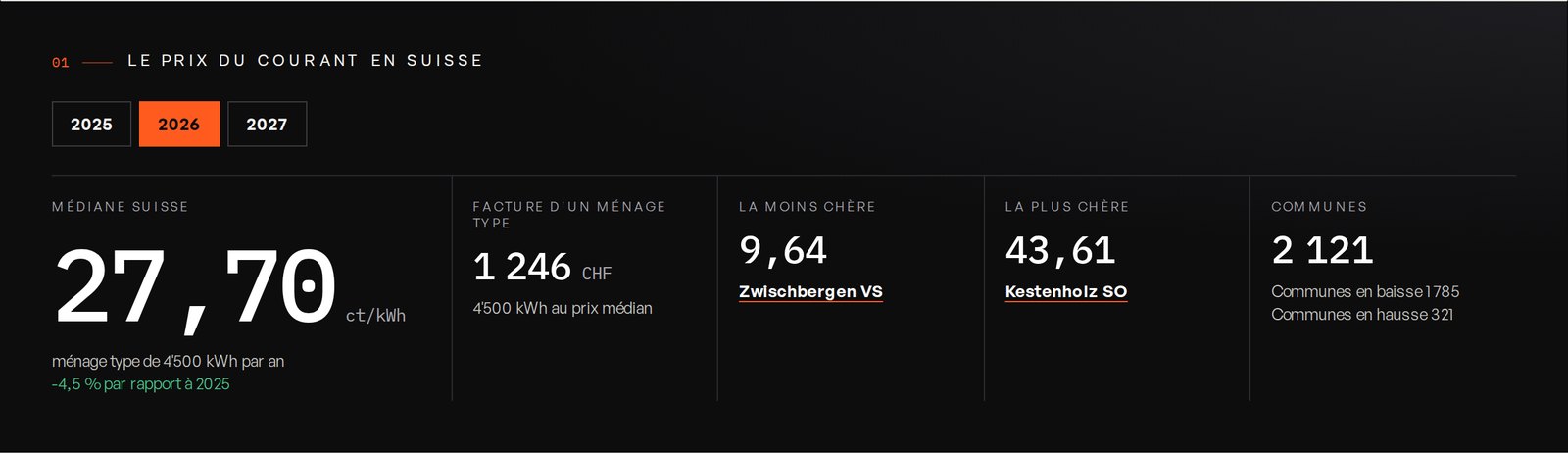
The key figures at the top of the price map. In 2026, a typical household using 4,500 kWh pays 1,246 francs a year at the median price. Screenshot: HB9V.
The calculator step by step
The electricity consumption calculator fits on a single page, in five numbered parts. It only takes a few minutes to get the cost of your station.
- Find your municipality. Type its name, your postcode or the name of your locality. ‘1660’ offers Château-d'Œx and its villages, Les Moulins, L'Etivaz and La Lécherette. The ‘Use my location’ button finds the locality nearest to you.
- Choose the year. The 2025, 2026 and 2027 buttons change the tariff used. The current year is selected by default.
- Check the network operator. In more than 120 municipalities, several companies share the area. The calculator offers them all, so choose the one shown on your bill.
- Put your station together. Start from one of the four profiles, then tick, untick and adjust each item.
- Read the result in the right-hand panel, which stays visible while you scroll through the list. It updates with every change.
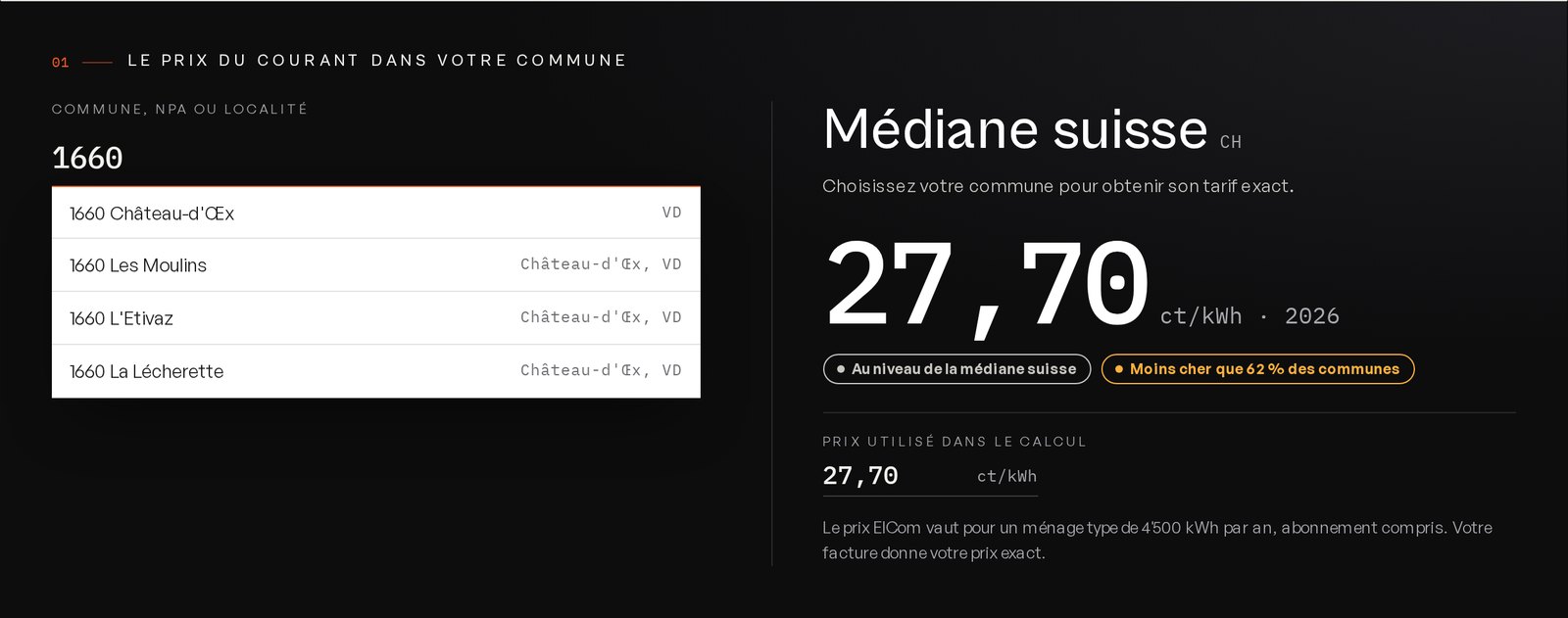
The search accepts the name of the municipality, the postcode or the locality. Each locality leads to its municipality's tariff. Screenshot: HB9V.
Once the municipality is chosen, its card shows its tariff in large type, the share of each price component and three benchmarks. You can see whether your municipality is above or below the Swiss median, how its price has changed since the previous year and what share of municipalities pay less than it does. If you know your exact price, from your bill for example, you can enter it in the ‘Price used in the calculation’ field.
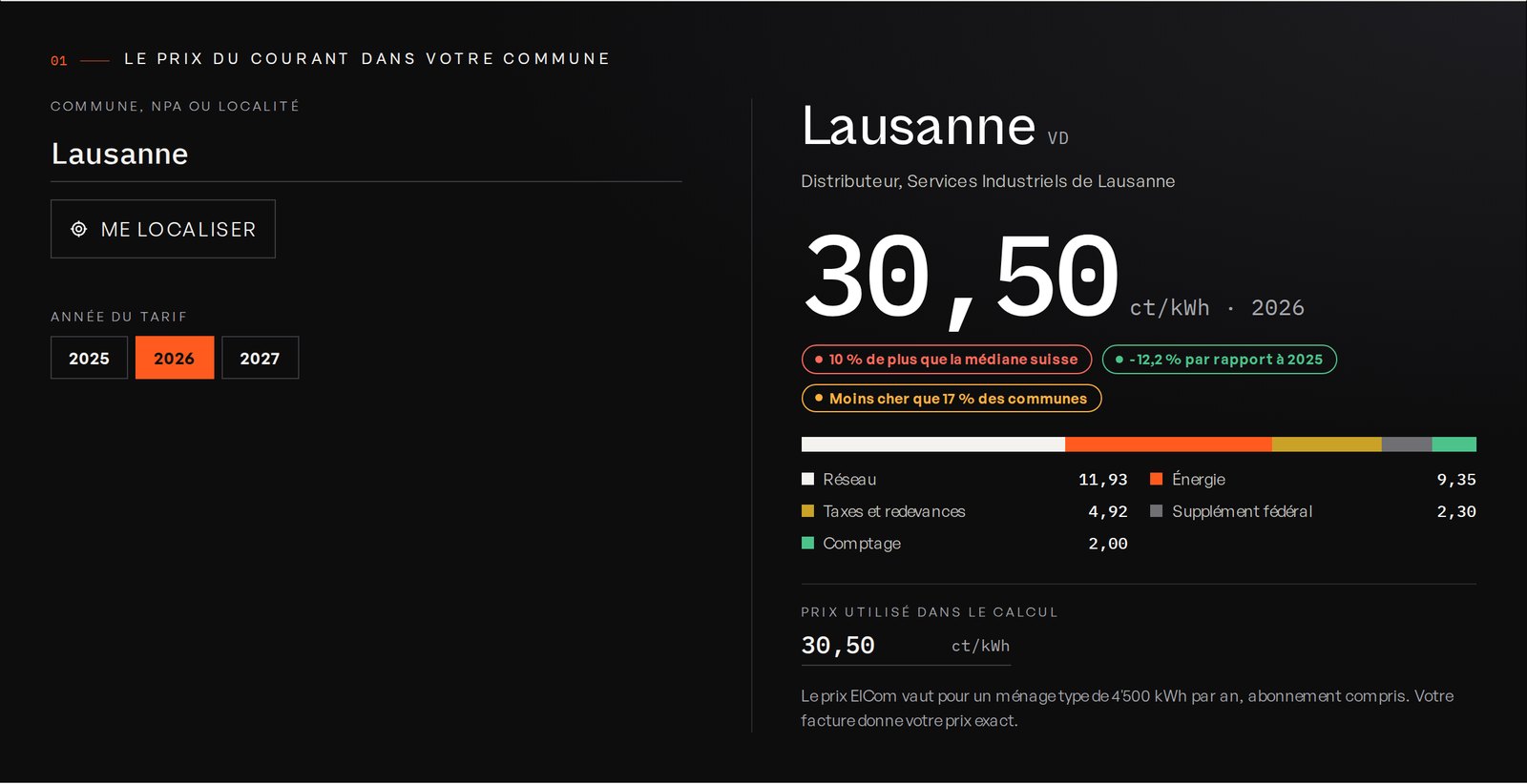
In Lausanne, a kWh costs 30.50 centimes in 2026, 10 per cent more than the Swiss median but 12.2 per cent less than in 2025. Screenshot: HB9V.
Realistic values for an amateur radio station
The list has 25 items, sorted into four groups: the radio station, digital and receiving, computers, and finally network, workshop and comfort. Each line has its power, its hours per day and its days per week. The ‘Add’ button lets you complete the list with your own equipment.
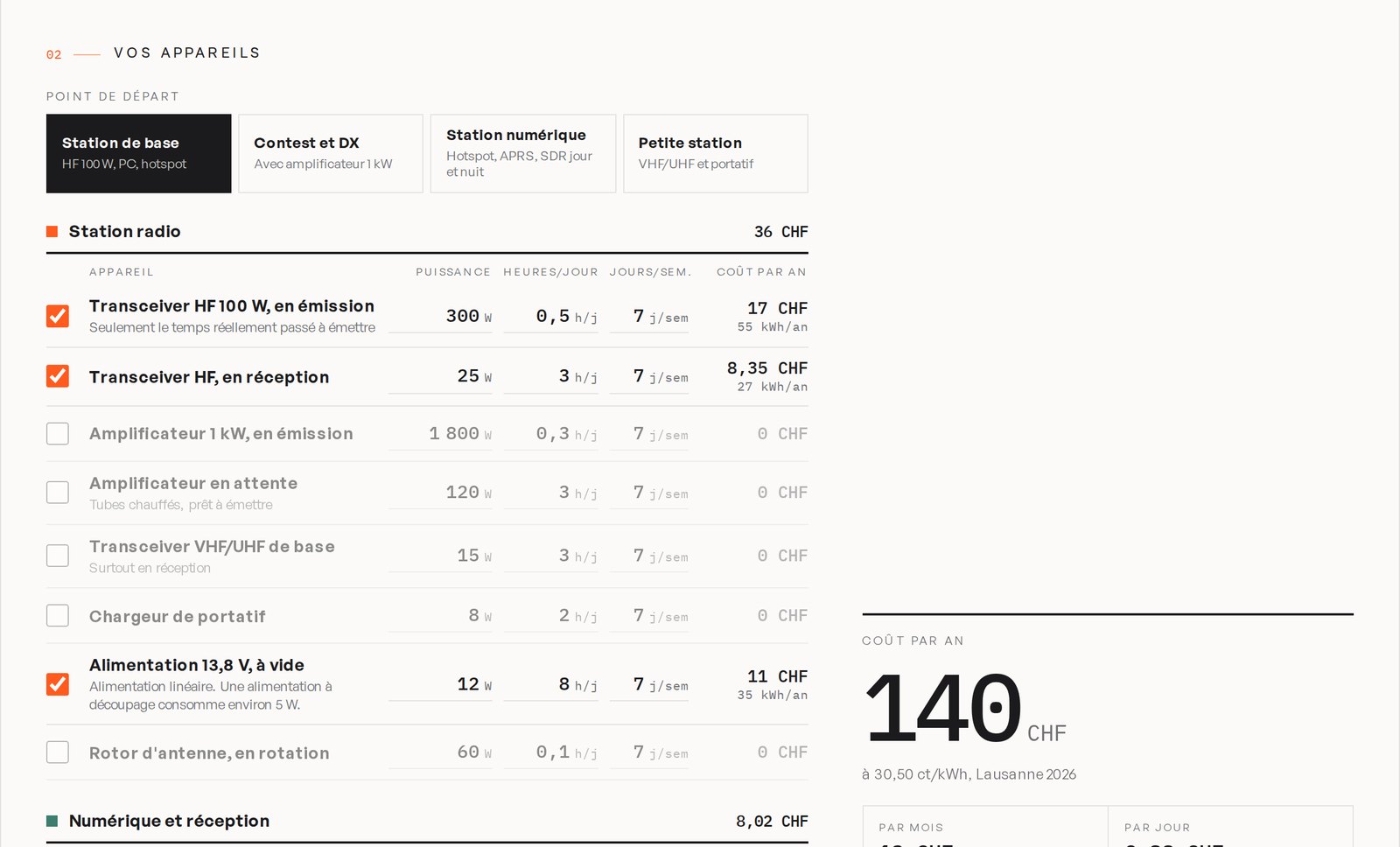
The four starting profiles and the start of the equipment list. The annual cost of each group appears to the right of its heading. Screenshot: HB9V.
We have reviewed all the suggested values so that they match a real station. A few examples:
- 100 W HF transceiver transmitting: about 20 A at 13.8 V, so nearly 300 W drawn from the mains with the power supply losses. The calculation only counts the time actually spent transmitting, half an hour a day by default.
- The same transceiver on receive: about 25 W, ten times less than when transmitting.
- 13.8 V linear power supply at idle: 12 W, often running all evening. A switch-mode power supply makes do with about 5 W.
- 1 kW amplifier: about 1,800 W when transmitting, and 120 W on standby with the valves heated.
- MMDVM hotspot, APRS iGate or web receiver: only a few watts, but day and night, all year round.
The four profiles give a good starting point. The base station combines a 100 W HF transceiver, its power supply, a PC, a screen, a hotspot and the internet router. It uses about 460 kWh a year, or 127 francs at the 2026 median price. The contest and DX profile adds a 1 kW amplifier, a rotator, a second screen and long evenings, for 1,256 kWh a year. The digital station runs a hotspot, APRS and an SDR receiver around the clock, and the small station is limited to VHF/UHF and a handheld.
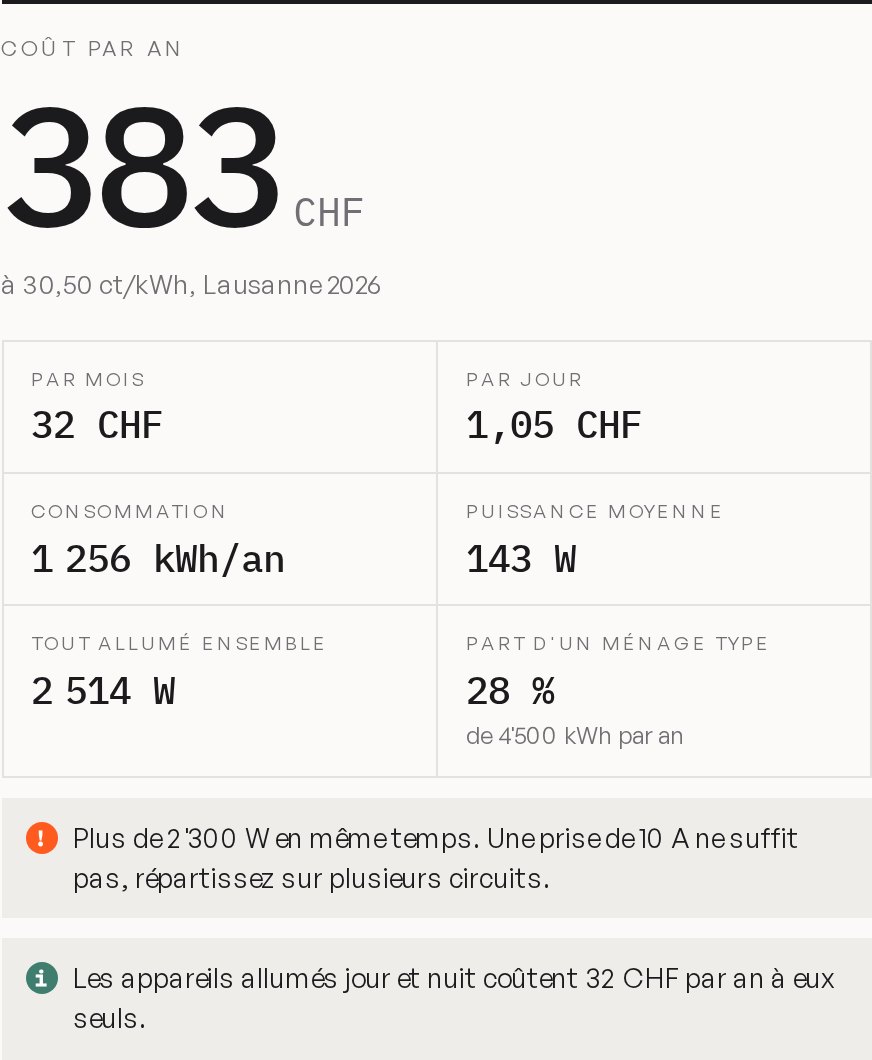
In Lausanne in 2026, the contest and DX profile comes to 383 francs a year. The red warning shows that switching everything on at once exceeds what a 10 A socket can supply. Screenshot: HB9V.
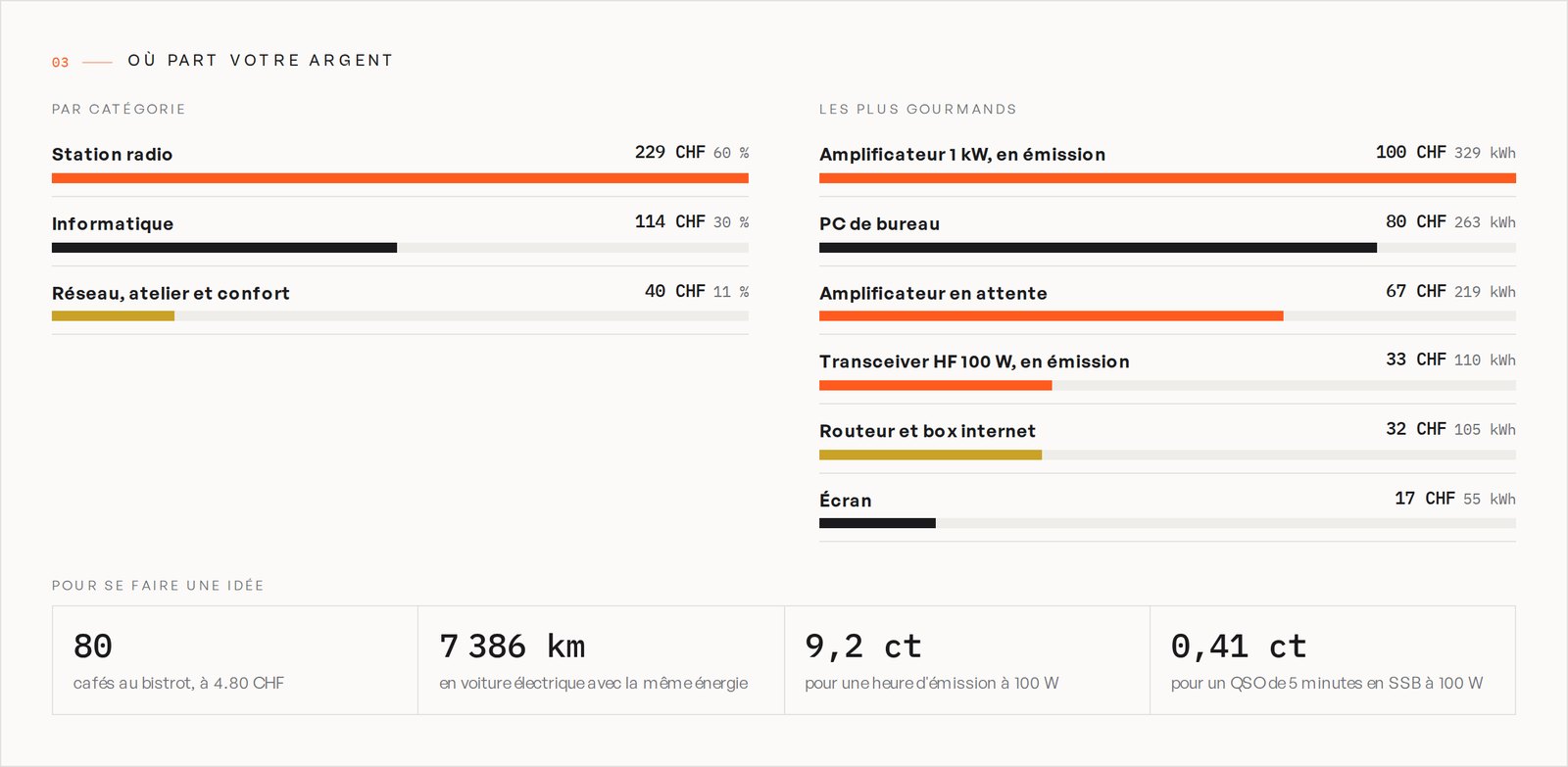
Part 03 shows where the money goes, the biggest consumers and a few telling comparisons. Screenshot: HB9V.
Below the result, the calculator turns the figures into concrete benchmarks. It counts how many café coffees the bill represents and how many kilometres an electric car would cover with the same energy. It also gives the price of one hour of transmitting at 100 W (about 8 centimes) or of a five-minute SSB QSO (less than half a centime).
Watch your sockets. A Swiss T13 socket is rated for 10 A, which is 2,300 W. A 1 kW amplifier alone already draws about 1,800 W. The calculator warns you as soon as the power of all the ticked items exceeds 2,300 W, then 3,680 W (16 A). Plug the amplifier into its own circuit, ideally a 16 A T23 socket, and have the installation checked by an electrician if in doubt.
The same station, elsewhere in Switzerland
Part 04 of the calculator keeps your station exactly as it is and only changes the kWh price. First you see its cost in 2025, 2026 and 2027 in your municipality. In Lausanne, the contest station goes from 436 francs in 2025 to 383 francs in 2026, then to 382 francs in 2027.
Next come the ten cheapest and the ten most expensive municipalities in Switzerland, with the cost of your station in each. For the contest profile in 2026, the gap reaches 427 francs a year between Zwischbergen (121 francs) and Kestenholz (548 francs). Finally, a table gives the median for each canton. Zug is the cheapest (21.88 centimes in 2026), Basel-Stadt the most expensive (33.25 centimes). Clicking a municipality opens it in the calculator.
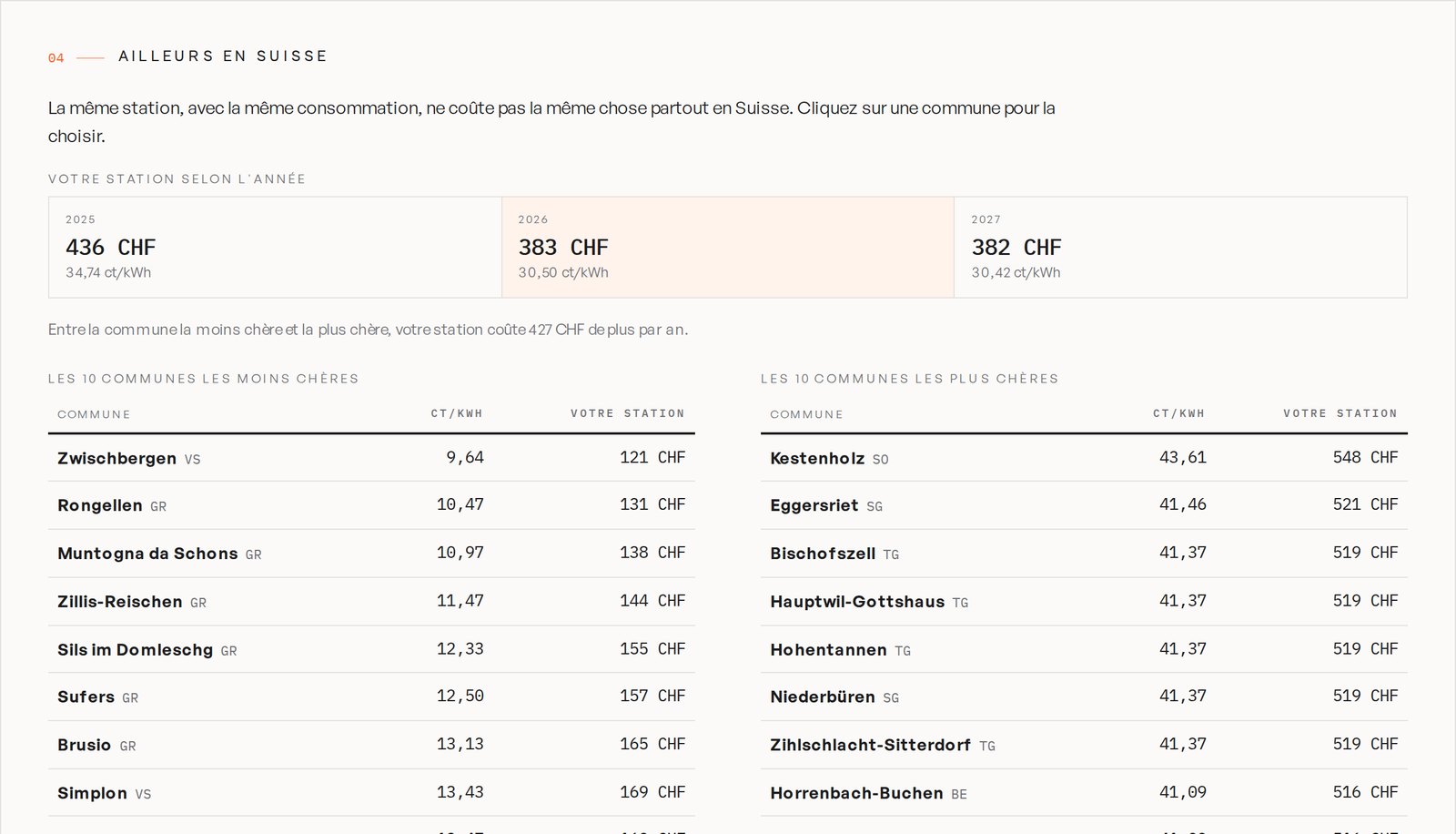
The cost of the same station by year, then in the cheapest and most expensive municipalities in the country. Screenshot: HB9V.
The price map, rebuilt with the same data
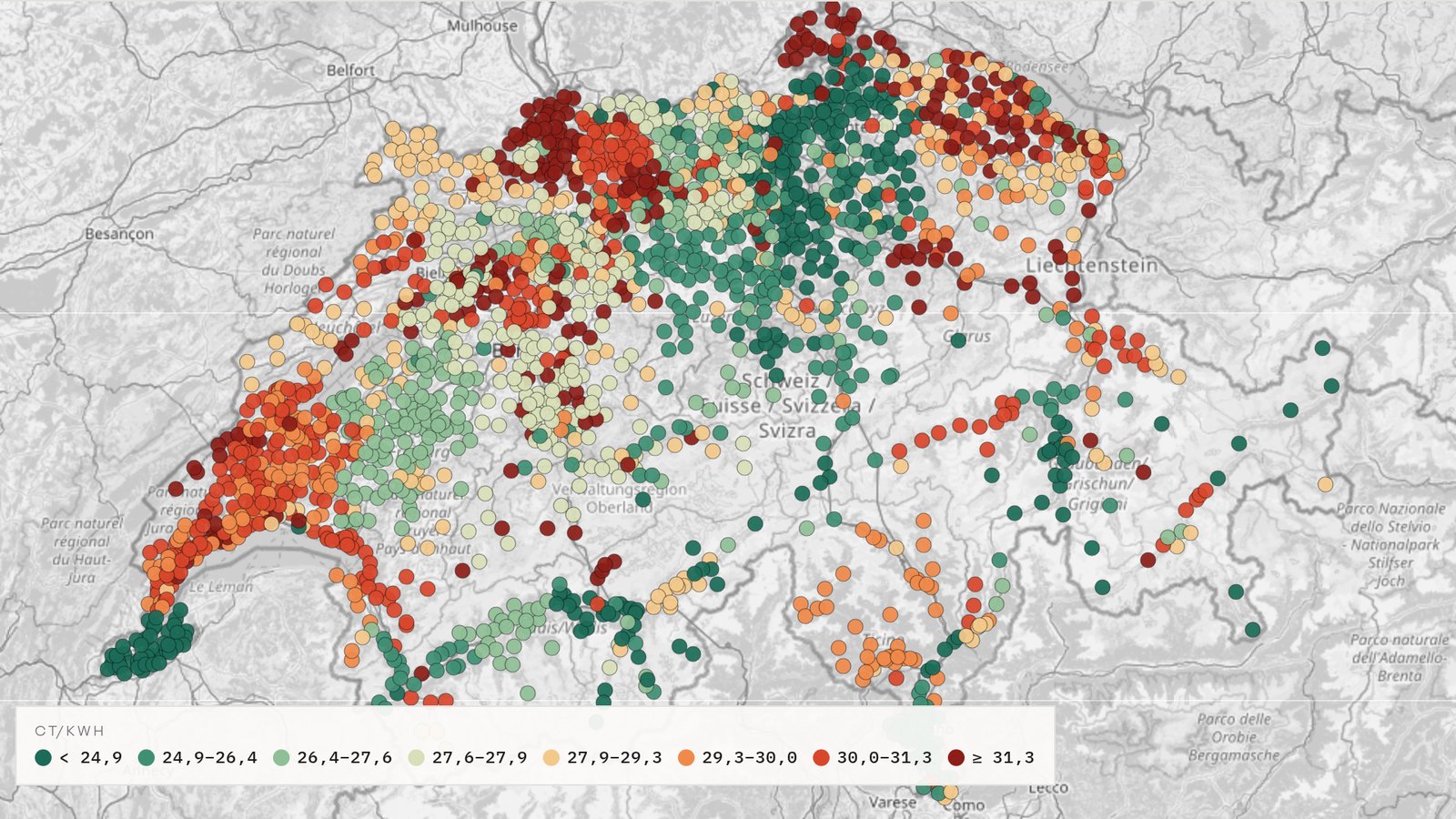
The map of electricity prices by municipality uses exactly the same official tariffs. Each municipality is a dot, coloured from green (cheap) to dark red (expensive). The colours are distributed so that each class contains roughly the same number of municipalities, which makes regional differences stand out clearly.
- Five views: total price, grid use, energy, taxes and levies, and change compared with the previous year.
- Three years to choose from, 2025, 2026 and 2027.
- Filters by canton and by network operator, and a search by municipality or postcode.
- A card for each municipality, with its network operator or operators, the price breakdown, the bill for a typical household, the three-year history and a button that opens the municipality in the calculator.
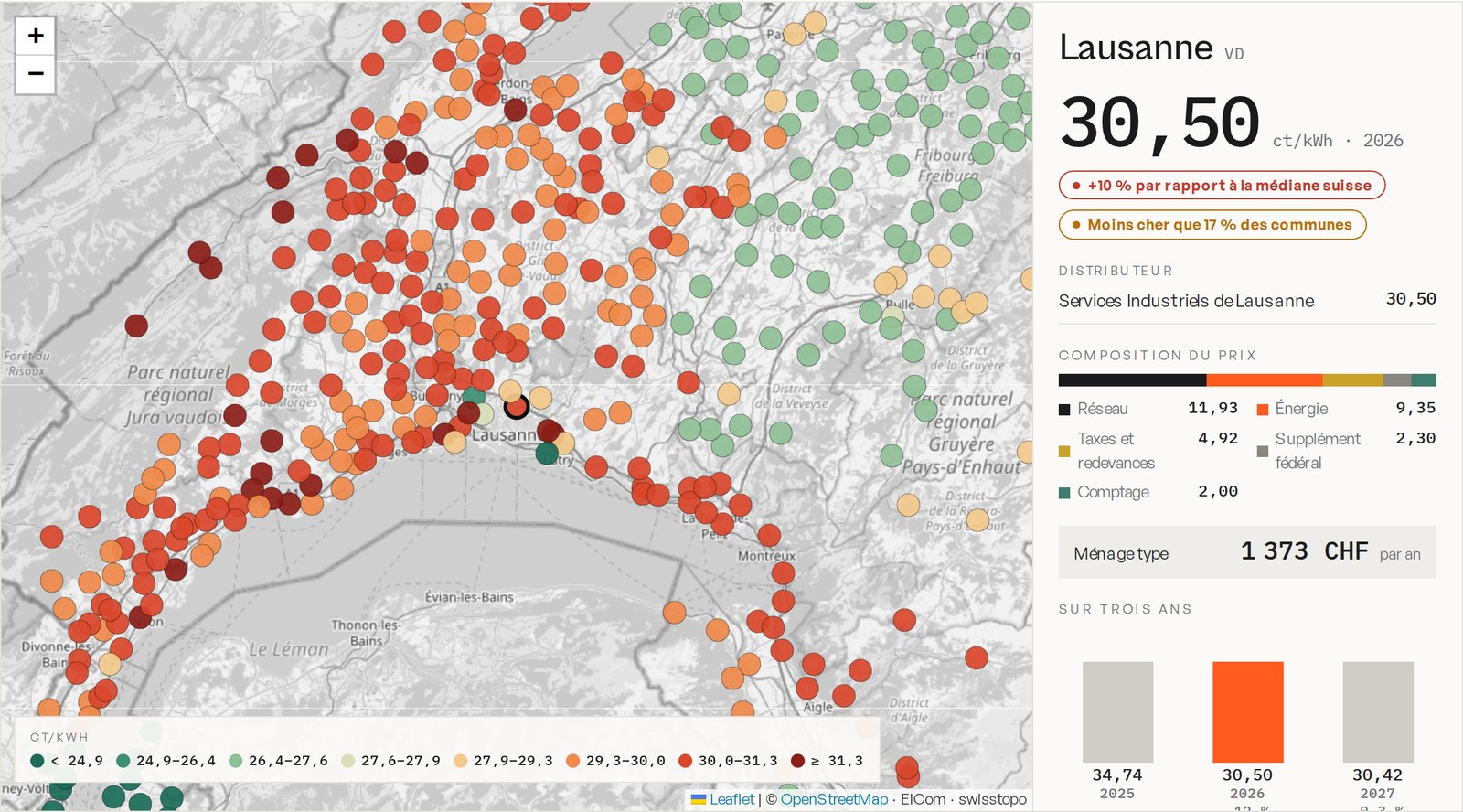
The map centred on Lausanne, with the municipality's card. It details the price breakdown, the bill for a typical household (1,373 francs a year) and the three-year history. Screenshot: HB9V.
The ‘Change’ view is particularly telling. In 2026, most of the country turns green, while red patches mark the regions where electricity is going up, notably around Lucerne and in part of Graubünden.
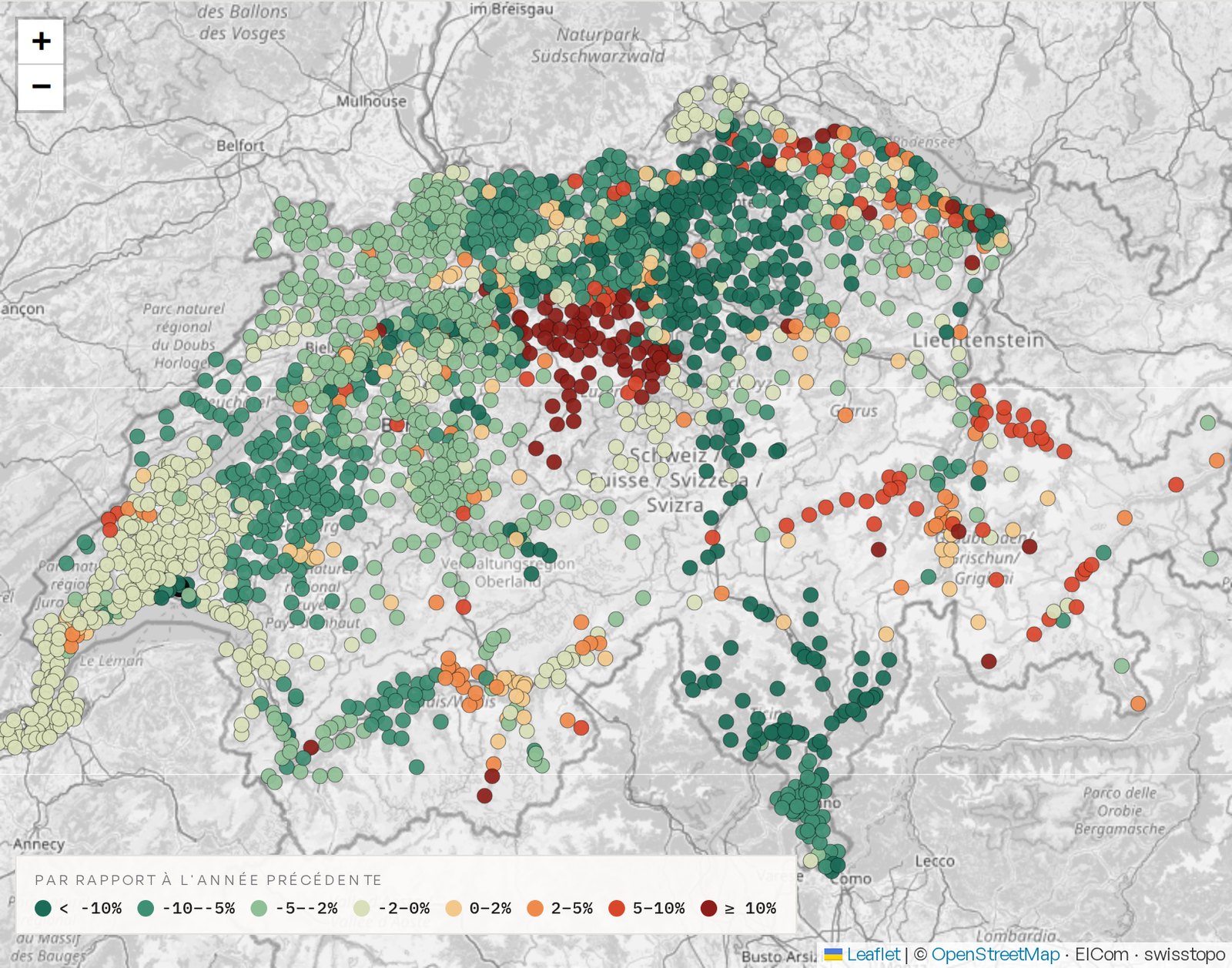
The change in prices between 2025 and 2026, decreases in green and increases in red. Base map © OpenStreetMap, data from ElCom and swisstopo. Screenshot: HB9V.
Further down, the page presents rankings (cheapest and most expensive municipalities, biggest decreases and biggest increases) and a table by canton. For each canton, a bar shows the gap between its cheapest and its most expensive municipality, with the median marked by a dot.
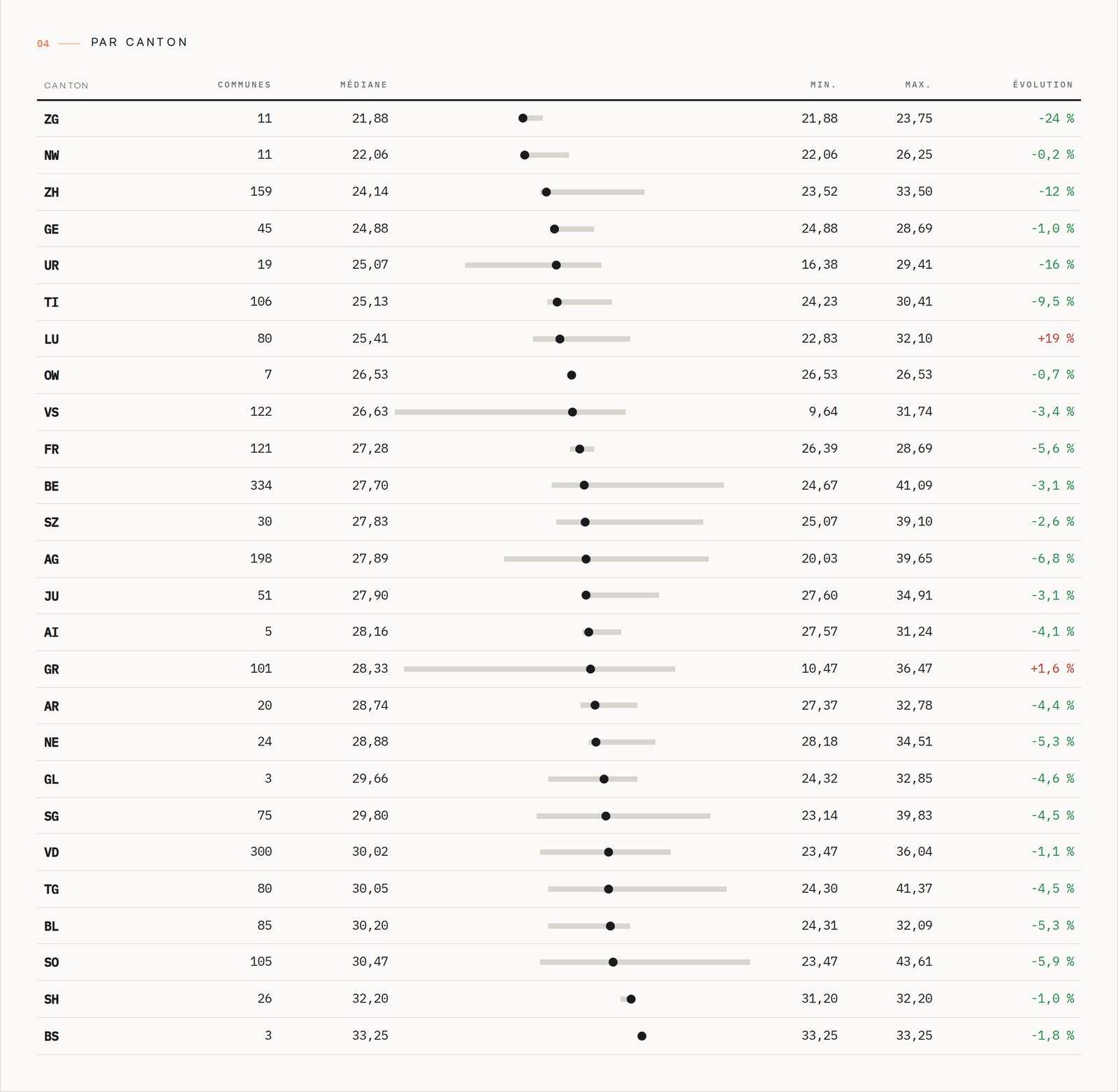
The table by canton, sorted by median price. Graubünden has the widest gap, from 10.47 to 36.47 centimes. Screenshot: HB9V.
Municipal mergers and special cases
The map of Swiss municipalities changes every year. To make sure a search always succeeds, the tools follow the mergers. A municipality that has merged points to its new municipality, and the old tariffs stay attached to the right place. Postcodes and localities come from the official swisstopo directory. So a locality that does not bear the name of its municipality, such as L'Etivaz, still leads to the right tariff.
One special case is worth mentioning. Moutier left the canton of Bern for the canton of Jura on 1 January 2026. It appears in the tools under Jura, with its full history.
On your phone, and in five languages
Both pages adapt to small screens. On a phone, the results panel moves below the equipment list and the municipality's card appears below the map. Both tools are available in French, German, Italian, English and Spanish, like the rest of the site.
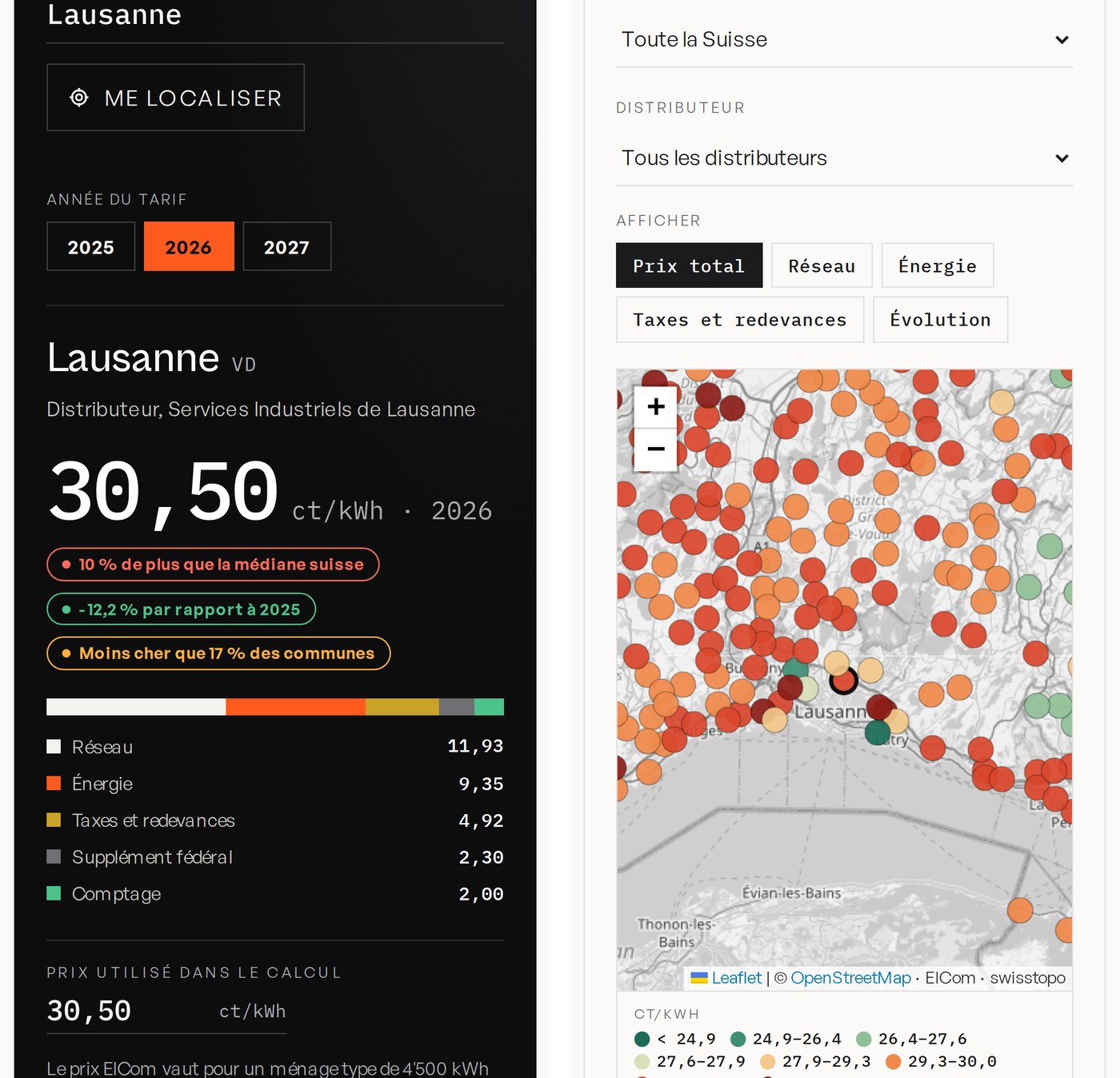
The calculator (left) and the price map (right) on a phone. Screenshots: HB9V.
What about your data? Everything happens in your browser. Your position, if you use ‘Use my location’, only serves to find the nearest locality on your screen. It is never sent to HB9V or stored. Your equipment list is kept in your browser for your next visit, with no account or registration.
The ‘Copy link’ button creates an address that contains your municipality, the year and your equipment. Handy for comparing with a friend or keeping a configuration. You can also export the details as CSV or print them.
Good to know
Measure rather than guess
A plug-in power meter, sold for about twenty francs, shows the real consumption of each item, standby included. The calculator's values are averages.
Standby costs all year
A 5 W item left on day and night uses 44 kWh a year. A switched power strip cuts the power supply, screens and chargers when the station is not in use.
The extra kWh costs a little less
The ElCom price includes the fixed standing charge, spread over 4,500 kWh. The kWh your station adds to the bill therefore usually cost a little less. The result remains a cautious estimate.
Updated every autumn
The following year's tariffs are published at the end of the summer. We will add the 2028 prices as soon as ElCom publishes them.
A word from HB9V
Radio is not a power-hungry hobby. A base station usually costs between 100 and 150 francs a year, roughly the price of one or two tanks of petrol. It is mainly the equipment running day and night and the big amplifiers that push up the bill. The calculator helps you spot them.
We wanted accurate tools rather than approximate ones. If you notice a tariff that does not match your bill, or if a common item is missing from the list, write to us. We will gladly correct it.
Work out the cost of your station
Both tools are free to use, on a computer or a phone, and available in the site's five languages.
Also on HB9V
- The DMR hotspot: Pi-Star, WPSD and Brandmeister step by step
- Amateur radio repeaters in Switzerland: the map, the details and the exports
- Swiss amateur radio band plan: all HF, VHF and UHF frequencies
- Propagation conditions: solar indices and real-time tools
Sources: Federal Electricity Commission (ElCom), electricity price website, 2025, 2026 and 2027 tariffs for the H4 profile (standard product), read from the Confederation's open data (LINDAS) on 27 November 2026; Federal Statistical Office, official list of Swiss municipalities and history of mergers; swisstopo, official directory of localities (postcodes and coordinates). Calculations, rankings and medians by canton: HB9V.
Images: screenshots of HB9V pages taken on 27 November 2026. Base map © OpenStreetMap contributors.
© 2026 HB9V · Club Radioamateur Suisse All rights reserved. No reproduction, even partial, without the written permission of HB9V. Photos and trademarks mentioned remain the property of their respective owners.